Every culture in human history has had to make sense of loss, change, and starting over. That is why symbols of rebirth exist. They give a shape to something we feel but struggle to put into words — the idea that ending does not mean finished.
Whether carved into ancient stone, worn as jewelry, or inked into skin, these symbols have carried the same quiet message across thousands of years: you can begin again.
At their deepest level, symbols of rebirth represent the belief that life is not a straight line. It circles. It ends and starts. And It goes underground before it blooms. These symbols hold space for grief and hope at the same time — they say that destruction can lead somewhere new, and that nothing is permanently lost.
Historically, these symbols grew from what people observed in nature. Seeds crack open in the dark. Snakes shed their skin. The sun disappears at night and comes back every morning. Ancient civilizations watched these cycles and turned them into sacred images that still speak to us today.
When you feel like you are starting from zero, these symbols remind you that starting over is not failure — it is part of the design.
25 Symbols of Rebirth and Their Meanings
1. The Phoenix
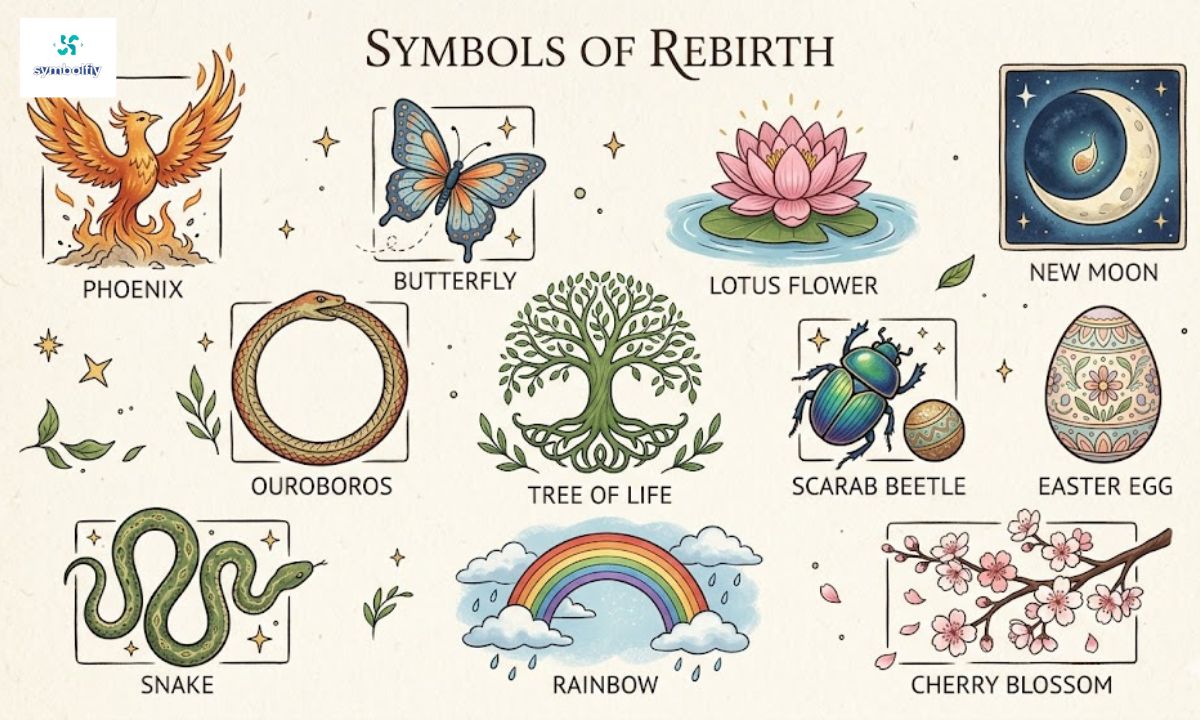
The phoenix is the most recognized symbol of rebirth across the world. It comes from ancient Egyptian mythology and was later embraced by the Greeks and Romans. The legend says the phoenix burns itself to ash when its life ends, then rises from those very ashes, fully alive and renewed.
In Chinese tradition, it is called the Fenghuang and represents balance and cosmic renewal. Today, it shows up in tattoos, literature, and art whenever someone wants to mark a major transformation in their life. The phoenix does not just survive — it starts over completely.
2. The Lotus Flower
The lotus grows from muddy, murky water and rises into a beautiful bloom. This is why it has been a spiritual symbol of rebirth across Hindu and Buddhist traditions for thousands of years. In Hinduism, the goddess Lakshmi sits on a lotus — a sign that beauty and abundance can rise from any starting point.
Buddhism uses the lotus to represent enlightenment: the soul moving from darkness and suffering toward clarity and wisdom. The fact that it blooms clean despite its muddy roots is the whole point. Struggle is not an obstacle to beauty. It is the path.
3. The Butterfly
Few symbols tell the story of transformation as clearly as the butterfly. It starts as a caterpillar, disappears entirely into a cocoon, and comes out in a form that seems impossible. Many Indigenous cultures across North America saw butterflies as messengers from the spirit world.
In Greek, the word for butterfly — psyche — is also the word for soul. Psychologically, the butterfly is often used to represent personal change after a difficult period. The cocoon stage matters: transformation is not instant, and it often requires a period of quiet retreat before the new version of yourself can emerge.
4. The Ouroboros
The ouroboros is a serpent eating its own tail, and it is one of the oldest symbols in existence. It appears in ancient Egyptian tomb carvings, Norse mythology, Greek alchemy, and Gnostic religious texts.
The image captures something profound: endings and beginnings are the same moment. The snake is both consuming and creating itself. Carl Jung used the ouroboros as a symbol of the psyche renewing itself through cycles of self-reflection and growth. It is not a symbol of destruction — it is a symbol of continuity. Life feeds on itself to keep moving forward.
5. The Scarab Beetle
Ancient Egyptians observed the dung beetle rolling a ball of dung across the ground and saw in that humble act a mirror of the sun moving across the sky. The scarab became the symbol of Khepri, the sun god of the dawn — the force of life returning after darkness.
Scarab amulets were placed on the hearts of the dead in Egyptian burial rites to protect and guide the soul through transformation in the afterlife. Today, the scarab remains a powerful symbol of resilience, protection, and spiritual renewal. It is a reminder that even the humblest beginnings can carry sacred meaning.
6. The Ankh
The ankh is shaped like a cross with a loop at the top, and it is one of the most recognized ancient Egyptian symbols in the world. It was known as the “Key of Life.” Gods and pharaohs are shown carrying it or offering it to the living as a gift of eternal existence.
The loop represents the eternal soul — the part of a person that never truly dies. The cross below represents earthly life. Together, they say that physical life and spiritual life are connected, and that death is not an end but a transition. It remains a popular symbol in spiritual jewelry and tattoo art today.
7. The Egg
Across cultures that have never had contact with each other, the egg emerged independently as a symbol of new life and creation. Hindu cosmology speaks of a cosmic egg — the Hiranyagarbha — from which the universe itself was born. In Norse mythology, life emerged from similar primordial origins.
Easter eggs in Christianity represent the sealed tomb and the surprise of resurrection. The egg is powerful precisely because it looks inert on the outside while holding everything it needs to create life on the inside. It is a symbol of potential that has not yet revealed itself.
8. The Snake (Shedding Skin)
The snake sheds its skin completely and emerges looking fresh and new. Ancient cultures across the globe saw this as a literal act of rebirth. In Greek mythology, the god of medicine Asclepius carried a staff with a snake wrapped around it — the rod of Asclepius — because snakes represented healing and renewal.
Snakes also appear in Hindu tradition as Nagas: divine serpents connected to water, fertility, and the cycle of time. The shedding of the skin became a powerful metaphor for releasing the old self. You do not have to die to be reborn. Sometimes you just have to let go of something you have outgrown.
9. The Tree of Life
The Tree of Life appears in nearly every major spiritual tradition on Earth. In Norse mythology, it is Yggdrasil — the great ash tree whose roots and branches connect all the realms of existence.
In the Kabbalah, it maps the spiritual dimensions of reality. And In Celtic traditions, the sacred tree connected the world of the living to the world of ancestors.
Trees are natural symbols of rebirth because they lose their leaves in autumn, appear dead in winter, and return to full life in spring. Their roots reach down while their branches reach up — a perfect image of being grounded while still growing.
10. The Rising Sun
Every sunrise is a small act of rebirth. The sun disappears into darkness and comes back every single day without fail. This is why the rising sun has been a symbol of hope and renewal in virtually every ancient civilization. In ancient Egypt, the sun god Ra traveled through the underworld each night and was reborn at dawn.
Japanese tradition centers on the rising sun as a symbol of the nation’s spirit and renewal. For anyone going through a hard time, the sunrise is a daily reminder that the dark period has a guaranteed end. Light always returns.
11. The Moon (Crescent and New Moon)
The moon completes a full cycle of death and rebirth every 28 days. The new moon disappears entirely before growing back into fullness. This cycle made the moon a natural symbol of renewal, particularly in feminine spiritual traditions.
Many goddess-worshipping cultures throughout history, including Wicca and ancient Greek religion, tied the phases of the moon to cycles of creation, destruction, and new beginnings. The crescent moon specifically represents the very first light after darkness — that thin sliver of hope that something new is just beginning to take shape. It is the symbol of the turning point.
12. Water
Water holds a unique place in human spirituality because it cleanses, sustains, and changes form. It becomes rain, river, ice, and ocean — always the same substance, always transforming. Virtually every major religion uses water in purification rituals to mark spiritual rebirth.
Christian baptism, Hindu ritual bathing in the Ganges, and Jewish mikveh all use water to signify the washing away of the old self and the beginning of a new one. Symbolically, water represents the unconscious — the deep place where transformation happens before it is visible on the surface.
13. The Butterfly Cocoon
The cocoon deserves its own entry because it represents the part of transformation we tend to forget: the in-between stage. Inside the cocoon, the caterpillar essentially dissolves into liquid before reorganizing into a butterfly.
That messy middle is not failure — it is necessary. Spiritually, the cocoon represents times in life when you cannot quite see who you are becoming.
You have left behind the old version of yourself but have not yet arrived at the new one. Many spiritual traditions honor this liminal space as sacred. The cocoon says: trust the process, even when it feels like dissolution.
14. Fire
Fire destroys, and that destruction makes room for something new. After wildfires, certain plants — like lodgepole pines — can only release their seeds when exposed to intense heat. The land that burns becomes more fertile than the land that never does.
Across human history, fire has been used in sacred rituals to burn away the old: old grief, old identities, old mistakes. In Hindu tradition, the sacred fire Agni is a witness to life’s most important transitions, including marriage and death.
In many Indigenous traditions, fire ceremonies mark seasons of personal renewal. Fire says: let it burn, because what survives is what was meant to last.
15. The Infinity Symbol (∞)
The infinity symbol looks like a figure-8 laid on its side, and it carries the message that cycles have no final ending point. In mathematics, it represents a quantity without limit. In spiritual symbolism, it represents eternal continuation — life folding back into itself and starting again.
The symbol also mirrors the ouroboros in concept: what seems like an end is actually the turning point back toward beginning. Many people wear the infinity symbol as a reminder that love, the soul, and life itself are not subject to permanent endings. They simply change direction.
16. The Triquetra (Trinity Knot)
The triquetra is a Celtic symbol made of three interlocked arcs forming a continuous knot with no beginning and no end.
It has been used in Celtic Christianity to represent the Holy Trinity, and in older pagan Celtic tradition to represent the Triple Goddess — the three phases of womanhood that mirror the three phases of the moon.
The three arcs also represent the three stages of life: birth, death, and rebirth. Because the lines never break and never end, the triquetra speaks to the idea of continuous renewal. Nothing stops. Everything returns to start again.
17. The Triskelion
The triskelion is an ancient symbol of three interlocking spirals radiating from a single center point. It appears prominently in Celtic and Mycenaean art going back thousands of years. The three spirals represent movement, progress, and the flow of life through its natural stages.
In Irish mythology, the triskelion was associated with the triple nature of the world: land, sea, and sky. In spiritual practice, the outward spiraling motion represents growth and transformation moving from a central point of stillness. It is a symbol that captures life not as a fixed state, but as a constant, graceful becoming.
18. The Djed Pillar
The Djed is one of ancient Egypt’s most powerful sacred symbols, though it is less widely known today. It is depicted as a pillar with horizontal crossbars at the top and is closely linked to Osiris — the god who was killed, dismembered, and then resurrected.
The “raising of the Djed” was a real annual ceremony in ancient Egypt, performed to symbolize the return of life after death and the restoration of order after chaos. The Djed represents structural stability and the backbone of renewal. It says that even the most broken things can be reassembled into something strong and sacred.
19. The Salamander
In medieval European symbolism, the salamander was believed to live inside fire without being burned. Alchemists used the salamander as a symbol of purification through fire — the idea that the soul could pass through the most intense trials and emerge unchanged in its core nature.
Salamanders also regenerate lost limbs in real life, making them biologically connected to the theme of renewal. Leonardo da Vinci described the salamander as “nourished by fire” and used it as a symbol of spiritual endurance. It represents the part of you that cannot be destroyed, no matter how intense the heat.
20. The Dragonfly
The dragonfly spends most of its life as a water nymph living below the surface before it transforms into its winged adult form and takes flight. This transition from a hidden underwater world to open sky made it a natural symbol of transformation and rebirth in many Asian and Indigenous traditions.
In Japan, the dragonfly is linked to late summer and is considered a symbol of courage and strength. In Native American traditions, it represents the soul’s ability to see through illusions and move toward higher truth. The dragonfly’s speed and iridescent wings make it feel like a tiny flash of magic during a moment of personal change.
21. The Peacock
Every year, the peacock molts — it loses its spectacular tail feathers and grows a new set. This natural cycle made the peacock a symbol of immortality and renewal in several cultures.
In early Christianity, the peacock’s feathers were believed to never decay, which made them a symbol of the resurrection and eternal life. In Hinduism, the peacock is associated with Saraswati, goddess of wisdom and renewal.
And In Persian mythology, the peacock was sometimes associated with paradise. The annual regrowth of something more beautiful than what was lost became a powerful metaphor: letting go is what allows the most spectacular version of yourself to emerge.
22. The Rainbow
The rainbow appears after rain and storms, which is why it has been a symbol of hope and renewal in cultures around the world. In the Christian Bible, God sends a rainbow after the great flood as a promise of renewal and a fresh covenant with humanity.
In Norse mythology, the rainbow bridge Bifrost connects the mortal world to the realm of the gods — a passage between what was and what will be. While In many Indigenous traditions, the rainbow is seen as a spirit bridge or a message of blessing from ancestors. The rainbow says: the storm is over, and something beautiful has been made possible by it.
23. The Seed
A seed holds everything it needs to become something entirely different from what it looks like right now. It lies dormant in darkness, seemingly doing nothing, before splitting open and sending life upward. The seed is one of the most quietly powerful rebirth symbols in existence.
In Buddhist teaching, the seed represents the potential within every person for awakening. In Christian tradition, Jesus uses the image of a seed falling into the ground before it can bear fruit as a teaching on death and resurrection. The seed says that stillness and darkness are not obstacles to growth — they are the conditions that make it possible.
24. The Frog
The frog’s life cycle is one of the most visible transformations in nature. It hatches from an egg as a tadpole, lives in water, and then grows limbs to move between water and land as an adult. This journey across two worlds made the frog a symbol of transformation, cleansing, and spiritual crossing in many traditions.
In ancient Egypt, the frog goddess Heqet was associated with fertility and the birth of new life. And In Celtic symbolism, frogs were believed to hold the healing power of water. In many shamanic traditions, the frog’s connection to rain made it a bringer of abundance and renewal after drought.
25. The Crocus
The crocus is one of the first flowers to appear after winter, often pushing through snow before any other sign of spring has arrived. Because of this, it has become a powerful natural symbol of courage, renewal, and the persistence of life.
In Greek mythology, the crocus was tied to themes of youth and new beginnings. In many European folk traditions, finding the first crocus of the year was considered a sign that hardship was ending and a better season was arriving.
The crocus does not wait for perfect conditions. It blooms anyway. That is its message: do not wait until everything is easy before you start again.
Ancient Cultures That Used These Symbols
Symbols of rebirth were not invented in one place. They grew independently across civilizations that had never met each other, because the experiences they describe — loss, change, and starting over — are universally human.
Ancient Egypt: Egyptian culture was deeply preoccupied with rebirth and the afterlife. The scarab, ankh, Djed, and Ajet all emerged from Egyptian beliefs about the soul’s journey through death into renewed existence.
Greek and Roman traditions: The phoenix, the ouroboros, and the butterfly’s link to the soul all come from Greek mythological thinking, which emphasized cycles of cosmic order, destruction, and renewal.
Celtic traditions: Celtic art is filled with endless knots, spirals, and triple motifs like the triquetra and triskelion — all representing continuous cycles with no true ending point.
Buddhism and Hinduism: Both traditions center on cycles of rebirth. The lotus flower, the sacred fire, and the concept of samsara (the wheel of existence) all arise from these traditions’ belief in the soul’s repeated journey through life.
Norse mythology: Yggdrasil (the World Tree), Bifrost (the rainbow bridge), and the cyclical endings of the world in Ragnarok all reflect Norse belief in eternal renewal through destruction.
Native American traditions: Many Indigenous nations used dragonflies, frogs, snakes, and seasonal cycles as symbols of transformation and the soul’s movement through different states of being.
Chinese traditions: The Fenghuang (Chinese phoenix) and the symbolism of the moon and water reflect a belief in harmonious cycles of change where transformation is natural, not feared.
Why Symbols Still Matter Today
In a world that moves fast and often feels unstable, symbols of rebirth offer something steady to hold onto. They show up on wrists and shoulders as tattoos, hang as pendants, appear in meditation spaces and therapy rooms.
People do not choose a phoenix tattoo because they think they are mythological birds. They choose it because something in their life burned down, and they need a reminder that rising is still possible.
These symbols also matter because personal growth rarely comes with obvious external markers. Symbols give shape to internal change. When someone places a lotus on their wall or wears a moonstone bracelet, they are not being superstitious.
They are creating a visible anchor for an invisible process. They are reminding themselves — and everyone who sees it — that transformation is real, it is ongoing, and it is worth honoring.
Frequently Asked Questions
What is the most powerful symbol of rebirth?
The phoenix is widely considered the strongest symbol of rebirth across multiple cultures worldwide.
What does the lotus flower represent spiritually?
It represents the soul rising from suffering into enlightenment, especially in Buddhist and Hindu traditions.
Why do people get rebirth symbols as tattoos?
To mark a major personal transformation and carry a visible reminder that starting over is possible.
Are symbols of rebirth connected to death?
Yes — most rebirth symbols acknowledge death or loss as the necessary first stage before renewal begins.
What natural symbols represent new beginnings?
Seeds, the crocus, the rising sun, rain, and the new moon are the most common natural symbols of fresh starts.
Conclusion
Symbols of rebirth have survived thousands of years because the experience they describe never goes out of style. Every person, in every era, eventually faces a moment when something ends and they have to figure out how to begin again.
These 25 symbols are humanity’s collected answer to that moment. They say, across every language and culture: endings are not the last word. Something new is always possible — and the evidence is written into the world around you, in every sunrise, every blooming flower, and every skin-shedding snake.