Virgo symbols connect astrology with ideas of harvest, service, order, and careful thought. The best-known Virgo symbol is a maiden, often shown holding a sheaf of wheat. The Virgo glyph looks like a curved or looped “M” and represents the zodiac sign in a simple form. Virgo is the sixth sign of the zodiac and belongs to the Earth element in Western astrology. Mercury rules Virgo, linking the sign with communication, analysis, and practical thinking. This guide explains Virgo symbols, their meanings, history, mythology, and modern uses.
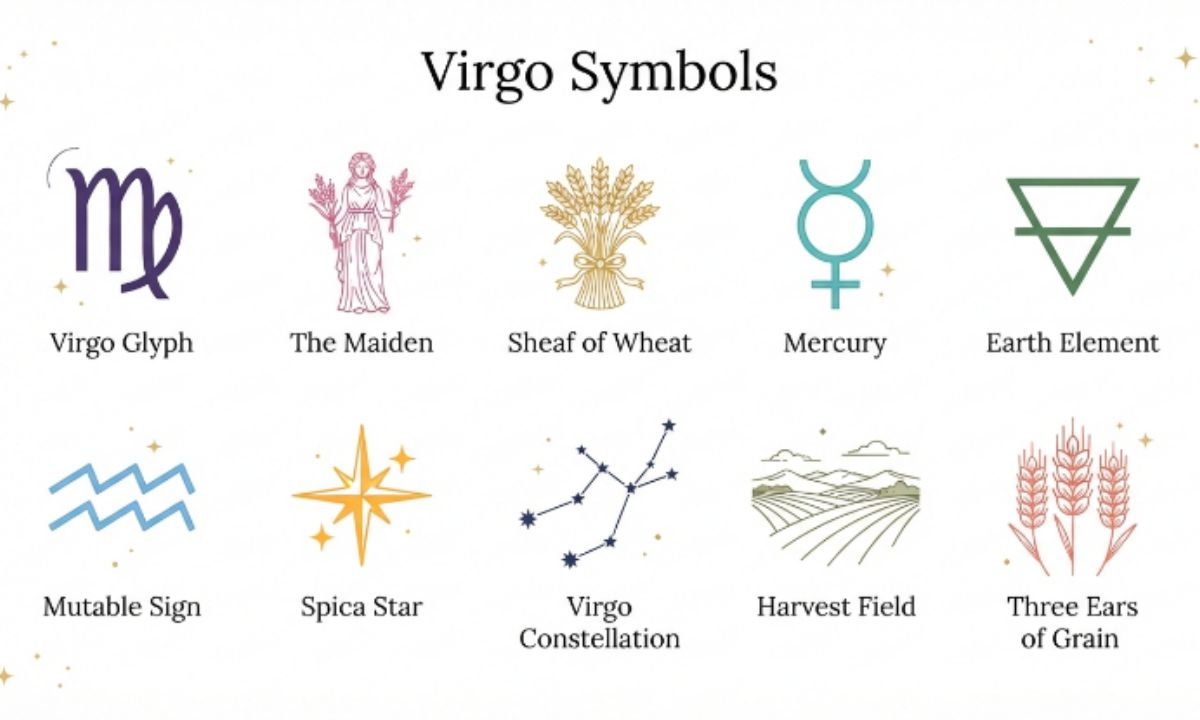
Virgo symbols are visual signs and images associated with the Virgo zodiac sign. The most familiar are the maiden, wheat, Virgo glyph, Mercury, Earth imagery, and the Virgo constellation.
These symbols come from different traditions, so they do not all carry the same meaning. Some belong to astrology, while others come from mythology or astronomy.
The main Virgo symbols include:
Symbol
Common meaning or association
Maiden
Purity, care, harvest, and femininity
Wheat
Harvest, nourishment, fertility, and completed work
Virgo glyph ♍
The written symbol of Virgo
Mercury ☿
Communication, thought, analysis, and intellect
Earth
Practicality, stability, and grounded qualities
Spica
Virgo’s brightest star and a major astronomical association
Virgo constellation
The celestial constellation linked with the sign
Astrological meanings are interpretive traditions rather than scientific findings. They describe how different astrology systems assign meaning to signs and symbols.
The Main Virgo Zodiac Symbol
The primary Virgo zodiac symbol is the Maiden, sometimes called the Virgin. Artistic depictions often show her carrying wheat or standing near crops.
The image connects Virgo with the harvest. Wheat suggests food, growth, agriculture, and the result of careful work. The Maiden also appears in stories involving fertility, seasonal change, and agricultural cycles.
The symbol can therefore represent several related ideas:
Care and nourishment
Harvest and productivity
Purity and innocence
Practical work
Service to others
Order and completion
Connection with nature
The exact interpretation depends on the artistic, mythological, or astrological tradition being used.
Virgo Symbol Copy-and-Paste Glyph
The standard Virgo glyph is ♍.
You can copy it here: ♍
The glyph provides a compact way to represent Virgo without drawing the Maiden or the constellation. You may see it in birth charts, astrology apps, jewelry, tattoos, social-media profiles, artwork, and decorative designs.
The glyph is different from the Maiden image. The Maiden is a figurative symbol, while ♍ is a zodiac glyph.
Maiden, Virgin, and Harvest Maiden: What Is the Difference?
Virgo is often described as the Virgin, but this word can cause confusion.
In traditional astrology, “Virgin” does not necessarily mean a modern statement about someone’s sexual behavior. It functions as a symbolic title for the figure associated with Virgo.
“Maiden” can be a more useful term when discussing the visual tradition. It focuses on the female figure represented in Virgo artwork rather than assigning a modern personal meaning to the word virgin.
The wheat she carries adds another layer. It shifts the image toward agriculture, harvest, nourishment, and seasonal cycles.
So, when people ask, “Is Virgo’s symbol a virgin or a maiden?”, both terms appear in traditional descriptions. “Maiden” often gives clearer context for the symbolic artwork.
The Meaning of the Virgo Glyph
The Virgo glyph ♍ is one of the most recognizable zodiac symbols. Its curved lines and looped shape give it a distinctive appearance.
Astrology writers commonly interpret the glyph through ideas connected with the Maiden and Virgo’s traditional qualities. However, there is no single universally accepted historical explanation for every line or curve.
That distinction matters. A modern symbolic interpretation is not automatically the original historical meaning of the glyph.
The glyph is best understood as a conventional astrological sign used to identify Virgo.
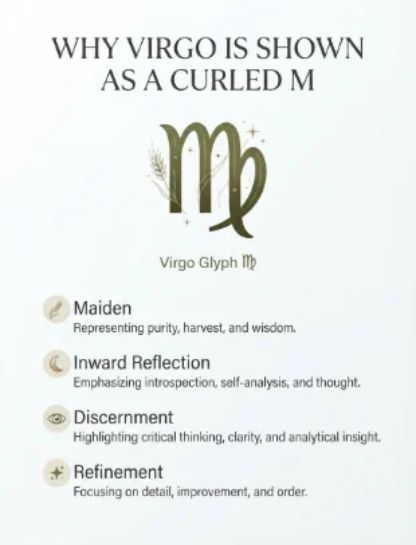
Why Virgo Is Shown as a Curled “M”
The Virgo glyph resembles a stylized or curled M, although it does not simply function as the letter M.
Different astrology traditions and modern designers interpret its shape in different ways. Some connect its curves with the Maiden, while others focus on themes such as inward reflection, discernment, or refinement.
These interpretations are part of astrology’s symbolic language. They should not be treated as established historical facts unless a specific historical source supports them.
Common Interpretations of the Loop and Lines
Modern interpretations often connect the Virgo glyph with:
Discernment
Self-reflection
Practical thinking
Purity
Organization
Careful judgment
Attention to detail
The meaning becomes especially useful when the glyph appears beside other Virgo imagery, such as wheat, stars, leaves, or the Maiden.
How Virgo’s Glyph Differs From Scorpio’s Symbol
Virgo and Scorpio have glyphs that can look similar at first glance.
Virgo: ♍ Scorpio: ♏
Both feature curved, pointed, or looped forms. The main visual difference is the ending of the symbol and the overall structure.
This similarity can cause confusion in small fonts or decorative artwork. If you plan to use a Virgo tattoo, logo, necklace, or digital design, check the symbol carefully before using it.
Why Glyph Designs Can Look Different
You may notice small differences between Virgo glyphs across websites, fonts, jewelry, tattoos, and astrology charts.
The basic character remains ♍, but artists can alter its proportions, line weight, curves, and decorative details.
Common styles include:
Minimal line art
Bold geometric designs
Hand-drawn glyphs
Floral Virgo symbols
Celestial designs with stars
Wheat-and-glyph combinations
Maiden illustrations
A decorative version may look very different from the standard Unicode character while still representing Virgo.
The Virgo Maiden Symbol
The Virgo Maiden symbol gives the zodiac sign a human form.
Artists commonly portray the Maiden as a woman carrying wheat, standing among plants, or appearing in a celestial setting. Some images emphasize beauty and grace, while others focus on agriculture and the harvest.
The image has changed across cultures and historical periods. There is no single artwork that defines every version of Virgo.
What remains consistent is the connection between the female figure and the agricultural or seasonal symbolism surrounding Virgo.
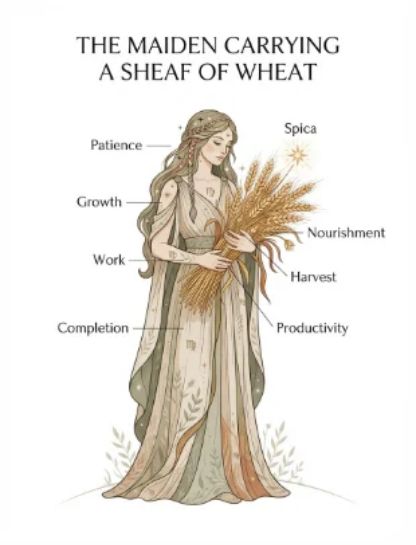
The Maiden Carrying a Sheaf of Wheat
Wheat is one of the most important visual details in Virgo imagery.
A sheaf of wheat represents the harvested crop. It suggests the point when months of planting and cultivation produce a useful result.
That makes wheat a natural symbol for themes such as:
Growth
Patience
Work
Nourishment
Harvest
Productivity
Completion
The connection also appears in astronomy. Virgo’s brightest star is Spica, whose name comes from Latin and refers to an ear or head of grain.
What Wheat Represents in Virgo Symbolism
In astrology-based symbolism, wheat can represent the practical side of growth.
A seed does not become a harvest without time, care, and favorable conditions. The image therefore works well with traditional Virgo themes of preparation, effort, usefulness, and attention to detail.
Wheat can also symbolize abundance and nourishment. It turns agricultural labor into something that supports life.
Links to Harvest, Fertility, Agriculture, and Service
Virgo’s harvest imagery connects several ideas that may seem separate at first.
Agriculture requires work. Harvest requires patience. Food provides nourishment. Caring for crops supports a wider community.
This creates a symbolic chain:
Planting → Care → Growth → Harvest → Nourishment
Astrology traditions often use this chain to explain why Virgo symbolism includes service, responsibility, productivity, and practical care.
Is Virgo’s “Virgin” Symbol About Personality or Sexuality?
Not necessarily.
In astrology, the word Virgin belongs to Virgo’s traditional symbolic identity. It should not be read as a direct description of a person’s sexual history or behavior.
The Maiden can instead represent independence, purity, self-containment, or an archetypal feminine figure, depending on the tradition.
Modern readers may interpret the image differently from ancient or medieval audiences. That is why “Virgo Maiden” and “Virgo symbol” are often more useful search terms when discussing the visual tradition.
Mythology Behind Virgo Symbols
Virgo’s mythology does not come from one single story.
Different traditions have connected the constellation and zodiac sign with female figures associated with agriculture, fertility, justice, or seasonal change. These stories helped shape later representations of Virgo.
The important point is that Virgo mythology has multiple proposed identities, rather than one universally established origin.
Virgo and the Ancient Harvest Goddess
Some interpretations connect Virgo with ancient goddesses associated with agriculture and fertility.
These associations make sense within the broader imagery of wheat, crops, and seasonal cycles. The Maiden holding grain became a powerful visual representation of the connection between the sky and the agricultural year.
However, different historical sources identify the figure differently. It is safer to describe these as proposed or traditional associations rather than claim that one goddess definitively created the Virgo symbol.
Ishtar and Other Fertility-Goddess Connections
Some astrology sources associate Virgo with Ishtar, an ancient Mesopotamian goddess linked with themes including fertility and sexuality.
Such comparisons reflect attempts to connect later zodiac imagery with older mythological traditions. They should not be treated as proof that Virgo directly represents one particular ancient goddess.
The history of zodiac imagery developed across many cultures and periods.
Persephone and Greek Harvest Traditions
Persephone is another figure frequently discussed alongside Virgo because Greek mythology connects her story with seasonal change and agriculture.
Her story also involves Demeter, the goddess strongly associated with farming and grain.
This makes Persephone relevant to discussions of Virgo’s harvest imagery, but the identification of Virgo with Persephone varies by source and tradition.
How Mythology Shaped Modern Virgo Imagery
Modern Virgo artwork often combines several old ideas into one visual language.
You might see a woman, wheat, stars, leaves, a crescent moon, or a celestial background in the same design. These elements can draw from different mythological and astrological traditions.
As a result, modern Virgo symbolism is often a blend rather than a direct copy of one ancient image.
Virgo in Astrology
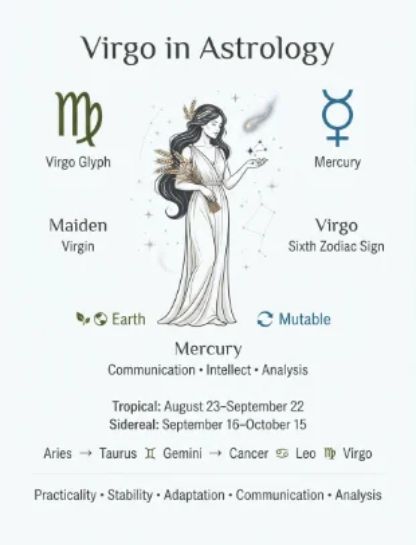
Virgo is the sixth sign of the zodiac in Western astrology.
Its standard astrological associations include:
Element: Earth
Modality: Mutable
Ruling planet: Mercury
Symbol: Maiden or Virgin
Glyph: ♍
Common Tropical dates: Approximately August 23 to September 22
Exact dates can vary slightly by year and astrology system.
Virgo Dates in the Tropical Zodiac
In the Tropical zodiac, Virgo generally covers approximately August 23 through September 22.
The exact transition can vary because the Sun’s apparent movement does not match the calendar in exactly the same way every year.
For a precise birth chart, astrologers usually use the birth date, exact time, and location.
Virgo Dates in Sidereal Astrology
The Sidereal zodiac uses a different reference framework from the Tropical zodiac.
As a result, Virgo dates in Sidereal astrology occur later on the calendar. One commonly cited range is approximately September 16 to October 15.
This difference explains why someone may receive different zodiac signs from different astrology systems.
Why Virgo Is the Sixth Zodiac Sign
Virgo occupies the sixth position in the traditional sequence of the twelve zodiac signs:
Aries → Taurus → Gemini → Cancer → Leo → Virgo
It follows Leo and comes before Libra.
The number six is therefore a positional feature of the zodiac system rather than a separate Virgo symbol.
Virgo’s Earth Element
Western astrology traditionally places Virgo among the three Earth signs, alongside Taurus and Capricorn.
Earth symbolism is commonly associated with:
Practicality
Stability
Material concerns
Patience
Grounded action
Real-world results
These are interpretive associations within astrology.
Virgo’s Mutable Modality
Virgo is also classified as a mutable sign.
In astrology, mutable signs are traditionally associated with adaptation, adjustment, transition, and flexibility.
Virgo’s mutable quality is often combined with its Earth element to create a symbolic picture of practical adjustment: observing what needs to change and finding a workable solution.
Mercury: Virgo’s Ruling Planet
Mercury is Virgo’s traditional ruling planet.
Astrology associates Mercury with communication, information, thought, learning, and analysis. This connection helps explain why Virgo symbolism often includes writing, organization, problem-solving, and careful observation.
The astronomical planet Mercury is a physical celestial body. Its role as Virgo’s “ruling planet” is an astrological interpretation, not a scientific causal relationship.
The Mercury Symbol and Its Connection to Virgo
The traditional Mercury glyph is ☿.
Astrological artwork may place Mercury and Virgo together because Mercury is traditionally considered Virgo’s ruling planet.
You may see the two symbols in birth charts, educational graphics, or decorative astrology designs.
Virgo Symbol Meanings in Personality
Virgo personality descriptions vary between astrology sources, but several themes appear repeatedly.
Traditional interpretations often describe Virgo as analytical, practical, organized, helpful, and detail-focused.
Other descriptions emphasize possible challenges such as worry, perfectionism, overthinking, and excessive criticism.
These descriptions are part of astrology and should be understood as interpretive rather than scientifically validated personality assessments.
Order, Detail, and Practical Thinking
Virgo is often associated with making sense of details.
The symbolism fits an image of someone examining information, organizing a task, and looking for a practical solution.
That is why Virgo artwork frequently uses clean lines, structured layouts, geometric patterns, and carefully arranged natural elements.
Service, Helpfulness, and Responsibility
The harvest image also supports Virgo’s association with useful work.
A harvest does not exist only for decoration. It provides food and supports a community.
Astrological interpretations build on this idea by connecting Virgo with service, responsibility, reliability, and practical help.
Analysis, Communication, and Problem-Solving
Mercury’s traditional association with communication strengthens this part of Virgo symbolism.
Astrology often portrays Virgo as a sign that observes details, sorts information, and searches for workable answers.
This is one reason you may see Virgo represented through notebooks, books, writing tools, plants, charts, or organized spaces in modern zodiac artwork.
Perfectionism and High Standards
Virgo symbolism also has a more demanding side.
The same attention to detail that can support careful work may be interpreted as perfectionism. Astrology descriptions sometimes connect Virgo with high standards, self-criticism, worry, or difficulty accepting mistakes.
These are symbolic personality themes, not established facts about everyone born under Virgo.
Virgo Constellation vs. Virgo Zodiac Sign
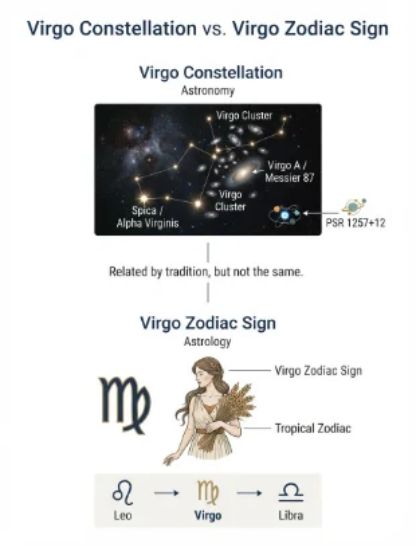
One of the most important distinctions is between Virgo the constellation and Virgo the astrological sign. They are related by name and historical tradition, but they are not the same thing.
What Is the Virgo Constellation?
Virgo is a constellation, or officially recognized region of the night sky.
It lies between Leo and Libra and contains several notable astronomical objects.
Its brightest star is Spica, also known as Alpha Virginis.
Where Virgo Appears in the Night Sky
Virgo occupies a large area of the southern sky.
Its visibility depends on the observer’s location and the season. The constellation is especially useful for locating other objects because it lies near the Virgo Cluster, a large collection of galaxies.
The constellation is an astronomical feature. It can be observed regardless of whether someone follows astrology.
Virgo Between Leo and Libra
In the traditional zodiac sequence, Virgo comes after Leo and before Libra.
The same neighboring relationship appears along the zodiac’s celestial path, although the boundaries and astronomical positions of constellations do not perfectly match the modern Tropical zodiac signs.
Spica: Virgo’s Brightest Star
Spica is the brightest star in Virgo.
Its name refers to an ear or head of grain, which fits the Maiden’s traditional wheat imagery.
This gives Virgo symbolism an interesting connection between astronomy and mythology: the constellation contains a prominent star whose name itself relates to grain.
The Virgo Cluster and Other Astronomy Facts
Virgo contains the Virgo Cluster, a major nearby cluster of galaxies.
The region also includes Virgo A, a powerful radio source associated with the galaxy Messier 87.
Virgo has another notable astronomical connection. The pulsar PSR 1257+12 became important in the history of exoplanet research because planets were discovered orbiting it in the early 1990s.
These facts belong to astronomy rather than astrological interpretation.
Why the Constellation and Sun Sign Are Not the Same Thing
The Sun sign used in Western Tropical astrology does not perfectly match the present-day astronomical constellation boundaries.
Earth’s axial precession has shifted the relationship between the zodiac signs and the constellations over long periods.
So, Virgo the constellation is not simply the same thing as the Tropical Virgo zodiac sign.
This distinction helps avoid one of the most common misunderstandings about Virgo symbolism.
Virgo Symbol Colors and Visual Style
Modern astrology sources often assign colors to Virgo, although these associations vary.
Commonly suggested Virgo colors include:
Beige
Grey
Earth tones
Pale yellow
Soft green
Natural brown
These choices fit the sign’s common visual connection with soil, wheat, plants, and harvest.
Earthy Design Ideas for Virgo Symbols
If you are creating Virgo artwork, natural elements can reinforce the traditional symbolism.
Useful design elements include:
Wheat stalks
Leaves
Small stars
Botanical line art
Earth textures
Celestial circles
The ♍ glyph
A stylized Maiden
A restrained design often works well because the Virgo glyph already has a strong shape.
Wheat, Leaves, Stars, and Maiden Illustrations
A wheat stalk can communicate harvest and nourishment.
Leaves can suggest nature and growth.
Stars can connect the design with the night sky and constellation.
The Maiden can provide the strongest traditional reference.
Combining all four can create a detailed zodiac illustration, while using only the glyph and one botanical element can produce a minimalist design.
Minimalist Virgo Glyph Designs
For a simple Virgo symbol, use ♍ as the central element.
You can pair it with:
A thin circle
A small star
One wheat stalk
A crescent
A simple botanical frame
Avoid adding too many details if the design needs to remain readable at a small size.
Virgo Symbol Tattoo and Jewelry Meanings
People often use Virgo symbols in tattoos, necklaces, rings, bracelets, and other personal designs.
A Virgo symbol tattoo may represent someone’s zodiac identity, a birthday, an interest in astrology, or a connection with Virgo’s traditional imagery.
Different elements can create different symbolic themes.
For example:
♍ glyph: A simple zodiac identity
Wheat: Harvest, growth, and nourishment
Maiden: Traditional Virgo imagery
Spica/star: A link to the constellation
Mercury: Virgo’s traditional planetary ruler
Leaves: Nature and renewal
The meaning ultimately depends on the person who chooses the design.
Virgo Symbols in Modern Culture
Virgo symbols now appear far beyond traditional astrology books.
You can find them in digital art, social-media profiles, fashion, jewelry, tattoos, stationery, home décor, and horoscope applications.
Horoscope Apps and Zodiac Art
Digital astrology platforms often use the Virgo glyph because it works well at small sizes.
Illustrators may add wheat, stars, planets, or a Maiden to create a richer visual identity.
These designs often combine traditional symbols with modern graphic styles.
Jewelry, Fashion, and Home Decor
Virgo jewelry commonly uses the ♍ glyph, constellation patterns, stars, or wheat imagery.
Home décor may use framed zodiac charts, botanical Virgo art, or celestial prints.
The symbols work especially well with natural materials and earthy visual themes.
Social-Media Uses of the Virgo Glyph
The Virgo glyph can function as a quick visual identifier.
People may place ♍ in usernames, profile descriptions, captions, or zodiac-themed posts.
It is simple, recognizable, and easy to copy across digital platforms.
Respectful Ways to Use Astrology Symbols
When using mythology or cultural imagery, context matters.
Avoid presenting one mythological interpretation as the only historical truth. Virgo has accumulated meanings across different cultures and astrology traditions.
A respectful design can acknowledge the difference between:
Ancient mythology
Historical astronomy
Traditional astrology
Modern personal symbolism
This makes Virgo artwork more accurate and easier to understand.
Virgo Compatibility and Symbolic Pairings
Astrology commonly discusses Virgo compatibility with other signs.
Different sources give different combinations, so there is no single universal compatibility list.
Virgo is an Earth sign, and astrology often compares it with other Earth and Water signs.
Virgo and Taurus
Both are traditionally classified as Earth signs.
Astrological interpretations often connect this pairing with practicality, stability, and shared attention to real-world concerns.
Virgo and Pisces
Virgo and Pisces sit opposite each other in the zodiac.
Astrology often treats opposing signs as complementary or contrasting. Virgo is commonly associated with practical detail, while Pisces is often associated with intuition and imagination.
Virgo and Cancer
Cancer is a Water sign.
Some astrology traditions connect Virgo and Cancer through themes of care, support, reliability, and attention to everyday needs.
Virgo and Capricorn
Capricorn and Virgo are both Earth signs.
Their traditional symbolism overlaps around work, structure, responsibility, and practical goals.
How Compatibility Claims Vary by Astrology System
Compatibility interpretations can change depending on the astrology system and whether a person considers the entire birth chart.
A Sun-sign comparison uses only one part of a chart. Other approaches may consider the Moon, rising sign, Venus, Mars, houses, and planetary relationships.
Therefore, a simple Virgo compatibility list should not be treated as a complete relationship assessment.
Frequently Asked Questions
What is Virgo’s official zodiac symbol?
Virgo’s standard zodiac glyph is ♍, while the traditional figurative symbol is the Maiden or Virgin.
What does the Virgo “M” mean?
The curled “M” shape is the conventional Virgo glyph, although detailed interpretations of its individual lines vary among astrology traditions.
Why does Virgo hold wheat?
Wheat connects Virgo imagery with harvest, agriculture, nourishment, fertility, and the results of careful work.
Is Virgo represented by a maiden or a virgin?
Both terms appear in traditional astrology, with “Maiden” often used to describe the female figure shown in Virgo artwork.
What planet rules Virgo?
Mercury is traditionally considered Virgo’s ruling planet and is associated in astrology with communication, thought, and analysis.
Conclusion
Virgo symbols bring together several layers of meaning, from the Maiden and sheaf of wheat to the glyph ♍, Mercury, and the Virgo constellation. The wheat points toward harvest, nourishment, agriculture, and completed work, while the Maiden provides the sign’s central visual identity. In astrology, Virgo is the sixth zodiac sign, an Earth sign, a mutable sign, and traditionally ruled by Mercury.
The astronomical constellation adds another dimension through Spica, the Virgo Cluster, and other celestial objects. Understanding these distinctions makes Virgo symbolism clearer and prevents mythology, astronomy, and astrology from being treated as the same system. Whether you use the Virgo glyph for a tattoo, jewelry, artwork, or simple zodiac reference, its meaning can be shaped by both traditional symbolism and your own purpose.