Symbols carry weight that words sometimes cannot. For over 2,500 years, Buddhist symbols have guided monks, artists, and everyday people toward deeper truths about life, suffering, and peace.
They appear on temple walls, meditation cushions, jewelry, and tattoos — not as decoration, but as silent teachers. Understanding them opens a window into one of the world’s most thoughtful spiritual traditions.
Buddhist symbols are visual shortcuts for complex ideas. Early Buddhists used them because some truths — like impermanence, compassion, or the nature of suffering — are hard to put into words. A single image could say what a paragraph could not. These symbols became a universal language across India, Tibet, China, Japan, and Southeast Asia.
On a deeper level, each symbol points inward. They are not just about history or religion. They are about the human experience — how we deal with pain, how we grow, and what we are reaching toward. That is why they still move people today, whether inside a temple or on someone’s wrist.
25 Buddhist Symbols and Their Meanings
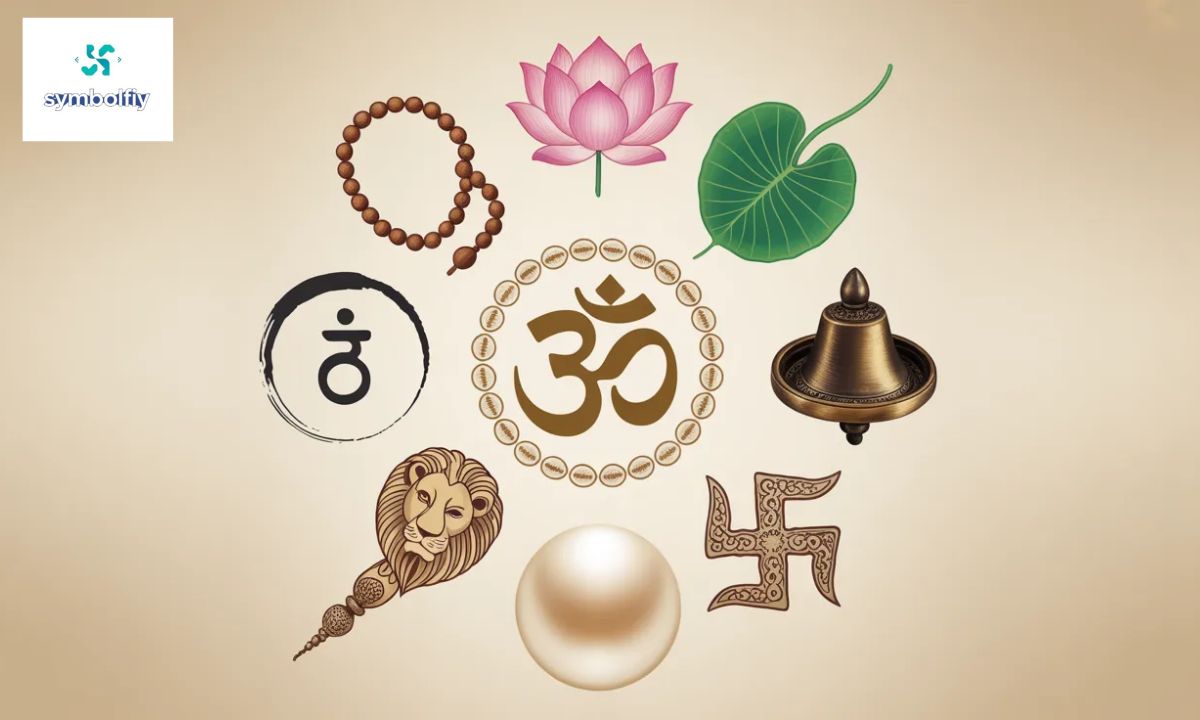
1. Lotus Flower
Origin: Ancient India; adopted from Hindu traditions
Spiritual meaning: Purity, awakening, and the potential within every person
Historical background: Used in Buddhist art since the earliest period
Cultural connection: Central to Indian, Thai, and Tibetan Buddhism
Modern interpretation: Popular in tattoos and jewelry as a sign of personal growth
Emotional symbolism: The idea that beauty can rise from difficult circumstances
The lotus grows in muddy water but blooms cleanly above it. A closed bud represents the start of the spiritual path. A fully open bloom represents enlightenment. It reminds people that hardship does not have to define you.
2. Dharma Wheel (Dharmachakra)
Origin: Ancient India; derived from the royal wheel of power
Spiritual meaning: Buddha’s teachings set in motion; the Noble Eightfold Path
Historical background: One of the oldest Buddhist symbols, predating Buddha images
Cultural connection: Found on India’s national flag, temples across Asia
Modern interpretation: Often used to represent Buddhism as a whole
Emotional symbolism: Progress, direction, and the courage to keep moving forward
The wheel has eight spokes, each standing for one teaching of the Eightfold Path — right view, right thinking, right speech, right action, right livelihood, right diligence, right mindfulness, and right concentration. Together they form a complete guide for living well.
3. Bodhi Tree
Origin: Bodh Gaya, India — the specific fig tree under which Siddhartha meditated
Spiritual meaning: Enlightenment, awakening, and persistent effort
Historical background: The original tree’s descendant still stands in Bodh Gaya
Cultural connection: Sacred across all Buddhist traditions
Modern interpretation: Seen as a symbol of hope and transformation
Emotional symbolism: Patience — sitting long enough to understand something deeply
Siddhartha sat under the Bodhi tree and vowed not to rise until he reached enlightenment. The tree became a symbol of that commitment. The heart-shaped leaf is especially beloved — it represents the possibility of awakening that exists in every person.
4. Conch Shell
Origin: Borrowed from Hindu warrior traditions; used in battles to signal victory
Spiritual meaning: The sound of Buddha’s teachings spreading across the world
Historical background: One of the eight auspicious symbols (Ashtamangala)
Cultural connection: Used in Buddhist ceremonies across Asia
Modern interpretation: Represents fearlessness and truth-telling
Emotional symbolism: The courage to speak up, to wake others from ignorance
When monks blow a conch shell during ceremonies, they are calling people to pay attention. The sound is loud and clear enough to cut through noise and distraction — just as Buddha’s teachings were meant to cut through ignorance.
5. Endless Knot (Eternal Knot)
Origin: Central Asia and Tibet; also found in ancient Greek and Celtic designs
Spiritual meaning: Interconnectedness, karma, and the wisdom of compassion
Historical background: One of the eight auspicious symbols; common in Tibetan art
Cultural connection: Deeply embedded in Tibetan Buddhism
Modern interpretation: Used in jewelry to symbolize eternal love and connection
Emotional symbolism: Nothing exists alone — all things are linked
The knot has no beginning and no end. It represents the idea that wisdom and compassion are inseparable. It also reflects the Buddhist understanding of karma — that every action connects to every other action, and nothing happens in isolation.
6. Parasol (Umbrella)
Origin: Royal courts of ancient India and Hindu kingdoms
Spiritual meaning: Protection from suffering, authority, and spiritual shelter
Historical background: The number of parasols indicated social rank; Buddha is shown with thirteen
Cultural connection: Used in ceremonial processions across South and Southeast Asia
Modern interpretation: A symbol of divine protection and spiritual leadership
Emotional symbolism: The comfort of feeling sheltered from life’s harshest moments
Just as a physical umbrella blocks rain and harsh sun, the parasol in Buddhist symbolism represents protection from mental and emotional suffering. It shows that following the dharma offers real shelter — not from life, but within it.
7. Golden Fish (Pair)
Origin: Ancient India; originally representing the Ganga and Yamuna rivers
Spiritual meaning: Freedom, fearlessness, and navigating the waters of life
Historical background: Another of the eight auspicious symbols
Cultural connection: Common in Tibetan and Chinese Buddhist art
Modern interpretation: A symbol of happiness and flow
Emotional symbolism: Moving freely through difficulty without being swept away
Fish swim in any direction — with the current or against it. This is the lesson. When life goes smoothly, enjoy it. When it pushes back, push back too. The golden fish represent the kind of inner freedom that does not depend on outer conditions.
8. Victory Banner
Origin: Ancient Indian warfare; carried into battle as a sign of supremacy
Spiritual meaning: Buddha’s triumph over desire, fear, pride, and temptation
Historical background: Represents the defeat of the four maras — inner obstacles to enlightenment
Cultural connection: Displayed at the corners of monasteries and temples
Modern interpretation: Personal victory over one’s own destructive patterns
Emotional symbolism: The quiet strength of choosing wisdom over impulse
The four maras represent the fears that block human growth — choosing pleasure over discipline, shrinking from hardship, being ruled by emotion, and fearing death. The victory banner says these can all be overcome. That is an encouraging idea, then and now.
9. Treasure Vase
Origin: Ancient India; a symbol of abundance in Hindu traditions
Spiritual meaning: The inexhaustible wealth of Buddha’s teachings
Historical background: One of the eight auspicious symbols; often depicted in gold
Cultural connection: Used in rituals, altars, and Buddhist architecture
Modern interpretation: A reminder that spiritual wisdom is always available
Emotional symbolism: Abundance that does not run out when shared
Unlike material wealth, the teachings inside the vase never empty. The more you share them, the more they grow. This symbol challenges the fear of scarcity and points toward a different kind of richness.
10. Vajra (Thunderbolt)
Origin: Ancient Hindu weapon of the god Indra; adapted into Buddhist ritual
Spiritual meaning: Indestructibility, clarity, and the power to cut through illusion
Historical background: Central to Tibetan and Chinese Buddhism; often paired with a bell
Cultural connection: Tibetan Buddhism calls its tradition “Vajrayana” — the diamond path
Modern interpretation: Represents focused mental strength
Emotional symbolism: The part of the mind that cannot be broken
The vajra is both a diamond and a thunderbolt. Like a diamond, it cannot be cut. Like a thunderbolt, it cuts through everything else. Spiritually, it represents the quality of mind that stays steady even in difficult conditions — what some might call resilience.
11. Stupa
Origin: Ancient India; originally burial mounds that housed sacred relics
Spiritual meaning: Buddha’s enlightened mind and his lasting presence
Historical background: Emperor Ashoka built thousands of stupas across Asia to spread Buddhism
Cultural connection: Found in every Buddhist country — from Sri Lanka to Japan
Modern interpretation: A place of pilgrimage, meditation, and remembrance
Emotional symbolism: Continuity — the teachings live on even after the teacher is gone
A stupa is not just a building. It is a three-dimensional symbol. Each level represents a stage of the path to enlightenment. Walking around one (a practice called circumambulation) is itself a form of meditation and devotion.
12. Om (Aum)
Origin: Rooted in Hinduism; adopted and reinterpreted in Buddhism
Spiritual meaning: The body, speech, and mind of the Buddha
Historical background: Featured in the famous mantra Om Mani Padme Hum
Cultural connection: Used across Buddhist, Hindu, and Jain traditions
Modern interpretation: A universal sound of mindfulness and presence
Emotional symbolism: Stillness, the moment before thought
Om is often described as the sound of the universe — the vibration underlying everything. Chanting it slows the mind and anchors awareness in the present. In Buddhist practice, it opens the mind to compassion rather than closing it around the self.
13. Enso Circle
Origin: Japanese Zen Buddhism; drawn in a single brushstroke
Spiritual meaning: Enlightenment, completeness, and the beauty of imperfection
Historical background: A uniquely Japanese contribution to Buddhist symbolism
Cultural connection: Central to Zen art and calligraphy traditions
Modern interpretation: Widely used in minimalist art and meditation spaces
Emotional symbolism: Letting go — nothing is ever perfectly round, and that is fine
The enso is drawn without correction. What the hand produces in that single stroke is accepted as it is. Open circles represent openness and potential. Closed circles represent wholeness. Both are valid. This is a Zen lesson in itself.
14. Lion
Origin: Ancient royal symbolism across India and Central Asia
Spiritual meaning: Courage, royalty, and the power of the Buddha’s teachings
Historical background: Buddha is called the “Lion of the Shakyas”; his voice the “Lion’s Roar”
Cultural connection: Guardian lions appear at the entrance of temples across Asia
Modern interpretation: Inner bravery and the courage to face truth
Emotional symbolism: The strength to challenge injustice and alleviate suffering
Lions in Buddhist iconography guard sacred spaces and protect the dharma. They also serve as mounts for Bodhisattvas. Seeing a lion at a temple entrance is not just decoration — it is a reminder to enter with courage and leave pettiness outside.
15. Bodhi Leaf
Origin: The heart-shaped leaf of the sacred fig tree, ficus religiosa
Spiritual meaning: The potential for awakening within every living being
Historical background: Distinct from the tree itself, the leaf became its own symbol over time
Cultural connection: Used across South and Southeast Asian Buddhist art
Modern interpretation: A gentle, approachable symbol of growth and awareness
Emotional symbolism: Possibility — the idea that transformation is always within reach
Where the Bodhi tree represents the full achievement of enlightenment, the leaf represents the quieter beginning — the small, daily choice to pay attention, to be kind, to keep trying. It speaks to the ordinary person more than the monk.
16. Swastika (Buddhist)
Origin: One of the oldest symbols on Earth, over 5,000 years old
Spiritual meaning: Good fortune, the seal of Buddha’s heart, and infinity
Historical background: Found in ancient Egyptian, Roman, Celtic, Greek, and Native American cultures long before its misappropriation
Cultural connection: In China, it represents ten thousand — meaning infinity and auspiciousness
Modern interpretation: Still used in Buddhist and Hindu contexts with its original positive meaning
Emotional symbolism: Good will, continuity, and wholeness
The Buddhist swastika rotates clockwise and carries none of the associations from its twentieth-century misuse. In Buddhist art it appears on the chest, palms, and feet of Buddha images. It represents the completeness of his teachings and the boundlessness of compassion.
17. Bell
Origin: Ancient Buddhist monasteries across India and East Asia
Spiritual meaning: The voice of the Buddha; wisdom and compassion
Historical background: Used to call monks to meditation and mark sacred moments in ceremonies
Cultural connection: Wind bells hang on the eaves of temples throughout Asia
Modern interpretation: Used in mindfulness practice to mark pauses and presence
Emotional symbolism: A moment of clarity cutting through mental noise
The bell is almost always paired with the vajra in Tibetan rituals. Together they represent wisdom (bell) and method (vajra) — the two things needed together to reach enlightenment. The bell’s ring is not just sound; it is an invitation to stop and listen.
18. Mala (Prayer Beads)
Origin: Ancient Indian practice; adapted into Buddhist devotional use
Spiritual meaning: Connection, mindfulness, and the Buddha nature within all living beings
Historical background: Traditionally 108 beads, each representing one repetition of a mantra
Cultural connection: Used across Tibetan, Japanese, Chinese, and Theravada Buddhism
Modern interpretation: Worn as jewelry and used in secular mindfulness practice
Emotional symbolism: The reminder that we are connected to something larger than ourselves
Moving one bead at a time focuses the mind on a single breath or a single word. The beads are not separate — they are all strung together into one strand. That is the teaching: we are individuals, but we are never truly alone.
19. Mandala
Origin: Ancient India; developed into elaborate visual tools in Tibetan Buddhism
Spiritual meaning: The universe in miniature; a map of the enlightened mind
Historical background: Used in tantric visualization practices for centuries
Cultural connection: Central to Tibetan Buddhism; also found in Hindu and Jain traditions
Modern interpretation: Used in art therapy and meditation worldwide
Emotional symbolism: Wholeness, order, and finding center in chaos
Tibetan monks spend weeks creating intricate sand mandalas, then sweep them away when finished. This act of destruction is the lesson — nothing is permanent. The process matters more than the product. That is a difficult idea, and a freeing one.
20. Alms Bowl
Origin: Ancient Buddhist India; a daily practice since the earliest sangha communities
Spiritual meaning: Renunciation of material possession; dependence on community
Historical background: Monks have carried alms bowls since the time of the historical Buddha
Cultural connection: Still practiced daily by Theravada monks in Thailand, Myanmar, and Sri Lanka
Modern interpretation: A symbol of humility and the relationship between teacher and community
Emotional symbolism: Gratitude — receiving what you need and not grasping for more
When someone places food in a monk’s bowl, both people benefit. The monk receives sustenance. The giver receives merit and a moment of generosity. It is a small transaction with a deep purpose — the maintenance of a community built on trust and mutual care.
21. Pearl (Wish-Fulfilling Jewel)
Origin: Sanskrit tradition; the chintamani or wish-fulfilling gem
Spiritual meaning: Spiritual wealth; wisdom and compassion as the highest treasures
Historical background: Depicted in Buddhist art as a glowing orb, often atop a staff or surrounded by flames
Cultural connection: Appears in Chinese, Japanese, and Tibetan Buddhist iconography
Modern interpretation: The idea that the mind itself, when purified, is the greatest jewel
Emotional symbolism: Hope — that what you are looking for is already within you
The pearl does not grant wishes in the magical sense. It represents the realization that the qualities we seek — peace, clarity, love — are recoverable through practice. Meditation is the polishing. You are the pearl.
22. Mudras (Hand Gestures)
Origin: Ancient India; used in dance, ritual, and spiritual practice
Spiritual meaning: Different gestures represent different qualities — fearlessness, meditation, giving, enlightenment
Historical background: Codified in Buddhist iconography to communicate meaning without words
Cultural connection: Found in every Buddhist artistic tradition across Asia
Modern interpretation: Used in yoga and mindfulness practice today
Emotional symbolism: The body expressing what the mind holds
A raised hand means “do not be afraid.” An open palm facing down means “touch the earth, witness my truth.” Hands held in the lap mean “I am still, I am present.” Buddha statues speak through their hands. Once you learn the gestures, every statue tells you something.
23. Prayer Wheel
Origin: Tibetan Buddhism; developed around the 4th century CE
Spiritual meaning: Spinning the wheel sends compassion and merit outward into the world
Historical background: Contains printed mantras inside; each rotation equals one recitation
Cultural connection: Uniquely Tibetan; a distinctive part of that tradition’s visual identity
Modern interpretation: Seen as a physical act of intention and devotion
Emotional symbolism: The idea that small, consistent actions accumulate into something meaningful
You do not need to say a mantra out loud. Spinning a prayer wheel does it for you, in a sense. But the deeper teaching is about intention — turning the wheel with awareness is different from turning it mindlessly. That distinction applies to almost everything in life.
24. Buddha Footprint
Origin: Early Buddhism before physical images of the Buddha were created
Spiritual meaning: The presence of the Buddha on Earth; a path worth following
Historical background: Among the earliest Buddhist symbols, pre-dating statues by centuries
Cultural connection: Found at pilgrimage sites across India, Sri Lanka, and Thailand
Modern interpretation: A reminder to be mindful of where you step, literally and figuratively
Emotional symbolism: Humility — the greatest teacher left footprints, not a throne
Before Buddhists carved statues of the Buddha, they carved his footprints. The absence of the figure was the point — the teaching continues even when the teacher is gone. What matters is not the person, but the path they walked and what they left behind.
25. Dharma Chakra Flag (Buddhist Flag)
Origin: Designed in 1880 in Sri Lanka; adopted internationally in 1952
Spiritual meaning: Unity of all Buddhist traditions across cultures and countries
Historical background: The five colors represent the five rays of light said to emanate from the Buddha at enlightenment
Cultural connection: Recognized worldwide as the symbol of the global Buddhist community
Modern interpretation: Flown at temples, festivals, and events worldwide
Emotional symbolism: Belonging — a shared identity that crosses national and cultural lines
The Buddhist flag is relatively new, but it carries old meaning. Its five colors — blue, yellow, red, white, and orange — each represent a quality of the enlightened mind. Together they say: the dharma belongs to everyone, everywhere.
Ancient Cultures That Used These Symbols
Ancient India: The original home of Buddhism. Most core symbols — the lotus, dharma wheel, stupa, and bodhi tree — developed here first, shaped by Vedic and Hindu traditions already in place.
Tibetan culture: Added mysticism, color, and complexity. Tibetan Buddhism gave the world mandalas, prayer wheels, the endless knot, and elaborate thangka paintings rich in symbolic detail.
Chinese culture: Blended Buddhist symbols with Taoist and Confucian ideas. The pearl, lion, and swastika took on additional layers of meaning related to harmony, moral order, and good fortune.
Japanese culture: Simplified and refined. Zen Buddhism produced the enso circle — perhaps the most minimal yet most profound symbol in the entire tradition. Japan showed that less can carry more.
Southeast Asian cultures: Thailand, Myanmar, Cambodia, and Sri Lanka kept close to Theravada roots. Symbols like the alms bowl, Buddha footprint, and stupa remain daily realities in public life there.
Greek and Celtic traditions: The endless knot appears in both cultures independently, suggesting that certain symbolic ideas cross cultural lines naturally. Connection and continuity seem to be universal human concerns.
Why These Symbols Still Matter Today
Modern life is fast, loud, and often disorienting. Buddhist symbols offer something rare — a moment of quiet meaning. People choose the lotus for a tattoo not because they are Buddhist, but because the idea of growing through difficulty resonates with them personally.
The enso goes on studio walls because imperfection feels truer than perfection. These symbols travel because the human experiences they describe do not change.
They also provide a sense of continuity. In a world where things feel unstable, connecting to something 2,500 years old can be grounding.
Whether worn as jewelry, painted on a meditation room wall, or simply recognized in a temple abroad, Buddhist symbols quietly remind people that others have faced the same fears, the same losses, and the same questions — and found a way through.
Frequently Asked Questions
What are the eight auspicious Buddhist symbols?
The Ashtamangala: lotus, dharma wheel, conch shell, endless knot, parasol, golden fish, treasure vase, and victory banner.
What is the most important Buddhist symbol?
The Dharma Wheel is widely considered the most foundational, representing the core of all Buddhist teaching.
Can non-Buddhists use or wear Buddhist symbols?
Yes — as long as the symbol is used respectfully and with some understanding of what it means.
What does the lotus flower mean in Buddhism?
Purity, spiritual awakening, and the ability to rise above suffering without being defined by it.
Are Buddhist symbols used for protection?
Yes — the parasol, endless knot, and vajra are all associated with protection from negative energy and harmful forces.
Conclusion
Buddhist symbols are not relics of the past. They are active teachers — quiet, patient, and always available. Each one holds a specific truth about the human experience: that suffering is real, that growth is possible, that you are not alone, and that the path is always open. Whether you encounter them in a temple in Bodh Gaya or on a tattoo in a coffee shop, they carry the same invitation — to pay attention, and to keep going.