Symbols have always done what words can’t. They carry grief, faith, and identity in a single shape. Sleep Token, the masked British band that blurs the line between metal and devotion, has built an entire visual language around this idea.
Their symbols have taken on a life of their own — appearing as tattoos, phone wallpapers, and fan art across the world. This guide breaks down 25 of the most meaningful Sleep Token symbols and what they actually represent.
Sleep Token symbols are rooted in the idea of surrender. The band frames its music as offerings to a mysterious deity called “Sleep,” and every symbol feeds into that mythology. Together they represent devotion, anonymity, emotional transformation, and the blurry line between human feeling and something sacred.
These aren’t random designs. They pull from ancient runic alphabets, alchemical traditions, occult imagery, and sacred geometry — then wrap all of it inside a modern myth. That mix is why they resonate so deeply. They feel ancient and personal at the same time.
25 Sleep Token Symbols and Their Meanings
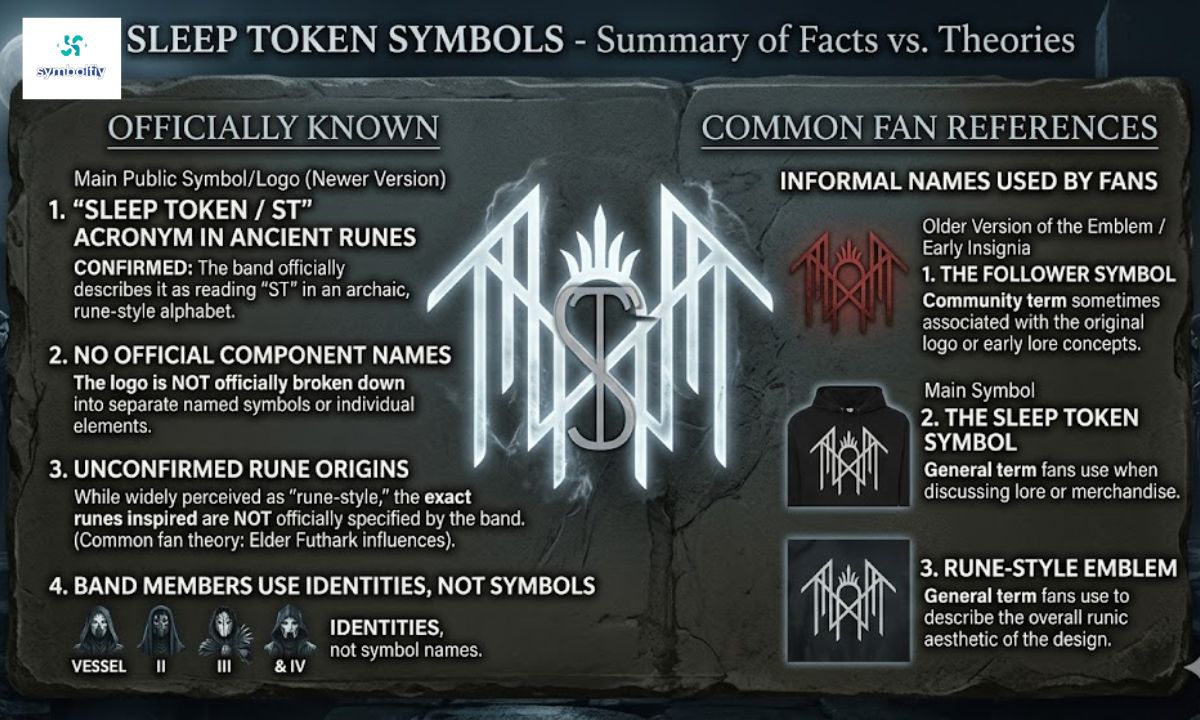
1. The Main Logo (The Sigil)
Origin: First appeared on the 2016 debut EP One, limited to 50 physical copies
Spiritual meaning: Devotion and surrender to a higher force
Historical background: Draws on Elder Futhark runic construction and possibly Etruscan letter forms
Cultural connection: Functions like a sacred seal, similar to alchemical or occult sigils
Modern interpretation: The band’s primary identity mark — worn on masks, stage backdrops, and merchandise
Emotional symbolism: Represents giving yourself over to something beyond your control, the core theme of Sleep Token’s music
2. The Arch (Sundowning Update)
Origin: Introduced with the 2019 Sundowning logo redesign
Spiritual meaning: A gateway between states of being — human to divine, pain to peace
Historical background: Arches have symbolized thresholds and transitions across nearly every ancient civilization
Cultural connection: Found in Roman, Islamic, and Gothic religious architecture as passages toward the sacred
Modern interpretation: Marks a shift in the band’s mythology and visual identity
Emotional symbolism: The feeling of crossing a point of no return — entering something you can’t come back from
3. The Five Crown Spikes
Origin: Part of the same 2019 logo revision alongside the arch
Spiritual meaning: Divine authority and spiritual awakening
Historical background: Crowns appear across cultures as symbols of power given by the gods, not earned by humans
Cultural connection: The number five carries weight in numerology, representing freedom, change, and balance
Modern interpretation: Points upward toward something beyond the self
Emotional symbolism: Ambition mixed with reverence — reaching for something greater while bowing to it
4. Vessel’s Mask
Origin: Worn by the lead singer since the band’s formation in London, 2016
Spiritual meaning: Ego death — the removal of personal identity to become a channel
Historical background: Ritual masks appear in ancient Greek theater, African ceremony, and Indigenous traditions worldwide
Cultural connection: Shamanic cultures used masks to embody spirits rather than personalities
Modern interpretation: A living symbol of the band’s commitment to anonymity over celebrity
Emotional symbolism: The idea that what you feel is more real than who you are
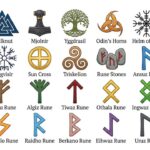
5. Tiwaz Rune (ᛏ)
Origin: Elder Futhark runic alphabet, used between the 2nd and 8th centuries AD
Spiritual meaning: Justice, sacrifice, and doing what’s right even when it costs you
Historical background: Named after Tyr, the Norse god of war and law who sacrificed his hand
Cultural connection: Viking-age Germanic tribes carved this rune for strength and moral clarity
Modern interpretation: Fans link it to Vessel’s devotion to Sleep — sacrifice with no guarantee of return
Emotional symbolism: Doing the painful thing because it’s the honest thing
6. Wunjo Rune (ᚹ)
Origin: Elder Futhark, representing joy and harmony
Spiritual meaning: The brief moments of peace found inside devotion
Historical background: One of the original 24 runes, associated with belonging and communal joy
Cultural connection: Norse and Germanic cultures used it to invoke happiness and connection
Modern interpretation: Some fans see it encoded in the main logo’s left-side geometry
Emotional symbolism: The quiet relief you feel when you stop fighting and just surrender to an emotion
7. Uruz Rune (ᚢ)
Origin: Elder Futhark, symbolizing raw strength and wild energy
Spiritual meaning: Primal force — the kind that exists before it’s shaped by civilization or reason
Historical background: Associated with the aurochs, a massive wild ox now extinct, representing untamed nature
Cultural connection: Germanic warrior culture revered this rune as a mark of power and vitality
Modern interpretation: Tied to the band’s heavier, more aggressive musical moments
Emotional symbolism: The part of your grief or love that feels too big to contain
8. Nauthiz Rune (ᚾ)
Origin: Elder Futhark, the rune of need and constraint
Spiritual meaning: Spiritual necessity — the things you must go through to grow
Historical background: Ancient Norse communities associated it with hardship and the friction needed for fire
Cultural connection: It was used in divination to signal struggle that leads to wisdom
Modern interpretation: Represents the emotional weight Sleep Token’s music explores — the necessity of pain
Emotional symbolism: That specific feeling of needing something you know might destroy you
9. Sundowning Track Sigils
Origin: Each track on Sundowning (2019) was assigned its own unique sigil
Spiritual meaning: Each sigil acts as a sacred mark for that song’s offering to Sleep
Historical background: Draws from Elder Futhark, alchemical symbols, and Ars Goetia demon sigils
Cultural connection: Medieval occult tradition used sigils as concentrated forms of spiritual intention
Modern interpretation: Fans decode and compare them to find hidden connections between songs
Emotional symbolism: The idea that every emotional experience is unique and deserves its own sacred form
10. Enochian Letter Influences
Origin: Enochian is a language supposedly revealed to occultist John Dee in the 16th century
Spiritual meaning: Communication with forces beyond human comprehension
Historical background: Used in ceremonial magic traditions, particularly in the Golden Dawn and Thelemic systems
Cultural connection: Western esoteric traditions treat Enochian as the original angelic language
Modern interpretation: Some Sundowning sigils appear to borrow Enochian letter shapes
Emotional symbolism: Speaking in a language that goes beyond what ordinary words can hold
11. Ars Goetia Sigil References
Origin: The Ars Goetia is part of the Lesser Key of Solomon, a 17th-century grimoire
Spiritual meaning: Summoning or acknowledging forces that exist outside ordinary human life
Historical background: These sigils were used in ceremonial demonology to invoke specific spirits
Cultural connection: Deeply rooted in Judeo-Christian occult traditions of the late medieval period
Modern interpretation: Sleep Token uses this aesthetic to suggest that their deity, Sleep, operates in that same realm of mystery
Emotional symbolism: The terrifying and magnetic pull toward something you can’t fully name
12. The Alchemical Triangle
Origin: Classical alchemy used triangles to represent the four elements
Spiritual meaning: Transformation — the process of changing one thing into another through suffering
Historical background: European alchemists from the 13th to 17th centuries used triangular symbols to represent fire, water, air, and earth
Cultural connection: Also present in Hermetic philosophy, connecting material change to spiritual growth
Modern interpretation: Reflected in Sleep Token’s recurring themes of emotional rebirth
Emotional symbolism: The strange alchemy of turning heartbreak into something beautiful
13. The Circle
Origin: Universal across virtually every symbolic tradition in human history
Spiritual meaning: Wholeness, eternity, and the cycle of things ending and beginning again
Historical background: From Celtic knotwork to Buddhist mandalas, the circle represents completeness without a starting point
Cultural connection: In Jungian psychology, the circle or mandala represents the integrated self
Modern interpretation: Appears in Sleep Token’s logo geometry and album visual compositions
Emotional symbolism: The exhausting but comforting truth that feelings cycle — nothing stays, nothing truly ends
14. The Follower Symbol (Original Logo)
Origin: Described on Sleep Token’s early Facebook page in 2017, though the exact source is unverified
Spiritual meaning: Identification as a follower of Sleep — belonging to something before you fully understand it
Historical background: Early religious movements often gave followers visual marks of belonging
Cultural connection: Functions like a tribal mark or religious seal from ancient traditions
Modern interpretation: The earlier, simpler version of the logo that preceded the Sundowning redesign
Emotional symbolism: The moment you commit to something before you can explain why
15. The S and T Initial Encoding
Origin: Theory suggests Vessel’s first mask encoded “S” and “T” in an ancient script
Spiritual meaning: Identity hidden beneath the surface, available only to those willing to look
Historical background: Ancient cultures often encoded names within symbols, particularly in Egyptian cartouche traditions
Cultural connection: The Etruscan theory proposes that SLEEP and TOKEN are both encoded within the logo’s geometry
Modern interpretation: Adds another layer to fan decoding culture — meaning hiding in plain sight
Emotional symbolism: The feeling that something important about you exists beneath what people actually see
16. The Bind Rune Structure
Origin: Bind runes combine multiple runes into a single symbol — a practice occasionally found in early medieval Scandinavia
Spiritual meaning: Multiple meanings compressed into one mark, like a chord carrying several notes at once
Historical background: Historically used to save space in carving or to create a shorthand for frequently used names
Cultural connection: The modern New Age movement revived bind runes as intentional spiritual tools in the 1980s
Modern interpretation: Sleep Token’s logo reads as a bind rune — Tiwaz, Nauthiz, Wunjo, and Uruz combined
Emotional symbolism: Complexity made simple — many feelings folded into a single gesture
17. The Duality Mirror
Origin: The logo’s symmetry — left half mirrored to form the right — is one of its most discussed features
Spiritual meaning: The tension between Vessel and Sleep, the human and the divine, the self and its shadow
Historical background: Mirroring in sacred art appears in Zoroastrian, Gnostic, and Hermetic traditions as a symbol of opposing forces in balance
Cultural connection: Carl Jung’s concept of the shadow self makes this duality personally resonant
Modern interpretation: Fans interpret it as the push and pull at the heart of every Sleep Token album
Emotional symbolism: That specific sensation of being pulled in two directions by the same feeling
18. Vessel’s Name as Symbol
Origin: The lead singer adopted the name “Vessel” rather than a personal identity
Spiritual meaning: A container for something larger — not the source, just the form it takes
Historical background: In religious traditions, prophets and priests were often described as vessels for divine will
Cultural connection: Sufi mysticism, Christian theology, and Shinto traditions all use vessel language for spiritual mediums
Modern interpretation: Frames every performance as an act of channeling rather than individual expression
Emotional symbolism: The relief of not having to be the source — just the instrument
19. The Ritual Performance Mark
Origin: Sleep Token calls its live shows “Rituals” — the logo present on stage becomes a ritual symbol
Spiritual meaning: Sacred space made visible — the performance as ceremony
Historical background: Ancient religious rites used visual markers to designate sacred ground
Cultural connection: Shared across Druidic, Native American, and Hindu ceremonial traditions
Modern interpretation: The logo transforms the concert venue into a temporary temple
Emotional symbolism: The communal release that only happens when a group of people give themselves to the same feeling at the same time
20. The Take Me Back to Eden Cipher Alphabet
Origin: Introduced in artwork and merchandise tied to the 2023 album Take Me Back to Eden
Spiritual meaning: Secret language as sacred text — meaning that requires devotion to decode
Historical background: Cipher alphabets appear in occult traditions, alchemical manuscripts, and esoteric orders
Cultural connection: The Rosicrucians, Freemasons, and other esoteric groups used custom scripts to gatekeep knowledge
Modern interpretation: Fans treat decoding it like translating a sacred manuscript
Emotional symbolism: The intimacy of being let into a secret — the trust that creates
21. The Moon Imagery
Origin: Associated with Sleep Token’s lore around their deity emerging from the moon
Spiritual meaning: The unconscious mind, cycles, and the hidden force that controls the tides of emotion
Historical background: Moon worship appears in Mesopotamian, Greek, Celtic, and Hindu traditions
Cultural connection: In Jungian analysis, the moon represents the unconscious and the anima
Modern interpretation: Tied to the 2024 graphic novel Teeth of God, which involves a lunar anomaly
Emotional symbolism: The irrational pull of something you didn’t choose to feel
22. Even in Arcadia Song-Specific Crests
Origin: Introduced with the 2025 album Even in Arcadia
Historical background: “Et in Arcadia ego” is a 17th-century memento mori phrase — even in paradise, death exists
Cultural connection: Draws from classical European painting and the tradition of idealized landscape as spiritual reflection
Modern interpretation: Each song crest functions as a heraldic mark for that emotional territory
Emotional symbolism: Beauty that knows it won’t last — and chooses to exist anyway
23. The Geometric Symmetry
Origin: Sacred geometry as a design philosophy across all Sleep Token visual materials
Spiritual meaning: Order within chaos — the idea that even overwhelming emotion has an underlying structure
Historical background: Sacred geometry appears in Islamic art, Gothic cathedral design, Buddhist mandalas, and Platonic philosophy
Cultural connection: The golden ratio and symmetrical forms have been associated with divine proportion since antiquity
Modern interpretation: The visual consistency of Sleep Token’s imagery creates a sense of sacred regularity
Emotional symbolism: The strange comfort of finding pattern inside pain
24. Black and White Color Symbolism
Origin: The band’s consistent use of black, white, and occasional red across all visual materials
Spiritual meaning: Duality — light and dark, waking and sleeping, devotion and grief
Historical background: Black and white carry ritual significance in Zoroastrian, Taoist, and Christian symbolic traditions
Cultural connection: In Taoist philosophy, the interplay of black and white (yin and yang) represents cosmic balance
Modern interpretation: The color restraint forces attention onto shape and symbol rather than surface decoration
Emotional symbolism: The starkness of feelings that don’t come in gradients — love, loss, and the absence of both
25. The Fan Tattoo as Living Symbol
Origin: Fans began permanently inking Sleep Token symbols shortly after the band’s rise to prominence
Spiritual meaning: The permanent marking of an inner transformation on the outer body
Historical background: Ritual tattooing for spiritual purposes appears in Polynesian, Maori, Japanese, and Indigenous traditions across continents
Cultural connection: In many ancient cultures, tattoos marked initiations — the body as testimony to something survived
Modern interpretation: The Sleep Token sigil as a personal marker of healing, belonging, or emotional survival
Emotional symbolism: This happened to me. I changed. And I’m not hiding it.
Ancient Cultures That Used Similar Symbols
Norse/Germanic traditions: Elder Futhark runes were used for writing, protection, and later esoteric practice. Sleep Token’s logo draws most directly from this system.
Etruscan civilization: An ancient Italian culture whose partially decoded alphabet offers one compelling theory for how the logo encodes “Sleep Token” in full.
Medieval European occultism: Grimoires like the Ars Goetia and alchemical manuscripts used sigils and geometric seals to represent spiritual forces — the direct ancestors of Sleep Token’s song sigils.
Enochian/ceremonial magic: A 16th-century occult tradition that produced its own angelic alphabet, elements of which appear in some Sundowning visuals.
Indigenous and shamanic cultures worldwide: The use of masks to dissolve personal identity and channel spiritual forces appears across cultures from West Africa to the Pacific Northwest.
Classical European art: The Arcadian tradition from 17th-century painting, referenced directly in Even in Arcadia, connects pastoral beauty to the awareness of mortality.
Why Symbols Still Matter Today
In a culture that has more information than it knows what to do with, mystery feels rare. That’s part of why Sleep Token’s symbols land so hard. They don’t explain themselves.
They invite you to bring your own meaning — your own grief, longing, or need for something larger than your day-to-day life. That open-endedness is the point.
People get these symbols tattooed because they mark something real. A period of grief survived. A relationship that changed you. A moment where music felt like the only honest thing.
Symbols give those invisible experiences a visible form — and Sleep Token’s symbols are built specifically for the kind of feelings that resist ordinary language.
Frequently Asked Questions
What does the Sleep Token main logo mean?
It likely encodes the band’s name through ancient runic or Etruscan letter forms, while also functioning as a sigil of devotion and surrender.
Is the Sleep Token alphabet real?
It’s a custom cipher created for artistic purposes — fans have decoded it, and it maps onto English letters across album artwork and merchandise.
Why do fans get Sleep Token symbols tattooed?
Most describe it as marking a personal transformation — a way to carry something that changed them on the outside.
Are Sleep Token symbols connected to a real religion?
No. They borrow from multiple traditions — Norse paganism, Western occultism, alchemy — but the mythology is entirely the band’s own creation.
What changed between the original and 2019 logo?
The 2019 update added the central arch and five crown spikes, adding themes of spiritual thresholds and divine authority to the original runic structure.
Conclusion
Sleep Token symbols work because they don’t try to explain everything. They hold space for the kind of feelings that can’t be put into clean sentences — devotion, grief, transformation, and the need to belong to something.
Whether you’re drawn to the runic geometry, the occult sigils, or just the way the mask looks under stage lights, these symbols are doing what the best symbols have always done: pointing toward something true that exists just beyond what words can reach.