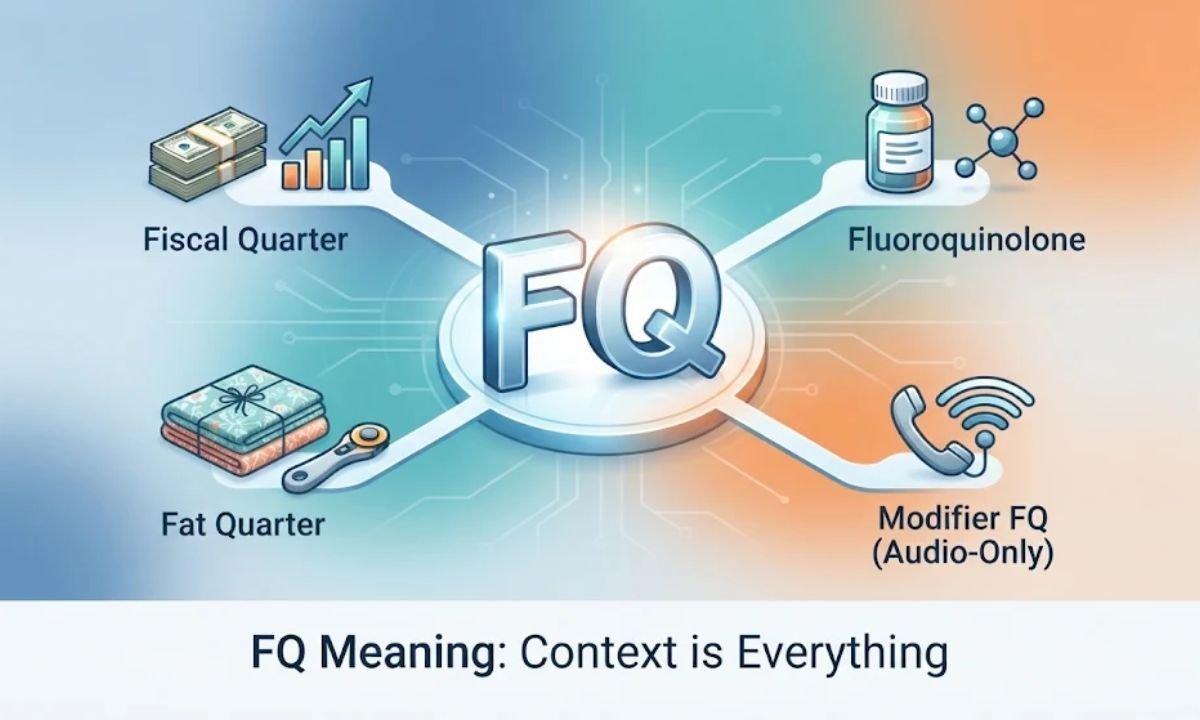
You spotted “FQ” on a bill, a spreadsheet, a fabric tag, or a text message, and now you need to know what it means. The trouble is that FQ stands for many different things. Which one applies depends on where you found it.
Thank you for reading this post, don't forget to subscribe!
Most pages dump a long list of definitions and leave you to guess. This guide sorts every common meaning by context so you can find yours fast. Start with the quick selector, then jump to the section that matches your situation.
FQ has no single meaning. It is a multi-industry acronym, and the right definition depends on the document, field, or conversation in front of you. The most common answers are fiscal quarter, financial quotient, fluoroquinolone, frequency, fat quarter, and a Medicare billing modifier for audio-only telehealth.
The table below gives the FQ acronym definition for each major context.
Context
FQ means
Where you will see it
Business and accounting
Fiscal quarter
Earnings reports, budgets, forecasts
Personal finance
Financial quotient
Money quizzes, financial education
Medicine and pharmacy
Fluoroquinolone
Clinical notes, drug guidelines
Healthcare billing
Modifier FQ (audio-only service)
Claims, explanations of benefits
Physics and electronics
Frequency
Signal notes, audio equipment
IT and databases
Fully qualified name, filter query
Code, search configuration
Sewing and quilting
Fat quarter
Patterns, fabric shops
Travel and culture
French Quarter
New Orleans guides, event listings
Texting and social media
Fair question, frequent question, and other slang
Chats, comments
Quick Selector: Find Your FQ in Under a Minute
Match your situation to the first line that fits:
On a medical claim or insurance statement: modifier FQ, meaning the visit was audio-only.
On a prescription, drug label, or clinical note: fluoroquinolone, an antibiotic class.
In an earnings report, budget, or sales plan: fiscal quarter.
On a quilting pattern or in a fabric shop: fat quarter.
In a money-skills quiz or finance article: financial quotient.
In a physics, audio, or radio context: frequency.
In code, a database, or a search query: fully qualified name or filter query.
Near Bourbon Street or a New Orleans map: French Quarter.
In a chat or comment thread: slang. Read the tone.
Still stuck? Look at the words and numbers around the letters. A number like FQ2 points to fiscal quarters. A five-digit code next to it points to billing. A measurement in inches points to fabric.
Why FQ Has So Many Meanings
FQ is short, and short acronyms get reused. The letter F stands in for words like fiscal, fat, frequency, and fluoro. The letter Q does just as much work, standing for quarter, quotient, query, and quality.
Each field coined its own FQ without checking what the others were doing. A quilter and a hospital billing clerk will never share a conversation, so neither needed to avoid the clash. The result is a term that is clear inside each field and confusing everywhere else.
That is why a flat list of definitions helps so little. You need the context first, then the answer.
FQ in Business and Finance
Fiscal Quarter (FQ1, FQ2, FQ3, FQ4)
In business, FQ means fiscal quarter, a three-month slice of a company’s or government’s financial year. Teams label the four slices FQ1 through FQ4. You will see these tags in earnings reports, budget documents, sales targets, and forecasting spreadsheets.
A fiscal year does not have to match the calendar year. A company whose year starts in July treats July through September as FQ1. The US federal government starts its fiscal year on October 1, so FQ1 there runs from October through December.
That gap causes real mix-ups. If someone mentions “FQ3 revenue,” check the company’s year-end date before you assume which months they mean. Calendar quarters often carry the labels CQ or Q1 to Q4, which makes the confusion worse.
Here is a quick example. Picture a retailer that closes its books on January 31. Its FQ4 covers November through January, which includes the holiday rush. A reader who assumes calendar quarters would misplace the busiest sales period entirely.
Financial Quotient (FQ): Your Financial IQ Explained
Financial quotient, or FQ, describes how well a person understands and manages money. Think of it as a cousin of IQ and EQ. It covers budgeting, handling debt, saving, investing, and protecting yourself against financial risk.
No single official test defines it. Quizzes, books, and financial educators score FQ in their own ways, so a number from one source does not compare with a number from another. Treat it as a self-check, not a credential.
Most frameworks break financial quotient into areas like these:
Spending and budgeting
Credit and debt
Income and career growth
Investing
Financial planning
Insurance and risk protection
A practical way to use the idea: rate yourself from one to five in each area, find your lowest score, and work on that one first. Small gains in your weakest area usually matter more than polishing your strongest.
In medical terms, FQ usually means fluoroquinolone, a class of broad-spectrum antibiotics. Ciprofloxacin, levofloxacin, and moxifloxacin are well-known examples. Clinicians use FQ as shorthand in notes, treatment guidelines, and research papers.
These drugs treat serious bacterial infections, but they carry safety warnings. The US FDA requires boxed warnings on the class for risks that include tendon inflammation and rupture, nerve damage in the arms and legs, effects on the central nervous system, and worsening muscle weakness in people with myasthenia gravis.
The FDA has also advised that these antibiotics be reserved for patients with no other treatment options for conditions such as uncomplicated sinus infections, acute bronchitis, and uncomplicated urinary tract infections.
If your prescription is a fluoroquinolone, do not stop it on your own. Call your prescriber or pharmacist right away if you notice tendon pain, tingling, confusion, or unusual changes in mood.
CMS Modifier FQ: Audio-Only Telehealth Billing
On a medical bill, FQ is a HCPCS Level II modifier. CMS describes it as showing that the service was furnished using audio-only communication technology. In plain terms, the visit happened by phone or another voice-only connection, with no video.
The FQ modifier for telehealth is tied mainly to Medicare mental health services. Federal regulation names CPT modifier 93 for audio-only services and, for rural health clinics and federally qualified health centers, the Medicare modifier FQ.
CMS guidance for those clinics has listed both 93 and FQ for audio-only mental health visits, so billing teams should confirm which one their Medicare Administrative Contractor expects.
Here is how the three modifiers compare:
Modifier
Meaning
Typical use
95
Real-time audio and video
Video telehealth visits
93
Audio-only (CPT modifier)
Phone visits across many settings
FQ
Audio-only (HCPCS modifier)
Medicare, mainly rural clinics and health centers
Three habits prevent most denials:
Never use modifier 95 for a phone-only visit.
Document why the visit was audio-only.
Check the payer’s policy for the exact date of service.
If you are a patient and see FQ on an explanation of benefits, it only means your appointment was audio-only. It is not a diagnosis, and it is not a penalty. Telehealth rules change with new legislation, so confirm current requirements with your payer.
FQ in Science, Engineering, and Technology
Frequency (Hz) and Signal FQ Notations
Frequency measures how often a repeating event happens in a set amount of time. The unit is the hertz (Hz), which equals one cycle per second. In formulas the symbol is usually f, though FQ shows up as shorthand in some engineering notes, audio equipment, and signal-processing labels.
The math is simple. Frequency equals 1 divided by the period. If a wave repeats every 0.02 seconds, its frequency is 50 Hz, which matches the mains electricity standard in much of Europe. The United States uses 60 Hz.
Higher frequency means faster repetition. In sound, that means a higher pitch. In radio, it means a different band. The note A above middle C is tuned to 440 Hz in standard concert pitch.
Fully Qualified Names and Filter Queries in IT
Developers run into FQ in two places. The first is the fully qualified name, often shortened to FQN. It spells out an object’s complete path, such as database.schema.table or a package name plus a class name. It removes any doubt when two objects share the same short name.
The second is the filter query. Search platforms such as Apache Solr use fq as a request parameter. A filter query narrows results without changing how they are ranked, and the engine can cache it to speed up repeat searches.
Most competing pages skip these meanings entirely. If your FQ sits inside code, a config file, or a query string, one of these two is almost certainly the answer.
FQ in Everyday Life, Arts, and Slang
Fat Quarter: What It Means in Quilting and Sewing
A fat quarter is a piece of fabric measuring about 18 by 22 inches, or roughly 46 by 56 centimeters. Shops make it by cutting a half-yard and splitting that piece in half along the fold. The word “fat” describes the shape, which is closer to square than a standard quarter-yard cut.
A regular quarter-yard cut measures 9 by 44 inches. Both pieces contain about 396 square inches of fabric. The fat quarter wins for most small projects because its wider shape lets you cut larger blocks, appliqué shapes, and patches with less waste.
Quilters often buy fat quarters in coordinated bundles to sample many prints without paying for full yards. Beginners should measure before cutting. Fabric widths vary by manufacturer, so a piece can come up slightly short of 22 inches.
French Quarter (New Orleans) and Cultural Uses
The French Quarter, also called the Vieux Carré, is the oldest neighborhood in New Orleans. Travel writers, locals, and event planners sometimes shorten it to FQ. You will find that shorthand in hotel listings, festival schedules, and walking tour notes.
If your FQ appears next to Bourbon Street, jazz, or a Louisiana address, this is your match.
FQ Meaning in Text Messages and Social Media Slang
In texts and comments, FQ has no fixed definition. People use it for “fair question” or “frequent question,” and sometimes as a joking play on IQ and EQ, like “fun quotient.” A few vulgar variants exist too, and the tone of the message usually gives them away.
Read the full sentence before you decide. If a friend answers your question with “FQ,” they probably mean fair question. If the surrounding tone is hostile, treat it as an insult. When you cannot tell, ask the sender. It takes one message and saves a misunderstanding.
What to Do If You Still Cannot Tell
Start with the source. Check the document for a glossary or a notes section, since billing statements and financial reports often define their own terms.
Next, search with context words attached. A query like “FQ modifier claim” or “FQ fiscal report” returns far better results than the two letters alone. Finally, ask the person or organization that sent it. A direct question beats a wrong guess, especially on a medical bill or a financial document.
Frequently Asked Questions
What does FQ stand for in medical terms?
In clinical settings, FQ most often means fluoroquinolone, a class of broad-spectrum antibiotics such as ciprofloxacin and levofloxacin.
What does FQ mean in text or chat?
It usually means “fair question” or “frequent question,” though the tone of the message decides the real meaning.
What is an FQ modifier in billing?
It is a HCPCS modifier showing that a telehealth service was delivered by audio-only communication, mainly used for Medicare mental health visits.
What does FQ mean in finance?
It means fiscal quarter in corporate reporting, or financial quotient when describing a person’s money-management skill.
What is the difference between FAQ and FQ?
FAQ stands for frequently asked questions and refers to a list, while FQ is a separate acronym with many context-based meanings.
Conclusion
FQ looks simple, but it carries at least ten meanings, and only the surrounding context tells you which one is right. A number after the letters points to a fiscal quarter, a billing code points to an audio-only telehealth visit, a drug label points to an antibiotic class, and a ruler points to a fat quarter of fabric.
When the clues run out, check the source for a glossary or ask the sender directly. With the quick selector and the context sections above, you can match any FQ you meet to the right definition and move on with confidence.