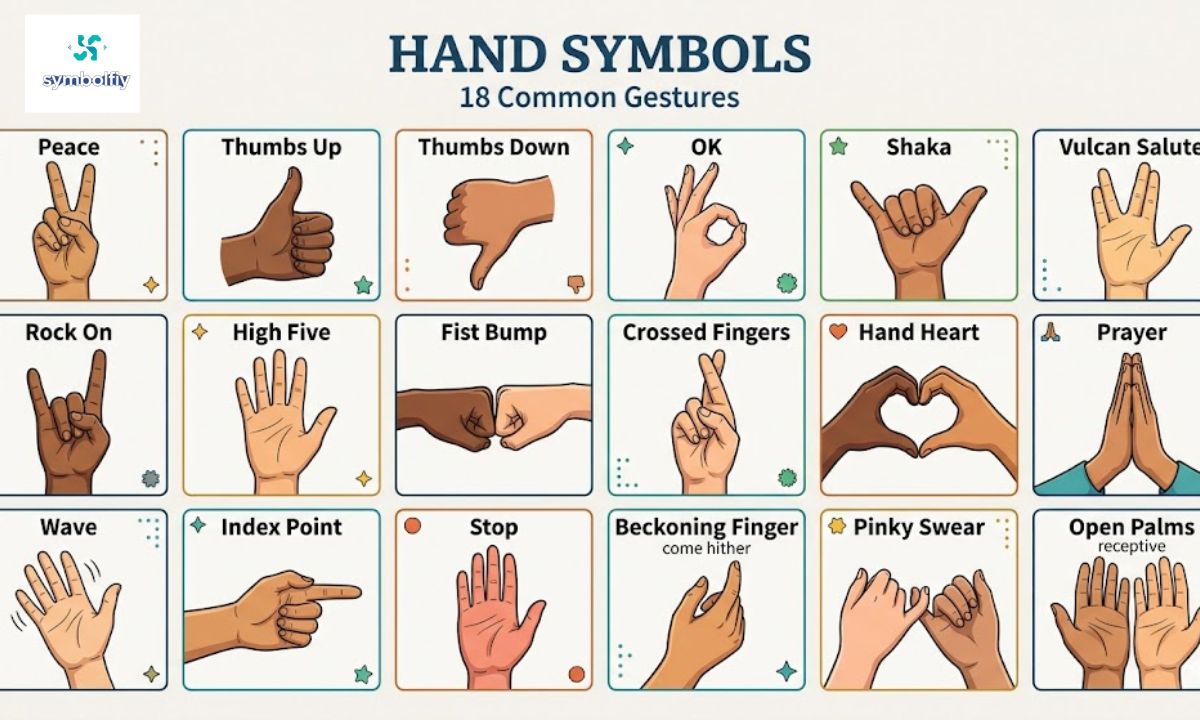
Hands have always been more than tools. Since the earliest cave paintings, humans have used hand symbols to express faith, power, protection, love, and identity. A single gesture can mean something sacred in one culture and something completely different in another.
That is what makes hand symbolism so rich and worth understanding. Whether you see these signs in ancient art, religious texts, tattoos, or everyday conversation, knowing what they mean — and where they come from — opens up a whole new way of reading the world around you.
Hand symbols carry some of the deepest meanings in human history. They represent the bridge between the physical and the spiritual — between what we do in the world and what we believe about it.
Across cultures and centuries, hands have stood for power, creation, protection, blessing, healing, and connection. They show up in temple carvings, holy books, meditation practices, and modern tattoo art for one simple reason: they speak a language everyone understands.
On a personal level, hand symbols often carry emotional weight too. A clenched fist can mean anger or strength depending on context. An open palm can mean welcome or stop.
Prayer hands speak to faith and surrender. Each symbol holds layers — historical, spiritual, emotional, and cultural — and that is exactly what makes them worth exploring.
25+ Hand Symbols and Their Meanings
Open Hand Gestures
🤲 Open Palm
The open palm is one of the oldest and most universal hand symbols in human history.
Origin: Found in cave paintings dating back over 30,000 years across every inhabited continent
Spiritual meaning: Openness, honesty, and receptivity to divine energy
Historical background: Used in ancient Egypt and Rome to signify offering and non-aggression
Cultural connection: In many Middle Eastern traditions, the open hand is a protective sign against evil
Modern interpretation: In body language, an open palm signals trust and transparency
Emotional symbolism: Vulnerability, readiness, and willingness to connect
🖐️ Raised Hand
The raised hand is a symbol of attention, authority, and spiritual reaching.
Origin: Used in ancient Greek and Roman courts as a sign of oath-taking and civic participation
Spiritual meaning: Reaching toward the divine; many prayer traditions involve raising hands skyward
Historical background: Egyptian hieroglyphs often show raised hands in worship scenes
Cultural connection: Native American traditions use the raised hand as a peace greeting
Modern interpretation: Still used in classrooms, courtrooms, and protests worldwide
Emotional symbolism: Confidence, acknowledgment, and a desire to be heard
🤝 Clasped Hands
Two hands clasped together represent unity, agreement, and mutual trust.
Origin: The handshake as a symbol of agreement dates back to ancient Mesopotamia, confirmed in Greek depictions of peace treaties
Spiritual meaning: Union of opposites; in prayer, clasped hands represent bringing oneself together in devotion
Historical background: Medieval knights would clasp hands to show they held no weapons — a sign of good faith
Cultural connection: Universally recognized across cultures as a sign of partnership and deal-making
Modern interpretation: Used in business, diplomacy, and friendship to mark agreement
Emotional symbolism: Trust, cooperation, and shared commitment
🙌 Two Hands Raised (Praise Hands)
Raising both hands above the head is a powerful sign of surrender, joy, and worship.
Origin: Rooted in ancient religious practices across Africa, the Middle East, and Asia
Spiritual meaning: Complete surrender to a higher power; used in Charismatic Christianity and African spiritual traditions to express pure joy in worship
Historical background: Egyptian tomb paintings show worshippers raising both hands before their gods
Cultural connection: Strongly present in Gospel, Evangelical, and Pentecostal Christian traditions
Modern interpretation: Also used as an emoji to express celebration and triumph
Emotional symbolism: Joy, gratitude, release, and spiritual ecstasy
Finger Gestures
☝️ Index Finger Pointing Up
A single finger pointed skyward is one of the most recognizable gestures in spiritual and philosophical art.
Origin: Used widely in Islamic art to represent Tawhid — the oneness of God
Spiritual meaning: Unity, divine singularity, and pointing toward truth
Historical background: Renaissance painters used this gesture to indicate divine inspiration or heavenly guidance
Cultural connection: In Buddhism, the pointing finger is used to direct attention — not to the finger itself but to what it points toward
Modern interpretation: Used in teaching, leadership, and motivational contexts to signal a key point
Emotional symbolism: Certainty, direction, and singular focus
✌️ V Sign (Peace Sign / Victory Sign)
Two fingers raised in a V shape carries two distinct meanings depending on context and history.
Origin: Used as a victory sign by Winston Churchill during World War II; later adopted by the 1960s peace movement with a different meaning
Spiritual meaning: Duality, balance, and harmony between opposing forces
Historical background: In medieval England, archers raised two fingers to show they still had them — a gesture of defiance toward the enemy
Cultural connection: In Japan, it is a common casual pose in photos with no political meaning at all
Modern interpretation: Either peace or victory depending on who is using it and when
Emotional symbolism: Hope, defiance, or lighthearted expression
👌 OK Sign
The circle formed by the thumb and index finger has one of the most complicated histories of any hand symbol.
Origin: Used in ancient Greece to represent perfection and approval; later adopted in American sign language
Spiritual meaning: The circle represents completion, wholeness, and the infinite
Historical background: In yoga and mudra traditions, this gesture (Gyan Mudra) channels mental clarity and wisdom
Cultural connection: Meaning shifts dramatically by region — in Brazil it is offensive; in Japan it can mean money; in scuba diving it means “I’m okay”
Modern interpretation: Requires careful context awareness before use across cultures
Emotional symbolism: Approval, satisfaction, and precision
🤞 Crossed Fingers
Crossing the index and middle finger is a gesture most people learn in childhood.
Origin: Pre-Christian European traditions believed the cross shape had protective power against evil spirits
Spiritual meaning: Warding off bad luck; some traditions say it invokes the protection of the cross
Historical background: Early Christians used it as a secret sign of faith during times of persecution
Cultural connection: In some parts of Asia, crossed fingers mean “friendship” or “being very close”
Modern interpretation: Wishing for luck, or secretly canceling a lie
Emotional symbolism: Hope, superstition, and childlike optimism
🤙 Shaka (Hang Loose)
The shaka — thumb and pinky extended with three middle fingers folded — is a symbol of relaxed goodwill.
Origin: Originated in Hawaiian culture; stories of its exact beginnings vary but it has been part of island life since at least the early 20th century
Spiritual meaning: Aloha spirit — a philosophy of harmony, peace, and connection to others and nature
Historical background: Became widely recognized through surfing culture in the 1960s and 1970s
Cultural connection: Deeply tied to Hawaiian identity; widely adopted in surf and beach cultures globally
Modern interpretation: Used worldwide to mean “chill,” “no worries,” or “all good”
Emotional symbolism: Ease, joy, acceptance, and a relaxed connection with others
🤘 Sign of the Horns
Index finger and pinky extended, middle two fingers folded — this symbol carries very different meanings across communities.
Origin: Rooted in ancient Mediterranean apotropaic gestures used to ward off evil; also found in Italian folk tradition (mano cornuta)
Spiritual meaning: In its original form, a protective symbol against curses and the evil eye
Historical background: Popularized in rock music by Ronnie James Dio, who learned it from his Italian grandmother
Cultural connection: In Buddhism and Hinduism, a similar gesture (Karana Mudra) repels evil and negative energy
Modern interpretation: Heavy metal culture, casual enthusiasm, and protective symbolism
Emotional symbolism: Intensity, protection, rebellion, or pure excitement
Approval and Positive Gestures
👍 Thumbs Up
Few symbols are as universally recognized as the thumbs-up — though its ancient meaning may surprise you.
Origin: The widespread belief that Roman gladiator audiences used thumbs-up for mercy is largely a myth; most historians now trace modern use to World War II pilots
Spiritual meaning: Approval from a higher authority; the thumb in many traditions represents the will
Historical background: The hitchhiking gesture in 20th century America helped cement its meaning as “proceed” or “all good”
Cultural connection: Negative in parts of West Africa, Greece, and the Middle East where it carries a rude meaning
Modern interpretation: The most common digital approval symbol across social media
Emotional symbolism: Encouragement, agreement, and positive affirmation
👎 Thumbs Down
The direct opposite of the thumbs-up carries rejection, disapproval, or a signal to stop.
Origin: Like thumbs-up, its gladiatorial history has been largely mythologized; modern usage developed alongside its positive counterpart
Spiritual meaning: Rejection of an offer or path; some traditions see the downward thumb as a grounding gesture
Historical background: Used in theater criticism and early film ratings as a symbol of poor quality
Cultural connection: Recognizable globally but carries varying degrees of rudeness by culture
Modern interpretation: Universal dislike button across digital platforms
Emotional symbolism: Disappointment, refusal, and clear rejection
🤜 Fist Bump
Two fists touching lightly is a modern gesture with older roots than most people realize.
Origin: Some researchers trace it to boxing training; others point to soul music communities in the 1970s
Spiritual meaning: Solidarity, mutual recognition, and equal respect between two people
Historical background: Gained mainstream visibility in sports and then in political settings — notably during the 2008 US presidential campaign
Cultural connection: More hygienic than a handshake and adopted widely during and after the COVID-19 pandemic
Modern interpretation: A casual but genuine sign of respect and connection
Emotional symbolism: Brotherhood, equality, and low-key warmth
Power and Strength Gestures
✊ Raised Fist
The raised clenched fist is one of the most powerful political and emotional symbols in modern history.
Origin: Used in labor movements in the late 19th century to represent worker solidarity
Spiritual meaning: Inner strength, resistance, and the refusal to be broken
Historical background: Adopted widely by civil rights, feminist, and anti-colonial movements throughout the 20th century
Cultural connection: Appears across virtually every major liberation movement in modern history
Modern interpretation: Symbol of resistance, Black power, and collective strength in contemporary protest culture
Emotional symbolism: Determination, courage, and defiant hope
🤜🤛 Interlocking Fists
Two fists locked together represent mutual strength and unbreakable unity.
Origin: Used symbolically in martial arts traditions across East Asia as a sign of respect between practitioners
Spiritual meaning: Balance of inner forces; the meeting of two equal energies
Historical background: Found in warrior culture symbolism across many traditions as a mark of brotherhood
Cultural connection: Common in fraternal organizations and sports team rituals
Modern interpretation: Used in logos, emblems, and team imagery to signal unity and shared purpose
Emotional symbolism: Partnership, equality, and combined strength
🙏 Steeple Hands
Fingertips pressed together pointing upward — the steeple gesture — communicates quiet authority and confidence.
Origin: Observed in body language research by Desmond Morris and later popularized by communications experts
Spiritual meaning: Focused thought; the shape mirrors a place of worship, which some believe is not accidental
Historical background: Associated with leadership and careful reasoning; seen in portraits of powerful figures across centuries
Cultural connection: Universal in business and political settings as a sign of composed authority
Modern interpretation: Common among executives, negotiators, and anyone who wants to project calm confidence
Emotional symbolism: Thoughtfulness, control, and measured certainty
Sacred and Religious Symbols
🙏 Prayer Hands (Namaste / Anjali Mudra)
Palms pressed together at chest height is one of the most cross-cultural spiritual gestures in human history.
Origin: Traced to ancient India in Hindu and Buddhist traditions; also present independently in Christian prayer traditions
Spiritual meaning: Unity of the self; the meeting of opposites — right and left, giving and receiving, human and divine
Historical background: Used in Buddhist, Hindu, Jain, and Christian worship for thousands of years
Cultural connection: In Southeast Asia it is a formal greeting (the wai); in yoga it marks the center of the heart chakra
Modern interpretation: Widely used globally as a sign of gratitude, respect, and peaceful greeting
Emotional symbolism: Reverence, humility, and inner balance
🖐️ Hamsa Hand (Hand of Fatima / Hand of Miriam)
An open hand with an eye in the center — the Hamsa is one of the most recognized protective symbols in the world.
Origin: Ancient Mesopotamia; adopted across Jewish, Islamic, and Christian traditions in the Middle East and North Africa
Spiritual meaning: Divine protection against the evil eye; a channel for blessing and positive energy
Historical background: Used as an amulet in ancient Carthage; later carried through Islamic and Kabbalistic traditions
Cultural connection: Found in Islamic art as the Hand of Fatima; in Jewish tradition as the Hand of Miriam; worn across cultures as protective jewelry
Modern interpretation: Popular in tattoos, home decor, and jewelry across religious and secular communities
Emotional symbolism: Protection, luck, strength, and faith
✝️ Hand of God (Dextera Dei)
A hand emerging from clouds or the sky — the Hand of God — appears across religious art from antiquity through the Renaissance.
Origin: Early Christian art used this image to depict divine presence without showing the full figure of God
Spiritual meaning: Divine authority, blessing, and intervention in human affairs
Historical background: Appears in Byzantine mosaics, medieval illuminated manuscripts, and Renaissance ceiling paintings
Cultural connection: Present in Jewish, Christian, and Islamic art traditions as a representation of divine action
Modern interpretation: Still used in religious art, film, and popular culture to represent God’s presence or fate
Emotional symbolism: Awe, trust, and the sense that something greater is at work
🤲 Open Receiving Hands
Both palms facing upward, held together or side by side, signal spiritual openness and receptivity.
Origin: Present in early Christian, Islamic, and African spiritual traditions as a gesture of prayer and receiving
Spiritual meaning: Willingness to receive blessing, grace, or divine guidance
Historical background: Used in Islamic prayer (du’a) as the standard posture for making requests of God
Cultural connection: In many indigenous traditions, upturned palms represent honoring the earth and sky
Modern interpretation: Widely used in meditation and mindfulness practice as an invitation to presence
Emotional symbolism: Humility, openness, and trust
☸️ Dharmachakra Mudra (Wheel-Turning Gesture)
Both hands held at chest level forming a wheel — the gesture the Buddha is said to have made at his first teaching.
Origin: Ancient India; represents the first turning of the Wheel of Dharma (Buddhist teaching)
Spiritual meaning: The spread of Buddhist teachings and the turning of the cosmic order
Historical background: Depicted in Gandharan Buddhist sculpture dating back over 2,000 years
Cultural connection: Specific to Buddhist iconography; one of the most significant mudras in all of Buddhist art
Modern interpretation: Used in Buddhist practice and meditation to connect with the energy of teaching and wisdom
Emotional symbolism: Purpose, truth, and the courage to share what you know
Mudras (Sacred Hand Positions)
🤌 Gyan Mudra (Wisdom Mudra)
Thumb and index finger touching in a circle, other fingers extended — the most recognized meditation mudra globally.
Origin: Ancient Hindu and Buddhist traditions; used in yoga and meditation for thousands of years
Spiritual meaning: The union of individual consciousness with universal consciousness; the flow of wisdom
Historical background: Depicted in statues of the Buddha and Hindu deities in this position as a sign of teaching
Cultural connection: Central to kundalini yoga, Vedic meditation, and mindfulness practices worldwide
Modern interpretation: The most widely practiced mudra in global yoga and meditation communities
Emotional symbolism: Mental clarity, focus, and the pursuit of deeper understanding
🤲 Abhaya Mudra (Fearlessness Gesture)
Right hand raised, palm facing outward — one of the most common gestures in Buddhist and Hindu sacred art.
Origin: Pre-Buddhist India; later incorporated into Buddhist and Hindu iconography as a primary sacred gesture
Spiritual meaning: Protection, peace, and the removal of fear; a blessing bestowed from deity to devotee
Historical background: Appears in nearly every tradition of Buddhist statue-making from Sri Lanka to Japan
Cultural connection: Also appears in early Christian art as a blessing gesture; present in ancient Egyptian depictions of protective gods
Modern interpretation: Used in meditation to cultivate inner fearlessness and a sense of divine protection
Emotional symbolism: Safety, courage, and the protective presence of the sacred
🤜 Varada Mudra (Giving Gesture)
Left hand extended downward, palm open and facing outward — the gesture of generosity and giving.
Origin: Ancient India; closely associated with Bodhisattvas and Hindu goddesses who bestow blessings
Spiritual meaning: Compassion, generosity, and the granting of wishes; it represents giving freely without expectation
Historical background: Common in statues of Guanyin (Chinese goddess of mercy) and other compassionate deities
Cultural connection: Found across Hindu, Buddhist, and Jain sculpture as a defining marker of benevolent deities
Modern interpretation: Used in contemplative practice to cultivate an attitude of generosity and open-heartedness
Emotional symbolism: Giving, abundance, and unconditional compassion
🤙 Chin Mudra
Similar to Gyan Mudra but with the palm facing downward — a grounding and connecting gesture.
Origin: Vedic India; used in seated meditation to help anchor the practitioner’s energy in the present moment
Spiritual meaning: Grounding, connection to the earth, and the integration of higher insight into daily life
Historical background: One of the two primary hand positions used in classical seated meditation alongside Gyan Mudra
Cultural connection: Used broadly across Vedic, Tantric, and Tibetan Buddhist meditation traditions
Modern interpretation: Taught in most modern yoga and meditation programs as a foundational mudra
Emotional symbolism: Stability, presence, and the ability to remain grounded in uncertainty
Communication and Everyday Gestures
🛑 Stop Hand (Open Palm Facing Outward)
A palm pushed outward in someone’s direction — a universal signal to halt.
Origin: Used in ancient Rome by military commanders; later institutionalized in traffic and safety signaling
Spiritual meaning: Boundary, protection of sacred space, and refusal of negative energy
Historical background: Traffic police adopted the gesture as an official signal worldwide in the early 20th century
Cultural connection: Near-universal meaning across cultures, though the emotional weight varies; in some regions it is considered rude
Modern interpretation: Used in traffic, sports officiating, and everyday boundary-setting
Emotional symbolism: Firmness, protection, and the drawing of a clear line
👋 Wave
A hand moving side to side in greeting or farewell is perhaps the most globally shared human gesture.
Origin: Likely prehistoric; waving to show an empty hand — no weapon — is thought to be one of its earliest functions
Spiritual meaning: Opening and closing a connection; welcoming a soul or wishing it safe passage
Historical background: Documented in ancient art across multiple civilizations as a greeting and parting gesture
Cultural connection: While widely shared, the style of waving varies — some cultures wave with the palm inward, which elsewhere means “come here”
Modern interpretation: Universal greeting used in person, on video calls, and as an emoji
Emotional symbolism: Friendliness, warmth, and the simple human desire to be acknowledged
🤫 Finger to Lips
A single finger pressed vertically against closed lips — the universal signal for quiet.
Origin: Found in ancient art and religious iconography as a symbol of mystery and hidden knowledge
Spiritual meaning: Sacred silence; the importance of holding wisdom within rather than speaking it carelessly
Historical background: The Egyptian god Harpocrates was depicted with his finger to his lips and became associated with secrets and sacred silence in Greek and Roman traditions
Cultural connection: Used as a symbol of initiation in mystery schools and esoteric traditions across history
Modern interpretation: Everyday request for quiet; also used in brand logos and cultural imagery to suggest mystery
Emotional symbolism: Secrecy, restraint, and the power of silence
🫶 Heart Hands
Two hands cupped together to form a heart shape is a modern gesture with quickly deepening roots.
Origin: Popularized in K-pop culture and East Asian celebrity fan culture in the early 2000s; gained global recognition through social media
Spiritual meaning: Pure love, warmth, and connection shared freely between people
Historical background: A relatively young gesture compared to most on this list; its rise tracks directly with the growth of digital communication and visual culture
Cultural connection: Especially popular in East Asian cultures before spreading globally through social media
Modern interpretation: Used in photos, concerts, and videos to express affection to fans or loved ones
Emotional symbolism: Love, joy, and the wish for someone’s happiness
🫵 Point (Finger Pointing at Someone)
A single finger aimed at another person or object carries very different meanings depending on culture and context.
Origin: One of the most instinctive human gestures, observed even in young children directing adult attention
Spiritual meaning: Direction and intentionality; in some traditions, pointing at the moon is used as a metaphor for guidance toward enlightenment
Historical background: Considered rude in many East Asian and African cultures; acceptable in Western contexts when not aimed at a person
Cultural connection: In Japan, pointing at a person is considered impolite; a whole hand or nod is used instead
Modern interpretation: Used to direct, accuse, identify, or indicate — meaning shifts entirely with facial expression and context
Emotional symbolism: Focus, accusation, or guidance depending on the relationship
Protection and Spiritual Shield Symbols
🧿 Evil Eye Hand Gesture
A specific hand shape used across Mediterranean and Middle Eastern cultures to reflect negative energy back at its source.
Origin: Ancient Mesopotamia and Egypt; the belief in the evil eye is one of the oldest and most widespread superstitions in human history
Spiritual meaning: Protection against envy-driven curses; a shield for the soul against malicious energy
Historical background: Documented in ancient Sumerian texts; present in Greek, Roman, Jewish, Islamic, and Hindu traditions
Cultural connection: Still actively practiced in Turkey, Greece, Italy, and across the Middle East in both traditional and modern forms
Modern interpretation: Hand gestures, amulets, and jewelry featuring the evil eye are popular worldwide in fashion and wellness culture
Emotional symbolism: Self-protection, awareness of envy, and spiritual resilience
🤌 Mano Fico (Fig Hand)
Thumb tucked between index and middle finger — an ancient protective gesture with roots in Roman and Italian folk magic.
Origin: Ancient Rome; the shape mimics a sexual gesture believed to confuse and repel evil spirits
Spiritual meaning: Protection, luck, and the deflection of curses
Historical background: Carved into amulets across the Roman Empire; carried in pockets for protection much like a lucky charm
Cultural connection: Still recognized in Italy, Spain, and Latin America as a folk protective symbol
Modern interpretation: Appears in antique jewelry, folk art, and protective talisman collections
Emotional symbolism: Defiance of bad luck and the instinct to protect what matters most
🖐️ Hopi Hand (Healing Hand)
An open hand with a spiral at its center — a sacred symbol used by the Hopi people of the American Southwest.
Origin: Native American, specifically Hopi; carved into rock art (petroglyphs) across the Southwest desert
Spiritual meaning: Healing energy flowing through the hands; the healer’s connection to the Great Spirit
Historical background: Used by medicine people and healers across generations as both a professional symbol and a spiritual marker
Cultural connection: Found across many Southwestern tribes with related but distinct interpretations
Modern interpretation: Adopted widely in alternative healing communities; appears in wellness branding and holistic medicine
Emotional symbolism: Care, healing intention, and the gift of service to others
✋ Khamsa
Closely related to the Hamsa, the Khamsa (meaning “five” in Arabic) specifically emphasizes the number five and its protective power.
Origin: North Africa and the Middle East; the number five is considered sacred and protective in Islamic and Jewish traditions
Spiritual meaning: Protection through the five pillars of faith, the five books of Moses, or the five fingers of Fatima
Historical background: Has been used as a protective amulet in Islamic cultures for over a thousand years
Cultural connection: Found in Moroccan, Tunisian, and Algerian folk art; present in both Sephardic Jewish and Sufi Islamic traditions
Modern interpretation: Widely used in jewelry and home decoration across North Africa, the Middle East, and globally
Emotional symbolism: Faith, protection, and the comfort of traditional wisdom
Additional Hand Symbols
🤟 I Love You Sign (ASL)
Thumb, index finger, and pinky extended — a combination of the ASL letters I, L, and Y.
Origin: American Sign Language; popularized widely after being used by Helen Keller and later by rock performers
Spiritual meaning: In its gesture form, an expression of complete and open-hearted love
Historical background: Became globally recognized through its use at concerts, sporting events, and in pop culture since the 1970s
Cultural connection: Rooted in Deaf culture but embraced across hearing communities worldwide
Modern interpretation: One of the most widely used gestures at concerts, in photos, and as an emoji
Emotional symbolism: Love, affirmation, and the desire to express deep feeling with a single gesture
🫱 Extended Hand (Offering Hand)
One hand extended forward, palm up — a gesture of offering, invitation, or request.
Origin: Appears in ancient Egyptian, Greek, and Roman art as a gesture of presenting gifts to gods or guests
Spiritual meaning: Generosity, invitation, and the willingness to give of oneself
Historical background: Used in formal dining, ceremony, and temple ritual across multiple civilizations
Cultural connection: In many South Asian cultures, things are given and received with both hands to show full respect
Modern interpretation: A common gesture in service industries and hospitality to welcome or direct guests
Emotional symbolism: Welcome, generosity, and open-hearted invitation
🫲 Reaching Hand
An arm and hand extended forward reaching toward something or someone.
Origin: One of the most emotionally resonant images in art history; Michelangelo’s Sistine Chapel ceiling made it iconic
Spiritual meaning: The human desire to connect with the divine; the gap between mortal reaching and divine presence
Historical background: Used in art across cultures to depict longing, prayer, rescue, and the moment before creation
Cultural connection: Appears in Renaissance, Byzantine, and Islamic art as both literal and metaphorical reaching toward God
Modern interpretation: A powerful symbol in branding, activism, and emotional storytelling
Emotional symbolism: Longing, hope, and the human instinct to seek something greater
🤲 Cupped Hands
Both hands curved together forming a bowl — a receiving vessel or a gesture of careful offering.
Origin: Found across multiple religious traditions as the posture for receiving blessing or communion
Spiritual meaning: Humility and readiness to receive what the divine wishes to give
Historical background: Used in Buddhist alms-giving rituals; in Christian communion; in indigenous ceremonies involving sacred items
Cultural connection: The act of cupping hands is embedded in daily spiritual practice across hundreds of traditions
Modern interpretation: Used in meditation visualization exercises to imagine holding or offering energy
Emotional symbolism: Careful holding, reverence, and the preciousness of what is received or given
🫶 Fingers Interlaced
Two hands with fingers woven together represent deep connection, commitment, and unity.
Origin: Holding hands with interlaced fingers is found across human cultures as an expression of close relationship
Spiritual meaning: The merging of two separate paths into one; the sacred union of complementary forces
Historical background: Used in marriage ceremonies and formal oaths in many traditions as a physical seal of commitment
Cultural connection: Universally associated with romantic love but also used in prayer in many Christian traditions
Modern interpretation: Seen in wedding photography, religious devotion, and interpersonal connection
Emotional symbolism: Intimacy, commitment, and the feeling of being deeply held
Ancient Cultures That Used These Symbols
Human civilizations have used hand symbols for thousands of years. Here is how some of the most influential cultures shaped the hand symbolism we still recognize today.
Ancient Egypt: Hands appear throughout Egyptian art as symbols of offering, power, and divine action. The Ankh was often depicted being held out toward the nostrils of a pharaoh as the gift of life.
Mesopotamia: One of the earliest known sources of the Hamsa and evil eye protective symbols; hand amulets were carried for protection across Sumerian and Babylonian societies.
Ancient Greece and Rome: Hand gestures were codified in public life — in courts, on the battlefield, and in theater. The rhetoric of the hands was considered part of educated speech.
Celtic Traditions: Hands were linked to the rays of the sun in Celtic symbolism; the spread hand represented light, warmth, and power flowing outward into the world.
Hindu and Buddhist Traditions: Developed the most sophisticated system of sacred hand symbols (mudras) in human history; these positions are still actively practiced in meditation and religious ritual today.
Christianity: The Hand of God (Dextera Dei), the blessing gesture, and prayer hands are all central to Christian iconography dating back to the earliest Church.
Native American Traditions: Different nations developed complex sign languages using hand gestures; the healing hand and handprint symbols are deeply embedded in spiritual and cultural identity.
Islamic Culture: Hand symbolism appears in protective amulets (the Khamsa), in prayer posture (du’a), and in calligraphic art representing the hand of Fatima.
Why Hand Symbols Still Matter Today
These symbols have outlasted empires, religions, and languages because they speak to something fundamental in human nature. People still wear Hamsa pendants to feel protected.
Meditators still hold mudras because they work on a real psychological level — the intentional position of the hands shifts focus and creates a sense of ritual that supports the mind.
Tattoo artists still draw healing hands and raised fists because people want to carry meaning on their bodies. The gesture has not changed; only the medium has.
In the digital age, hand symbols have even gained a new life. Emojis of prayer hands, raised fists, waving hands, and heart hands are used millions of times a day across every language and platform.
The desire to communicate through the hands is as old as humanity — and apparently, screens have not changed that at all.
Frequently Asked Questions
What is the most universal hand symbol in the world?
The prayer hands gesture — palms pressed together — is recognized across more cultures and religions than any other hand symbol.
What does the Hamsa hand mean spiritually?
The Hamsa is a protective symbol believed to guard against the evil eye and bring blessings, strength, and good fortune.
Are mudras scientifically proven to work?
Some research supports that mudras influence focus and mood, though their spiritual effects are part of personal or religious belief rather than clinical science.
Why does the OK sign mean different things in different countries?
Its meaning evolved separately across cultures; always check regional context before using it to avoid unintentional offense.
What hand symbol represents healing?
The Hopi healing hand — an open palm with a spiral — is one of the most recognized symbols specifically associated with healing energy and the healer’s touch.
Conclusion
Hand symbols are among the most enduring languages humanity has ever created. From cave walls to cathedral ceilings to modern social media, the same gestures keep appearing because they carry meanings that words alone cannot always reach.
Whether you are drawn to them for spiritual practice, cultural understanding, personal expression, or simple curiosity, the hands have something to say — and they have been saying it for as long as people have been here.