Long before texting or the internet, traveling workers in America found a smarter way to communicate. They drew small signs on walls, fences, and fence posts using chalk or coal.
These signs warned others about danger, pointed toward free food, or marked safe places to sleep. Today, hobo symbols are a fascinating window into a forgotten chapter of American history — one built on survival, trust, and quiet human ingenuity.
Hobo symbols are a visual language created by traveling workers in the late 1800s and early 1900s. They stand for something deeply human — the need to protect others you may never meet.
A person passing through town would leave a mark behind so the next traveler would know what to expect. That is a kind of quiet generosity that does not need a name attached to it.
On a deeper level, these symbols represent survival, community, and coded trust. They were drawn by people who had very little but chose to share what knowledge they had.
In that sense, hobo signs carry an emotional and even spiritual weight — the idea that strangers can look out for each other through nothing more than a simple chalk mark on a brick wall.
25+ Hobo Symbols and Their Meanings
Food and Handout Symbols 🍞
These were the most important symbols for any traveler. Knowing where to find a meal could mean the difference between going hungry and getting through the day. Hobos used these signs to point each other toward generous households and free food.
✝️ Cross (Meal After Religious Talk)
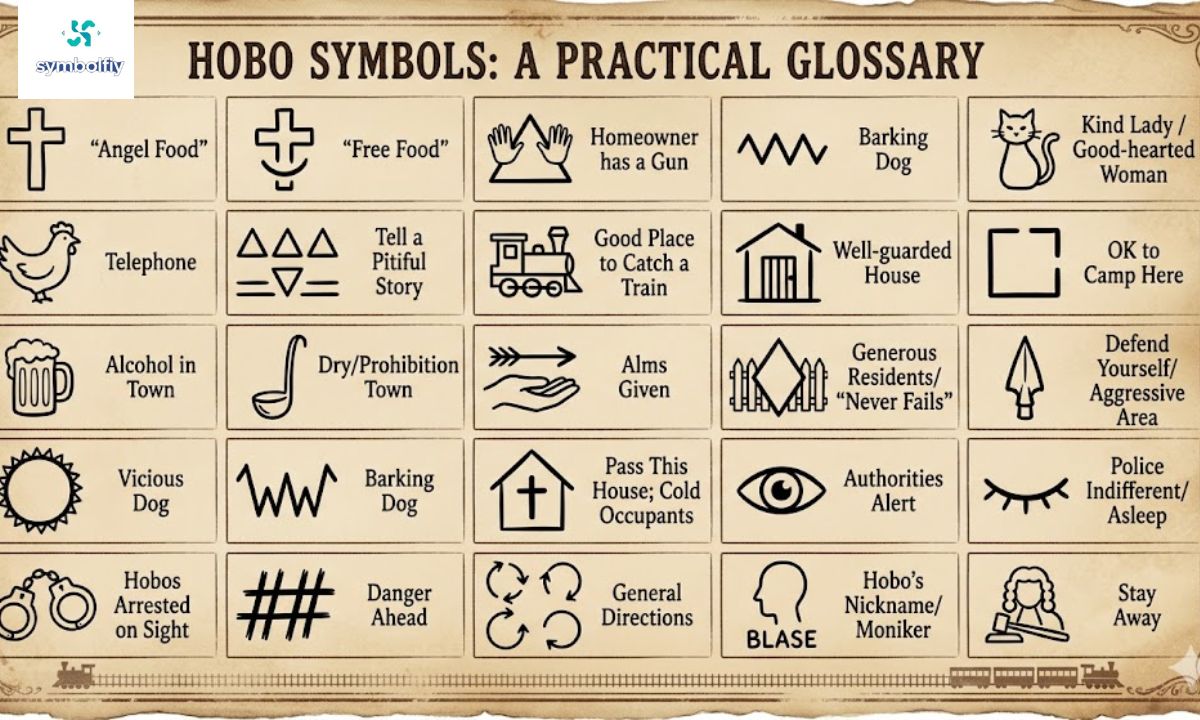
A plain cross drawn on a fence or door meant that the household would give you a meal — but you had to sit through a religious talk first. Hobos called this “angel food.” It was worth it to many. This symbol appears in sources as early as the 1890s and is one of the most frequently cited hobo signs.
A diamond drawn on a fence meant the people inside were reliably generous. “Never fails” was the phrase travelers used for it. If you saw this mark, you knew you could knock on that door and receive help. Documented in the Evening Star newspaper as early as 1894.
🖐️ Open Hand With Arrows (Alms Given Here)
An open hand with small arrows around it marked a home where charity was given freely — no conditions, no sermon required. One of the simpler and more direct food symbols in the hobo code. Referenced in the New York Tribune in 1912.
🍺 Open Mug (Alcohol Available in Town)
An open cup or mug drawn near town entry points told travelers that alcohol was available locally. This was useful information during and after Prohibition, when dry towns were common. Documented in multiple early 20th-century railroad culture records.
🥄 Upside-Down Ladle (Dry Town — No Alcohol)
A ladle drawn upside down was the opposite signal. It meant the town was dry — either by law or local custom. Hobos used this to plan their stops and avoid wasting time in places that did not meet their needs.
⛪ Circle With Cross (Good Food Available Nearby)
A circle with a small cross inside or attached to it indicated that good food was close by, often near a church or mission hall. Churches and missions were major sources of free meals for traveling workers across the country.
Danger and Warning Symbols ⚠️
Danger symbols were arguably the most critical part of the hobo code. A wrong turn could mean arrest, a dog attack, or worse. These marks gave travelers a fighting chance.
🔺 Triangle With Raised Hands (Armed Man Lives Here)
A triangle with two small lines rising from the top — representing raised hands — warned that the man of the house was armed and dangerous. Travelers were meant to keep moving and not knock on that door. Interpreted by NSA cryptologic historians as one of the clearest danger signs in the code.
🗡️ Spearhead (Defend Yourself — Hostile Area)
A spear or arrowhead shape warned that the area was aggressive or hostile to travelers. It did not specify a particular threat — it was a general alarm to stay alert. Dan Beard documented this symbol in his 1918 book on American signs and signals.
🐕 Circle With Jagged Teeth (Vicious Dog)
A circle with small jagged lines around its edge — like teeth — warned about a vicious dog on the property. This was one of the most practical symbols in the code. Getting bitten meant injury, infection, and no medical care. Referenced in an 1911 edition of The Caucasian newspaper.
〰️ Two Connected W Shapes (Barking Dog)
Two W shapes joined together indicated a barking dog — less dangerous than the jagged circle but still a warning. A barking dog could alert the household and get a traveler chased off the property or reported to police. Documented by hobo code researcher Stan Richards.
✖️ Cross on a House (Cold Occupants — Move On)
A cross drawn directly on or beside a house symbol meant the people inside were cold and unfriendly. Not dangerous, but not helpful either. Knocking was a waste of time. This symbol appeared in the Evening Star as early as 1894.
🔫 Line With Dot at End (Guns in This House)
A straight line with a dot or circle at one end represented a gun barrel. It was a direct, unmistakable warning: firearms are on the premises. Keep walking.
Police and Law Enforcement Symbols 👮
Knowing where the law was active — and where it was not — was essential for travelers who were often treated as criminals simply for being homeless and on the move.
👁️ Open Eye (Police Are Alert Here)
An open eye drawn on a wall or post meant local police were active and watching. Travelers needed to be careful about where they slept, what they said, and how long they stayed. One of the most consistently used police symbols in the code.
😴 Closed Eye (Police Are Indifferent)
The opposite of the open eye. A closed eye meant local law enforcement was relaxed, indifferent, or could be easily avoided. Travelers could move more freely through these areas.
⛓️ Handcuffs Shape (Hobos Arrested on Sight)
A simple drawing of linked loops or cuffs was one of the most serious warnings in the code. It meant that travelers were being arrested on sight in this area — no questions asked. Anyone who ignored this mark risked going directly to jail.
🏛️ Column Shape (Beware of the Magistrate / Judge)
A column or pillar shape indicated that a judge or magistrate in the area was harsh toward travelers. It was a warning to avoid any situation that might land you in front of local courts.
Safe Camp and Lodging Symbols 🏕️
Finding safe shelter was a nightly challenge. These symbols helped travelers locate places to sleep without fear of arrest, violence, or exposure.
□ Incomplete Square (Safe to Camp Here)
An open or incomplete square — three sides without the fourth — was one of the most welcome signs a traveler could find. It meant the area was safe for camping or sleeping overnight. Simple, clean, and direct.
🌾 Hay Symbol (Sleep in Barn Permitted)
Various hay-related drawings — wheat shapes, simple straw marks — indicated that a nearby barn was available for sleeping. Barns offered shelter from weather and were safer than sleeping in the open. Multiple variations of this symbol existed in different regions.
🏠 House With Curved Line (Kindhearted Woman Lives Here)
A simple house shape with a curved line beneath it — suggesting a smile or a welcoming gesture — meant a kind woman lived there who was known to help travelers. This was a highly valued mark. It meant food, perhaps a place to rest, and safe interaction.
✅ Circle With a Dot (Good Water Available)
A circle with a dot in the center marked a location with clean, accessible water. Fresh drinking water was not guaranteed in rural areas. Finding this symbol could be life-saving for someone who had been walking all day in summer heat.
Town and Community Assessment Symbols 🏘️
These signs helped travelers size up an entire town before investing time there. One well-placed symbol could save hours of wasted effort.
⬛ Solid Square (Town Is Not Safe)
A completely filled-in square indicated that the town as a whole was unsafe for travelers. Police were active, residents were hostile, or conditions were bad. Move through quickly and do not linger.
☰ Three Horizontal Lines (Everything Is Okay Here)
Three stacked horizontal lines — sometimes called the “OK here” symbol — told travelers the area was generally safe and welcoming. It was a green light to slow down, look around, and ask for help.
🔔 Bell Shape (Church Nearby — Help Available)
A simple bell drawing pointed travelers toward a nearby church, mission, or charitable organization. Religious institutions were often the primary source of free meals, temporary shelter, and medical help for homeless workers in the early 1900s.
↗️ Arrow Shape (Go This Direction)
Directional arrows were among the simplest and most universally understood symbols in the entire code. They pointed toward food, safe camps, water, or away from danger. Sometimes they combined with other symbols for more specific guidance.
Jail and Legal Condition Symbols 🔒
If a traveler ended up arrested, the conditions inside the local jail varied wildly. Knowing what to expect in advance helped people make better decisions about the risks they were willing to take.
🟦 Rectangle With Bars (Clean Jail)
A simple rectangular box with lines across it indicated that the local jail, while not good, was at least clean. Some travelers were so exhausted that a short jail stint in a clean facility was preferable to a freezing night outside.
🐛 Rectangle With Wavy Lines (Vermin-Infested Jail)
Wavy lines inside a box shape warned that the jail was infested with bugs and vermin. A serious warning for anyone weighing their options. Disease and vermin were real threats in early 20th-century jails.
💀 Rectangle With X (Prisoners Go Hungry Here)
An X inside the jail rectangle meant prisoners received little or no food. This was the worst jail symbol in the code. Avoid arrest at all costs in towns marked with this sign.
Personal and Social Symbols 🤝
Not all symbols were about food or danger. Some gave travelers social information — who to talk to, who to avoid, and how people in the area felt about outsiders.
👴 Stick Figure With Hat (Gentleman — Will Help You)
A stick figure with a top hat or rounded hat indicated a gentleman in the area who was known to assist travelers with money, food, or directions. This figure was trusted and approachable.
🙅 Figure With Arms Out (Dishonest Person — Do Not Trust)
A figure with arms spread wide was a warning about a specific person in the area known for being dishonest or deceptive. Travelers were warned not to ask for help, make deals, or take advice from this individual.
💊 Small Circle (Doctor Nearby)
A small circle, sometimes with a cross, marked the location of a doctor who was known to treat travelers, sometimes for free. Medical care for homeless workers was almost nonexistent, so this was an enormously valuable sign.
🔢 Numbers on Fence Posts (Distance or House Numbers)
Travelers sometimes used numbers combined with other symbols to indicate how many houses down the street a particular resource could be found — food at the third house, water at the fifth, and so on.
Cultures and Traditions That Used Similar Symbols
Hobo symbols were not the first time in history that people created secret visual languages for survival and communication. Many cultures have done the same throughout time.
Ancient Egypt — Egyptian hieroglyphs began as practical symbols for recording goods, directions, and warnings. Like hobo marks, they were a language that only the informed could read.
Medieval guilds — European craft guilds used secret symbols and marks on buildings to communicate trade, skill levels, and professional identity to fellow members.
Native American traditions — Many tribes used pictographic symbols on trails and rocks to communicate direction, danger, water sources, and territorial boundaries — almost identical in purpose to hobo marks.
Celtic traditions — Celtic ogham script was carved into stones and trees as a hidden language, used in part for travel and sacred communication away from outside eyes.
Freemasonry — Secret fraternal organizations like the Freemasons developed elaborate symbol systems for member identification and coded communication, rooted in the same human need for in-group language.
Military and intelligence history — Spy networks and wartime resistance movements have always relied on chalk marks, symbols on doors, and coded drawings — the same techniques the hobo community independently developed out of necessity.
Why These Symbols Still Matter Today
Hobo symbols fascinate people today not because they are mysterious, but because they are human. They represent a community of people who had almost nothing, yet still took the time to protect strangers they would never meet.
That instinct — to warn, to help, to share knowledge — is one of the best things people do. These symbols are a record of that instinct surviving under extreme hardship.
In modern culture, hobo symbols appear in tattoos, street art, graphic design, and history books. Artists and designers use them as inspiration for visual communication systems.
Historians study them as one of the earliest examples of a grassroots coded language in American history. And anyone who learns what these marks mean walks away with a new appreciation for the quiet, careful intelligence of the people who created them.
Frequently Asked Questions
What are hobo symbols used for?
They were chalk or coal marks left on walls and fences to warn travelers about danger, food, police, and safe shelter.
Are hobo symbols real or just a myth?
They are real — primary sources from 1879 to 1922 verify dozens of them — but many internet lists contain unverified symbols.
When did people use hobo symbols?
Mainly from the 1890s through the early 1930s, peaking between 1906 and 1911 when up to 700,000 hobos traveled the U.S.
What is the difference between a hobo, a tramp, and a bum?
A hobo traveled and worked; a tramp traveled but worked only when forced; a bum neither traveled for work nor worked at all.
Why did hobo symbols disappear?
Police learned to read them, railroad culture changed, and the code gradually evolved into modern graffiti traditions on freight trains.
Conclusion
Hobo symbols are one of the most quietly remarkable communication systems in American history. They were created not by governments or scholars, but by ordinary people trying to survive and look out for one another.
Every chalk mark on a fence post was an act of community — a message from one stranger to the next.
Understanding these symbols today means understanding something true and lasting about human generosity, resilience, and the enduring need to communicate across distance and time.