Humans have always needed more than medicine to heal. We reach for meaning. We look for signs. Across thousands of years and every culture on earth, people have used symbols to represent hope, restoration, and the will to recover.
Healing symbols are not just pretty designs. They carry emotional weight, spiritual depth, and centuries of human longing for balance and renewal. Whether you wear them, meditate on them, or simply keep them close, these symbols connect you to something much bigger than yourself.
Healing symbols represent the idea that recovery is more than physical. They speak to the mind, the spirit, and the emotions all at once.
Across history, these symbols have been used to mark sacred spaces, guide practitioners, and remind ordinary people that restoration is always possible. They are visual anchors in a world that can feel overwhelming.
On a deeper level, healing symbols carry the collective belief of generations. When a symbol has been used for thousands of years to represent protection, balance, or renewal, that meaning builds over time.
Even today, seeing a lotus flower or a Reiki symbol can bring a real sense of calm. That is not a coincidence. It is what these symbols were designed to do.
25+ Healing Symbols and Their Meanings
Reiki Healing Symbols
Reiki is a Japanese energy healing practice that uses specific symbols to focus and direct healing energy. Each symbol carries its own vibration and purpose. Reiki practitioners draw or visualize these symbols during sessions to promote physical, emotional, and spiritual well-being.
⚡ Cho Ku Rei — The Power Symbol
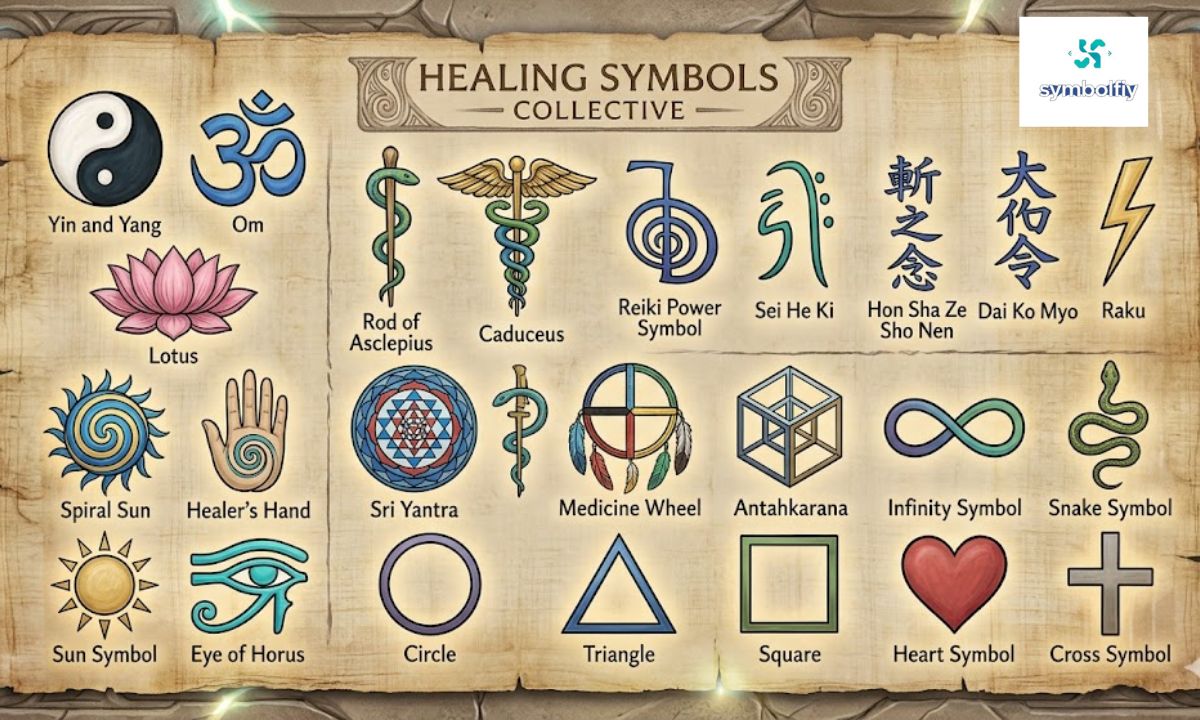
Cho Ku Rei looks like a horizontal line bending into a vertical line, which then coils into a spiral. It is the first symbol most Reiki students learn. This symbol is used to call in energy, amplify healing, and help clear energetic blockages in the body.
It is often placed over an area of pain or discomfort to focus healing where it is most needed. In modern practice, many people draw it on paper or visualize it during meditation for a sense of grounded energy and renewed focus.
🌊 Sei He Ki — The Mental and Emotional Symbol
Sei He Ki connects two worlds: the conscious mind and the subconscious. Its flowing shape is said to represent the coming together of two forces. Reiki practitioners use this symbol to calm emotional pain, release negative thought patterns, and restore mental clarity.
It is especially popular for use during emotional healing sessions, grief work, and anxiety relief. Many people find that focusing on this symbol during meditation helps quiet the inner noise and bring a sense of emotional steadiness.
🌐 Hon Sha Ze Sho Nen — The Distance Healing Symbol
This symbol is often translated as “no past, no present, no future.” It is used to send healing energy across physical distance, across time, or even to past wounds that have not fully healed.
Reiki practitioners use it when working with someone who is not physically present, or when trying to heal old emotional trauma.
The idea is that energy is not limited by space or time, and this symbol acts as the bridge. It is one of the most meaningful and widely used symbols in Reiki practice today.
✨ Dai Ko Myo — The Master Symbol
Dai Ko Myo means “great shining light.” It is the most powerful symbol in traditional Reiki and is usually taught only at the Master level. It represents enlightenment, divine love, and the highest form of healing energy.
This symbol works on the soul level rather than just the physical or emotional. Practitioners use it to connect with their deepest spiritual self and to help others do the same. It is a symbol of transformation and inner knowing.
🔥 Raku — The Grounding Symbol
Raku looks like a lightning bolt. It is used at the very end of a Reiki attunement or healing session to seal the energy and bring the person gently back to the present moment.
It is sometimes called the “fire serpent” because it is thought to pull energy downward through the body and into the earth.
Grounding is an important final step in any energy healing session, and the Raku symbol represents that closing, that sense of being settled and safe in your own body again.
Ancient and Universal Healing Symbols
These symbols come from cultures around the world and have been used for hundreds or thousands of years. Many are still widely recognized today.
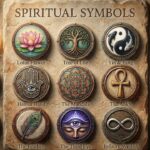
☯️ Yin Yang — The Symbol of Balance
The Yin Yang is one of the most recognized symbols on earth. It comes from ancient Chinese philosophy and shows two halves of a circle, one dark and one light, each containing a small piece of the other. It represents the idea that opposite forces are not enemies but partners.
Darkness and light, rest and action, feminine and masculine energy all need each other to create wholeness. In healing traditions, the Yin Yang is used as a reminder that balance is the foundation of good health, inside and out.
🕉️ Om (Aum) — The Sacred Sound Symbol
Om is one of the oldest sacred symbols in the world, rooted in Vedic texts from over 5,000 years ago. It is considered a sacred sound and symbol in Hinduism, Buddhism, and yoga traditions. Many believe it represents the sound of the universe itself, the vibration that underlies all of creation.
The symbol is made of three curves, a semicircle, and a dot. Meditating on the Om sound or symbol is said to calm the nervous system, deepen awareness, and bring a profound sense of inner peace. It is a cornerstone of healing meditation.
🌸 Lotus Flower — The Symbol of Rebirth
The lotus grows in muddy water but blooms into something beautiful and clean. That journey, from darkness to light, from struggle to bloom, is exactly what this symbol represents.
The lotus is central to Buddhist and Hindu traditions and is one of the most widely used healing symbols in the world.
It speaks to resilience, purity, and the possibility of transformation no matter how difficult life has been. Many people choose the lotus as a healing tattoo for this very reason: it reminds them that they, too, can rise from hard circumstances.
☀️ Spiral Sun — The Symbol of the First Healer
The Spiral Sun appears in cultures all around the world, from the Anasazi people of the American Southwest to Ghanaian tradition, where it is called Owia Kokroko.
Native American peoples often called it “the First Healer,” believing strongly in the sun’s power to restore health and vitality.
The spiral within the sun represents the cycles of life, growth, and renewal. This symbol connects light with healing and reminds us that warmth, energy, and natural cycles are at the heart of physical and spiritual recovery.
🖐️ Healer’s Hand (Shaman’s Hand) — The Symbol of Sacred Touch
The Healer’s Hand shows an open palm with a spiral at its center. The earliest known images of this symbol were found in Native American rock carvings and hieroglyphics. It represents the power of healing touch, the idea that a skilled and caring hand can bring relief and restoration.
In Reiki practice, the Healer’s Hand is also used as a symbol of protection and the channeling of healing energy through the practitioner. It is deeply connected to the belief that human contact, guided by intention, can carry real healing power.
🐍 Rod of Asclepius — The Symbol of Medicine
This is one of the most widely used healing symbols in the modern world. The Rod of Asclepius shows a single snake coiled around a simple staff. It comes from Greek mythology, where Asclepius was the god of medicine and healing.
The snake in this symbol represents renewal and regeneration, because snakes shed their skin and are reborn. The staff represents healing authority and knowledge.
Today this symbol is used by medical organizations, hospitals, and health institutions worldwide as a mark of the healing profession.
⚕️ Caduceus — The Symbol of Balance and Energy
The Caduceus looks similar to the Rod of Asclepius but features two snakes winding around a winged staff. It is connected to Hermes, the messenger god of Greek mythology, and also to Mercury in Roman tradition.
In spiritual practice, the two snakes represent the balance of masculine and feminine energy, or the Kundalini energy that rises through the body.
The wings represent swiftness and elevation. While it is sometimes confused with the medical symbol, the Caduceus carries its own distinct spiritual meaning around harmony, duality, and life force energy.
🌳 Tree of Life — The Symbol of Interconnection
The Tree of Life appears in almost every major world tradition. In Norse mythology it is Yggdrasil. In Celtic culture it is the Sacred Oak. And In Christianity it grows in the Garden of Eden. In ancient Egypt it was used in creation stories.
This symbol shows a tree with roots reaching deep into the earth and branches stretching toward the sky. It represents the connection between all living things and the cycle of birth, growth, death, and renewal. As a healing symbol, it reminds people that they are part of something vast and enduring.
🌼 Flower of Life — The Symbol of Sacred Geometry
The Flower of Life is a geometric pattern made of 19 overlapping circles arranged in a flower shape. It has been found carved into ancient temples in Egypt, India, China, and across the Middle East.
Many believe it holds the blueprint of creation itself, showing the patterns through which life forms and repeats. In healing and meditation practice, the Flower of Life is used to promote balance and wholeness across the body, mind, and spirit. It is one of the most striking and mathematically precise symbols in the world.
🔵 Sri Yantra — The Symbol of Divine Energy
The Sri Yantra is a sacred symbol from ancient Vedic tradition. It is made up of nine interlocking triangles surrounded by two rings of lotus petals. It is considered one of the most powerful symbols in Hindu spirituality.
Practitioners believe it holds the energy of the entire universe in one image. Meditating on the Sri Yantra is said to quiet the mind, open blocked energy channels, and connect the practitioner with higher states of consciousness. It is used widely in yoga, chakra healing, and spiritual growth practices.
🖐️✨ Hamsa — The Symbol of Protection
The Hamsa is a hand-shaped symbol with an eye at its center. The word “hamsa” comes from Arabic and means “five,” referring to the five fingers of the hand. In Jewish tradition it is called the Hand of Miriam and represents wisdom and strength.
In Muslim tradition it is the Hand of Fatima and stands for patience and love. Across Middle Eastern, North African, and South Asian cultures, the Hamsa is worn and displayed as a protection against the evil eye and negative energy. Today it is one of the most popular healing symbols in jewelry and home decor worldwide.
🔱 Ankh — The Symbol of Eternal Life
The Ankh is one of the oldest symbols in recorded human history, originating in ancient Egypt over 5,000 years ago. It looks like a cross with a loop at the top. The cross represents the physical world, and the loop represents eternity.
Ancient Egyptians used the Ankh in art, ceremony, and burial rites as a symbol of life, immortality, and the continuity of the soul beyond physical death. Today it is used as a healing and spiritual symbol by people drawn to Egyptian tradition, and it is a popular design in tattoos and sacred jewelry.
♾️ Infinity Symbol — The Symbol of Endless Renewal
The infinity symbol is a simple figure-eight lying on its side. Its mathematical roots go back to the 17th century, but the concept of infinite cycles is far older, appearing in ancient Indian, Greek, and Celtic traditions.
As a healing symbol, the infinity sign represents the idea that healing is not a destination but a continuous journey. There is always more growth, more restoration, more possibility.
Many people use this symbol during times of grief or illness as a reminder that life continues and that recovery has no fixed endpoint.
🌀 Spiral — The Symbol of Growth and Life Cycles
The spiral is one of the most ancient symbols found in human history, appearing in cave art, ancient temples, and rock carvings across the world. It represents the cycles of nature: the seasons, the growth of a plant, the turning of galaxies.
As a healing symbol, the spiral is used to represent personal growth, the expansion of the self, and the idea that healing moves in cycles rather than straight lines. Celtic traditions used spirals extensively to mark sacred spaces and transitions between life stages.
☸️ Dharma Wheel (Dharmachakra) — The Symbol of the Path
The Dharma Wheel is one of the oldest symbols of Buddhism, and it actually predates Buddhism itself, with origins as far back as 2500 BCE. Its eight spokes represent the Eightfold Path: right understanding, intention, speech, action, livelihood, effort, mindfulness, and concentration.
The circular shape represents the continuous cycle of life and the endless journey toward enlightenment. As a healing symbol, the Dharma Wheel reminds practitioners that the path to wellness and peace is a daily practice, not a single moment of arrival.
🪢 Eternal Knot — The Symbol of Interconnectedness
The Eternal Knot is a symbol used in Buddhist, Celtic, and Chinese traditions. It is made of interlocking lines with no visible beginning or end. This endless pattern represents the idea that all things in life are connected.
In Buddhism, it symbolizes the interdependence of all beings and the way that wisdom and compassion are always woven together. As a healing symbol, the Eternal Knot reminds people that their suffering and their recovery both connect to something larger than themselves.
✡️ Star of David — The Symbol of Elevation and Grounding
While the Star of David is most recognized as a Jewish religious symbol, it also carries a wider spiritual meaning in healing traditions. Made of two overlapping triangles, one pointing up and one pointing down, it represents the balance between heaven and earth, between the spiritual and the physical.
In some healing traditions, the upward triangle represents the rise of consciousness and the aspiration toward healing, while the downward triangle represents staying grounded and rooted in the present moment.
🌱 Seed of Life — The Symbol of Creation and New Beginnings
The Seed of Life is a sacred geometry symbol made of six circles arranged around a central seventh, all the same size and evenly overlapping. It appears in ancient art and architecture across many cultures.
It is considered a blueprint of creation, representing the very first stages of life and form. As a healing symbol, the Seed of Life speaks to new beginnings, fresh starts, and the creative power that exists within every person to build something new after a period of loss or difficulty.
🪷 Unalome — The Symbol of the Journey
The Unalome is a beautiful symbol used in Buddhist and Hindu traditions. It starts with a spiral at the base, winds up through a series of loops and curves, and then rises into a straight line. The spiral represents the confused, searching beginning of a spiritual journey.
The loops represent the detours, challenges, and lessons that come along the way. The straight line at the top represents clarity, peace, and alignment. As a healing symbol, the Unalome is deeply loved because it validates the messiness of recovery and growth.
🧿 Evil Eye (Nazar) — The Symbol of Protective Awareness
The Evil Eye, or Nazar, is a blue glass amulet used widely in Turkish, Greek, and Middle Eastern cultures to ward off harm and negative energy. It is one of the oldest protective symbols in the world, with roots in ancient Mesopotamia and Egypt.
The symbol is based on the belief that certain looks carry negative energy, and that this amulet can reflect that energy away. Today the Evil Eye is one of the most globally recognized healing and protection symbols, appearing in jewelry, art, and home decor in many countries.
🔵 Mandala — The Symbol of Wholeness
Mandalas are circular geometric designs that represent the universe, the self, and the path through life. The word “mandala” comes from Sanskrit and means “circle.” Mandalas are used in Hindu and Buddhist traditions as meditation tools and sacred art.
Carl Jung, the famous psychologist, also used mandala drawing as a therapeutic tool, noting that people naturally create circular patterns when working through inner healing. Today, mandala coloring and creation is widely used as a mindfulness and stress-relief practice.
🔺 Sacred Geometry — The Symbol of Universal Pattern
Sacred geometry refers to the use of specific shapes, like circles, triangles, spirals, and hexagons, to represent deeper truths about the universe. The circle represents wholeness. The triangle represents balance and direction. The square represents stability and grounding.
These shapes appear in ancient temples, churches, mosques, and healing spaces around the world. In spiritual practice, sacred geometry is used in meditation, energy healing, and the design of healing environments to create a sense of order, harmony, and connection.
🌟 Eye of Horus — The Symbol of Protection and Health
The Eye of Horus comes from ancient Egypt and is one of the most powerful protection symbols in recorded history. It was associated with the god Horus, and was used to protect the pharaoh, the living, and the dead.
It was placed on tombs, amulets, and healing objects throughout ancient Egyptian civilization. The symbol is said to represent health, restoration, and the watchful protection of a higher power. Today it is widely used in spiritual jewelry and tattoo art as a symbol of protection and healing vision.
🔯 Triquetra — The Symbol of Mind, Body, and Spirit
The Triquetra is a Celtic symbol made of three interlocked arcs, forming a continuous, unbroken line. It has been used in Celtic and early Christian art to represent the holy trinity, as well as the connection between mind, body, and spirit.
As a healing symbol, the Triquetra is especially meaningful for those on a holistic healing journey, because it visually shows that physical, mental, and spiritual health are not separate. They are one continuous, interwoven experience.
Ancient Cultures That Used These Healing Symbols
Healing symbols did not appear from nowhere. They grew out of real human need and the wisdom of civilizations that came long before us.
Ancient Egypt: Egyptians used the Ankh, the Eye of Horus, and hieroglyphic symbols for healing, protection, and the passage of the soul. These symbols were placed in tombs, on amulets, and in temple art across thousands of years of civilization.
Greek mythology: The Rod of Asclepius and the Caduceus both come from Greek tradition. Greek physicians and healers used symbol and ritual together, believing that physical and spiritual care were inseparable.
Celtic traditions: Celts used spirals, the triquetra, and knotwork as healing and sacred markers. These symbols were carved into sacred stones and used in ceremony to mark important transitions in life.
Buddhism: Buddhist culture gave the world the Lotus, the Dharma Wheel, the Unalome, and the Eternal Knot. All of these speak to healing as a path, a continuous practice of awareness and compassion.
Hinduism and Vedic tradition: Om and the Sri Yantra come from the oldest spiritual texts in human history. Both are still widely used today in yoga, meditation, and Ayurvedic healing practice.
Native American traditions: The Healer’s Hand, the Spiral Sun, and various nature-based symbols show how deeply healing was connected to the earth, the sun, and the natural world in Indigenous American cultures.
Middle Eastern and Mediterranean cultures: The Hamsa and the Evil Eye both originate in these regions and have spread worldwide as symbols of protection and healing. They are among the most universally recognized spiritual symbols alive today.
Why Healing Symbols Still Matter Today
In a world full of modern medicine and scientific tools, it might seem odd that ancient symbols still carry so much weight. But people are not just bodies. We are also minds, spirits, and emotional beings who need meaning alongside medicine.
Healing symbols give people something to hold onto when recovery feels uncertain or slow. They are visual reminders that restoration is possible, that others have walked this path before, and that we are not alone in our struggle.
Today, healing symbols appear in tattoos, meditation jewelry, home altars, yoga studios, and art therapy sessions. People choose them carefully, often after periods of loss, illness, grief, or personal struggle.
When someone gets a lotus tattoo after a hard year, or hangs a Hamsa in their home after a move, they are participating in a tradition that is as old as human civilization. These symbols are not just decoration. They are declarations of hope.
Frequently Asked Questions
What is the most popular healing symbol?
The Lotus flower is widely considered the most universally recognized symbol of healing and spiritual rebirth.
Are Reiki symbols spiritual or religious?
Reiki symbols are spiritual tools used in energy healing practice and are not tied to a single religion.
Can I wear a healing symbol if it comes from another culture?
Many people do, but it is worth learning the symbol’s meaning and treating it with the respect it deserves.
What healing symbol is best for emotional pain?
The Sei He Ki Reiki symbol and the Unalome are both widely used for emotional healing and inner peace.
Do healing symbols actually work?
They are not medically proven treatments, but many people find real comfort, focus, and emotional strength through their use in meditation and spiritual practice.
Conclusion
Healing symbols are one of the most enduring gifts that human history has left us. From the lotus rising out of muddy water to the Reiki master symbol glowing with inner light, each of these images carries a promise: that healing is possible, that balance can be restored, and that the human spirit is resilient.
You do not need to believe in every tradition behind these symbols to feel their power. You just need to know what they represent and let that meaning do its quiet, steady work.