Long before written history, people used symbols to connect with the world around them. Germanic tribes carved marks into stone, wood, and bone to honor their gods, protect their homes, and make sense of life and death. These ancient symbols carried deep spiritual power.
Many of them still speak to people today — through tattoos, jewelry, art, and personal belief. Understanding them means stepping into a world that valued courage, fate, and the sacred forces of nature.
Germanic symbols are rooted in a worldview where gods, humans, and nature were all connected. Every mark had a purpose — to seek protection, call on divine power, mark important life events, or understand one’s place in the cosmos. They were not just decorations. They were living tools of belief.
On a deeper level, these symbols reflect timeless human values: strength in the face of hardship, loyalty to family and tribe, the mystery of death and rebirth, and the search for meaning in a vast and unpredictable world. That is why so many of them still resonate with people today.
Core Germanic Mythology Symbols
These are the most sacred and widely recognized symbols tied directly to Germanic and Norse mythology. Each one carries layers of myth, spiritual meaning, and historical use.
ᚢ Valknut ᛉ
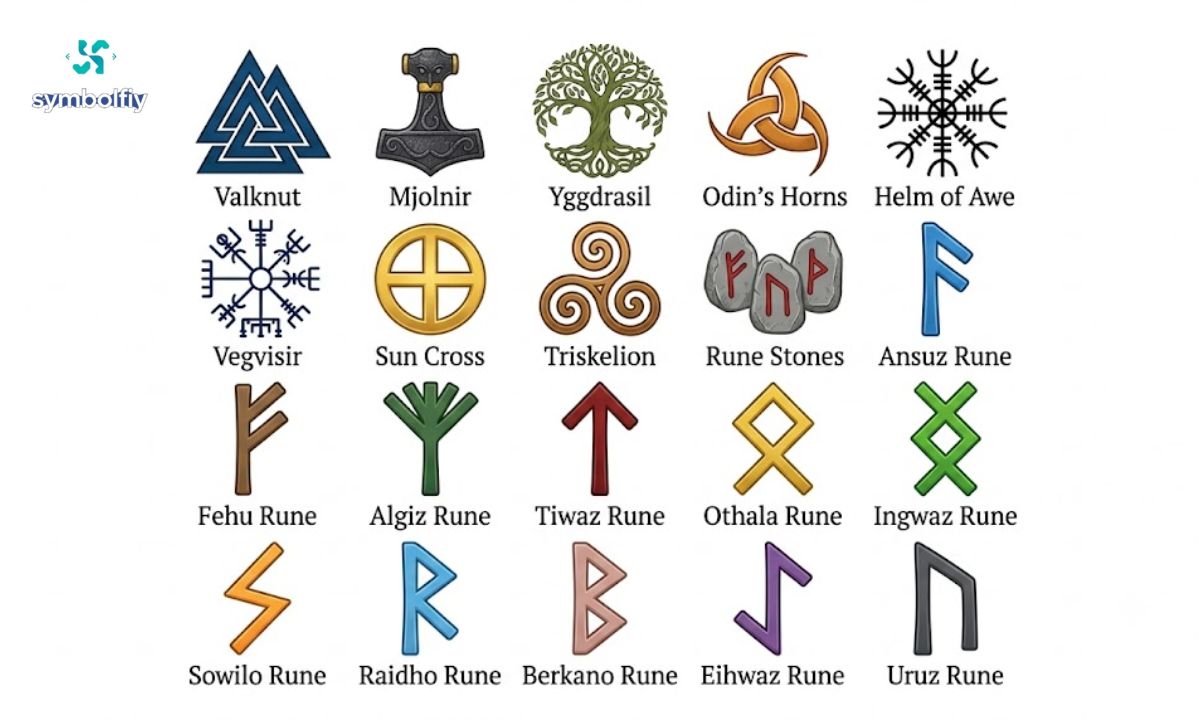
The Valknut is three interlocked triangles. It appears on ancient runestones and is closely tied to Odin, the chief god of Germanic religion. It is thought to mark the passage between life and death.
And it symbolizes the slain in battle, fate, and Odin’s power over death. Some call it the “knot of the slain.” Today it is used as a symbol of spiritual transition and honoring those who have passed.
🔨 Mjolnir (Thor’s Hammer)
Mjolnir is the hammer of Thor, the god of thunder and protection. It was one of the most popular protective amulets in the Norse and Germanic world. Archaeological digs across Northern Europe have found thousands of Mjolnir pendants.
It symbolizes strength, protection, and the power to fight chaos. Vikings wore it as a talisman to guard against evil. Today it remains one of the most worn symbols in Norse and Germanic-inspired spirituality.
🌳 Yggdrasil (The World Tree)
Yggdrasil is the great ash tree that holds the nine worlds of Germanic cosmology together. Its roots reach into the underworld, its trunk spans the middle world, and its branches touch the heavens.
It symbolizes the connection between all living things, the flow of fate, and cosmic balance. Yggdrasil teaches that everything is linked. It is a powerful symbol of life cycles and universal order.
ᚨ Elder Futhark Runes (Set of 24)
The Elder Futhark is the oldest runic alphabet, used by Germanic peoples from roughly 150 to 800 CE. Each of its 24 runes is both a letter and a symbol with its own meaning.
Runes were used for writing, divination, protection spells, and marking weapons and graves. They are among the most powerful and versatile symbols in the Germanic tradition.
☀️ Sun Cross / Sun Wheel
The Sun Cross is a circle with a cross inside it. It is one of the oldest symbols found in Germanic and Northern European culture, appearing on rock carvings thousands of years old.
It represents the sun, cosmic order, the four seasons, and the cycle of life. As a solar symbol, it was tied to life force, harvest, and divine light. Many people still use it to represent spiritual wholeness.
🐍 Ouroboros
The Ouroboros is a snake eating its own tail, forming a circle. In Germanic and Norse myth, it connects to Jormungandr, the great world serpent who encircles the earth.
It symbolizes eternity, cyclical time, and the endless nature of existence. Life feeds on itself and begins again. It is one of the oldest symbols of infinity known to humankind.
ᛟ Othala Rune
The Othala rune looks like a diamond with two legs. It is the final rune of the Elder Futhark and means “inheritance,” “ancestral home,” and “heritage.”
It’s represents family, land, and the wisdom passed down through generations. It was deeply tied to the Germanic idea of one’s people and homeland. Today it carries complex meanings and must be understood in its full historical context.
ᚠ Fehu Rune
Fehu is the first rune of the Elder Futhark. Its shape looks like the letter F with upward-angled branches. It means “cattle” or “wealth.”
In ancient Germanic society, cattle meant survival and prosperity. Fehu symbolizes abundance, new beginnings, and earned success. It was invoked to bring good fortune and material blessings.
ᚢ Uruz Rune
Uruz is shaped like an upside-down U and represents the wild aurochs — a massive, now-extinct ox. It was the symbol of raw, untamed strength.
It stands for physical power, health, endurance, and primal energy. Warriors called on Uruz to give them the strength and courage of the wild bull. Today it is used in runic practice for vitality and willpower.
ᚦ Thurisaz Rune
Thurisaz looks like a thorn and is tied to Thor and the Thursi — the giants of chaos in Germanic myth. It is a double-edged symbol.
It represents both the power to destroy and the power to protect. As Thor used his hammer to drive back chaos, Thurisaz is invoked for protection from evil and as a symbol of reactive force.
ᚨ Ansuz Rune
Ansuz is the rune of the Aesir gods, especially Odin. Its shape resembles an F with downward branches. It means “mouth,” “breath,” and “divine communication.”
It symbolizes wisdom, speech, poetry, and divine inspiration. Odin was the god of words and runes. Ansuz is the symbol of his gift — the ability to communicate truth and carry wisdom through language.
ᚱ Raidho Rune
Raidho looks like the letter R and means “ride” or “journey.” It was used by travelers and warriors before setting out on long roads.
It represents purposeful movement, the journey of life, and the right path. Raidho reminds us that how we travel matters as much as where we go. It is a symbol of direction, ritual, and cosmic order in motion.
ᚲ Kenaz Rune
Kenaz looks like a sideways angle and means “torch” or “beacon.” It is the rune of fire, light, and creative knowledge.
It symbolizes craft, skill, illumination, and the fire of creation. Kenaz was associated with the forge and the hearth. It is the light that drives away darkness — both physical and spiritual.
ᚷ Gebo Rune
Gebo is shaped like an X and means “gift.” In Germanic culture, the exchange of gifts was sacred and built the bonds between people and between mortals and gods.
It symbolizes generosity, balance, and sacred exchange. No gift is free — every giving creates a bond. Gebo is the rune of relationships, partnerships, and the sacred law of reciprocity.
ᚹ Wunjo Rune
Wunjo looks like a flag on a pole and means “joy” or “bliss.” It is one of the most positive runes in the Elder Futhark.
It represents happiness, harmony, and the feeling of belonging to a community. Wunjo was the joy that came from being with your people — safe, celebrated, and at peace. It is still used in runic practice to invite happiness and inner peace.
ᚺ Hagalaz Rune
Hagalaz looks like the letter H and means “hail.” Hailstorms were feared in ancient Germanic cultures because they could destroy entire harvests.
It symbolizes sudden disruption, natural forces, and the clearing that comes after destruction. Like a hailstorm, Hagalaz breaks things down so new growth can follow. It is the rune of transformation through crisis.
ᚾ Nauthiz Rune
Nauthiz looks like two crossed sticks and means “need” or “necessity.” It is the rune of hardship and constraint.
It represents the lessons learned through difficulty and the inner fire that keeps us going when life is hard. Nauthiz is not a symbol of defeat — it is the symbol of resilience born from need.
ᛁ Isa Rune
Isa is a single vertical line and means “ice.” It is the rune of stillness, pause, and frozen time.
It represents concentration, the quiet before action, and the power of waiting. Ice holds everything in place. Isa teaches patience and the importance of going still when nothing else will work.
ᛃ Jera Rune
Jera looks like two mirrored angles and means “year” or “harvest.” It is the rune of the turning seasons and the reward for patient effort.
It symbolizes the natural cycle of planting and harvest, cause and effect, and the fruits of hard work. Jera is one of the most positive runes — a reminder that right effort brings reward in time.
ᛇ Eihwaz Rune
Eihwaz is connected to the yew tree, one of the most sacred trees in Germanic culture. Yew trees can live thousands of years and were planted in graveyards.
It symbolizes endurance, death and rebirth, and the axis of the world. Eihwaz connects life and death, just as the yew bridges the worlds. It is the rune of transformation and deep spiritual resilience.
ᛈ Perthro Rune
Perthro looks like a cup tipped sideways and is one of the most mysterious runes. Its meaning is debated — some link it to fate, dice cups, or the hidden workings of destiny.
It symbolizes mystery, chance, and the hidden forces of fate. What is concealed will eventually be revealed. Perthro is the rune of secrets, luck, and the unknown.
ᛉ Algiz Rune
Algiz looks like a stick figure with arms raised. It is one of the most powerful protective runes in the Elder Futhark.
It represents divine protection, connection to the higher self, and the instinct to defend what is sacred. Algiz was used to ward off evil and invite the protection of the gods. Today it is widely used in spiritual practice for shielding and awareness.
ᛊ Sowilo Rune
Sowilo looks like a lightning bolt and means “sun.” It is the rune of solar energy, success, and divine light.
It represents victory, health, life force, and the guiding light of the sun. Warriors used it to call on strength before battle. It is one of the most positive and energizing runes in the entire set.
ᛏ Tiwaz Rune
Tiwaz is shaped like an arrow pointing upward and is the rune of the god Tyr. Tyr sacrificed his hand so the wolf Fenrir could be bound, making him the god of justice and self-sacrifice.
It symbolizes honor, justice, legal victory, and the courage to do what is right even at personal cost. Tiwaz was carved on weapons and used in battle rites.
ᛒ Berkana Rune
Berkana looks like the letter B and is named after the birch tree. The birch is one of the first trees to grow after winter — a symbol of new life.
It represents birth, growth, nurturing, and new beginnings. Berkana is tied to the sacred feminine, the care of children, and the healing power of nature. It is the rune of gentle renewal.
ᛖ Ehwaz Rune
Ehwaz looks like two connected M shapes and means “horse.” In the Germanic world, the horse was a sacred animal — a companion in life and a guide in death.
It symbolizes trust, partnership, and movement toward a goal. The horse and rider must work together. Ehwaz is the rune of loyal cooperation and the bond between equals.
ᛗ Mannaz Rune
Mannaz looks like the letter M with an X shape and means “man” or “humanity.” It is the rune of human consciousness and the self within a community.
It represents the individual, self-awareness, and one’s place among others. Mannaz asks us to know ourselves honestly and to understand how we relate to those around us.
ᛚ Laguz Rune
Laguz looks like a staff with a branch and means “water” or “lake.” Water was sacred in Germanic culture — rivers, wells, and lakes were offerings sites.
It symbolizes flow, intuition, the unconscious mind, and the mysteries beneath the surface. Laguz teaches us to trust our inner knowing and to move with life rather than against it.
ᛜ Ingwaz Rune
Ingwaz is a diamond shape and is tied to the god Ing (Freyr) — a fertility god of the Vanir. It is the rune of seed energy and potential.
It represents inner strength gathering before it is released outward. Ingwaz is the rune of gestation, sacred completion, and the creative force that rests quietly before it blooms.
ᛞ Dagaz Rune
Dagaz looks like a bowtie or infinity sign and means “day” or “dawn.” It represents the moment the darkness breaks and light floods in.
It symbolizes awakening, clarity, transformation, and the threshold between night and day. Dagaz is the rune of breakthrough — when everything changes and a new phase of life begins.
🔯 Helm of Awe (Aegishjalmur)
The Aegishjalmur is a symbol of eight trident-like arms radiating from a center point. It was one of the most powerful protective symbols in Norse and Germanic culture.
It was believed to paralyze enemies and protect the warrior who wore it. The Helm of Awe represents invincibility, terror in battle, and the invisible shield of the gods. Today it is used as a symbol of inner strength and protection.
🐺 The Wolf (Ulfhednar Symbol)
Wolves were sacred in Germanic religion. Odin kept two wolves — Geri and Freki. Wolf warriors called Ulfhednar wore wolf skins and fought in a trance-like battle fury.
The wolf symbolizes ferocity, loyalty to the pack, spiritual transformation, and the wild. It walks between worlds — both feared and revered. The wolf represents the untamed spirit that can never truly be caged.
🦅 The Eagle
The eagle was the symbol of divine power and the messenger of the gods in Germanic belief. Odin’s eagle sat at the top of Yggdrasil, watching over all the worlds.
It represents wisdom, vision, sovereignty, and spiritual authority. The eagle sees what others cannot. It was used to mark leaders, kings, and warriors of high standing.
🐦⬛ Huginn and Muninn (Ravens)
Odin’s two ravens — Huginn (Thought) and Muninn (Memory) — flew across the world each day and reported everything to Odin. They are among the most spiritually layered symbols in Germanic mythology.
They represent the power of mind, memory, and spiritual intelligence. The ravens remind us that knowledge gathered and remembered shapes who we are. They are symbols of the questing mind that seeks truth everywhere.
🐉 The Dragon (Nidhogg)
Nidhogg is the great dragon who gnaws at the roots of Yggdrasil. It is one of the most complex figures in Germanic myth — a force of destruction that also maintains cosmic balance.
The dragon symbolizes chaos, hidden power, the forces that work beneath the surface, and the inevitability of decay. It reminds us that destruction and creation are part of the same cycle.
⚡ Thor’s Lightning
Beyond Mjolnir, Thor himself was the god of storms, thunder, and lightning. Lightning was his direct mark — the visible sign of divine power striking the earth.
Lightning symbolizes sudden truth, divine intervention, and the raw power of nature. When lightning strikes, it changes everything in an instant. It is a symbol of transformation that cannot be slowed or stopped.
🌀 The Triskelion
The triskelion — three spiraling legs or arms from a center point — appears in Germanic and Celtic art. It represents motion, progress, and the three phases of existence: past, present, and future.
It symbolizes personal growth, forward movement, and the turning of the cosmic wheel. Three is a sacred number in Germanic myth, and the triskelion captures its energy in motion.
🔗 The Shield Knot
The Shield Knot is an ancient protective symbol made of interlaced loops. It appears across Northern Europe and was used to ward off evil spirits and protect homes and people.
It represents unbreakable protection and the interconnectedness of all forces. The knot has no beginning and no end — just as the circle of protection has no weak point to enter.
🌸 The Irminsul
The Irminsul was a great sacred pillar worshipped by the continental Germanic Saxons. It represented the cosmic column connecting heaven and earth — similar in meaning to Yggdrasil.
It symbolizes the axis of the world, divine connection, and the strength of the people rooted in their sacred traditions. The destruction of the Irminsul by Charlemagne in 772 CE was one of the pivotal moments in the end of Germanic paganism.
🪢 The Triquetra
The Triquetra is three interlocked arcs forming a triangular knot. It appears in Germanic and Norse art as a sacred symbol tied to three-fold power.
It represents the threefold nature of existence — mind, body, spirit — and the three realms of Germanic cosmology: upper, middle, and lower worlds. And It is a symbol of completeness and sacred unity.
Ancient Cultures That Used These Symbols
Germanic Tribes — The original users of these symbols. They carved runes on stones, weapons, jewelry, and burial items across Northern Europe from roughly 200 BCE to 1000 CE.
Norse/Viking Culture — Closely related to the broader Germanic tradition. Vikings used Mjolnir, runes, the Valknut, and the Helm of Awe in daily life, warfare, and spiritual practice.
Anglo-Saxon England — Germanic settlers brought their runic traditions to England. The Anglo-Saxon Futhorc expanded the Elder Futhark and was used in poetry and sacred inscriptions.
Frankish and Saxon Tribes — Continental Germanic groups used sacred pillars like the Irminsul and carved runic symbols until Christianization erased much of their tradition.
Celtic Traditions — Celtic and Germanic peoples shared some symbolic ground, including spiral forms, knotwork, and sacred tree imagery, though each tradition developed its own meanings.
Roman-Germanic Contact — Roman writers recorded Germanic sacred practices, and some symbols blended as cultures met along the Rhine and Danube borders.
Modern Neo-Pagan and Asatru Traditions — Today, practitioners of Asatru and Germanic paganism worldwide use these symbols in ritual, meditation, and personal spiritual practice.
Why Symbols Still Matter Today
These ancient marks carry weight in the modern world. You will find them on tattoos, pendants, carved into wooden altars, and printed on art across the globe.
People connect with Germanic symbols because they speak to something real — the desire for protection, the love of nature, the need to honor ancestors, and the search for meaning beyond daily life.
On a personal level, many people use these symbols to claim their identity and tell their own story. A Mjolnir pendant might say “I am strong.”
A Dagaz tattoo might mark a turning point in life. Runes carved into a journal might be a daily practice of self-reflection. These symbols are not stuck in the past — they are living tools that people carry into the future.
Frequently Asked Questions
What are the most important Germanic symbols?
The Valknut, Mjolnir, Yggdrasil, Elder Futhark runes, and the Helm of Awe are among the most recognized and widely used Germanic symbols.
What does the Valknut mean?
The Valknut represents death, fate, and Odin’s power over the souls of those who fall in battle.
Are runes considered Germanic symbols?
Yes — runes are among the most authentically Germanic symbols, used across all Germanic tribes for writing, ritual, and magic.
What is the difference between Germanic and Norse symbols?
Norse symbols are a subset of Germanic symbols, specific to Scandinavian cultures. Germanic symbols cover a broader range of Northern European tribal traditions.
Are some Germanic symbols controversial today?
Yes — a small number of Germanic symbols have been misused by extremist groups. Scholars and practitioners emphasize understanding their true ancient origins and spiritual meanings.
Conclusion
Germanic symbols are one of the richest symbol traditions in the world. From the cosmic tree of Yggdrasil to the protective power of Mjolnir, from the mysterious runes carved by firelight to the sacred Helm of Awe, these marks carried the hopes, fears, and beliefs of an entire civilization.
They were not just art — they were how people reached out to their gods, protected their families, and made sense of existence. That power has not faded. These symbols still speak clearly to anyone willing to listen.