Hera stands for more than just marriage. She is a symbol of authority, dignity, and the sacred bond between partners. As queen of the Olympian gods, she also represents the idea that true power comes with both strength and responsibility.
On a deeper level, Hera connects to the emotional world of women — their struggles, their loyalty, and their fierce protective nature.
Her symbols carry layers of meaning tied to fertility, divine queenship, and the cycle of life. People across the ancient world looked to her as a protector of the home and family.
Key Symbols of Hera and Their Meanings
Hera’s symbols appear throughout ancient Greek art, temples, and myths. Each one carries a unique meaning tied to her role as queen, wife, and goddess.
🦚 The Peacock
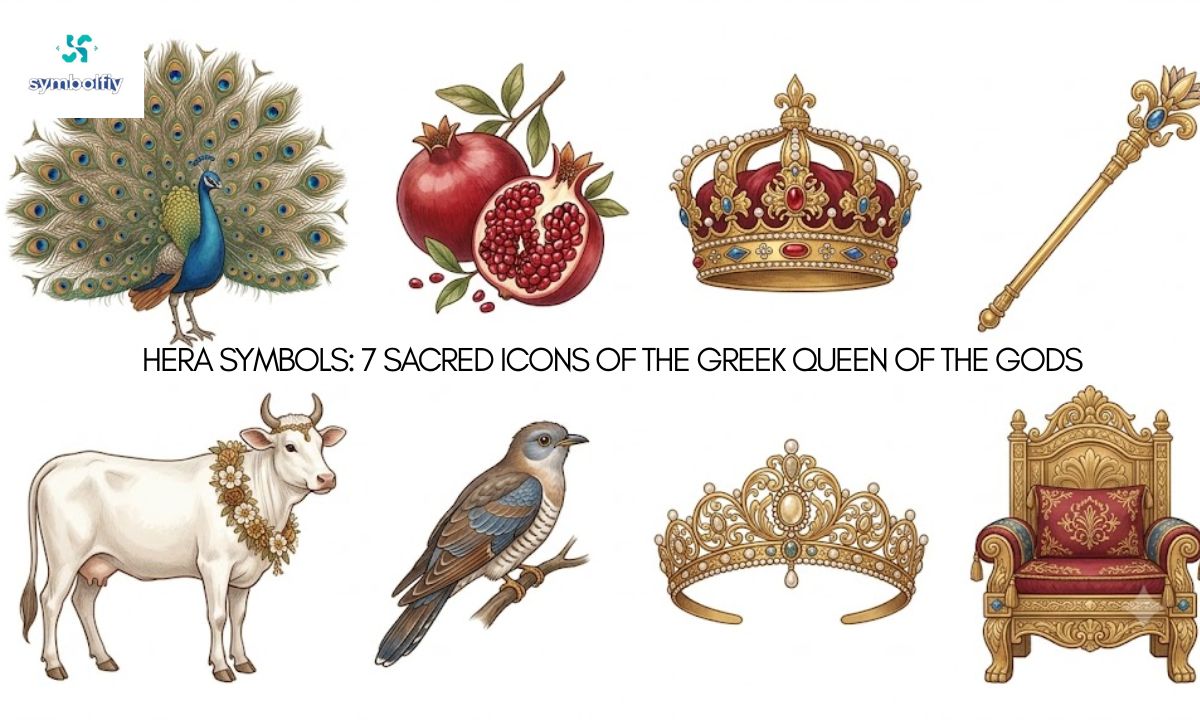
The peacock is Hera’s most famous symbol. Its feathers are covered in eye-like patterns, connected to the story of Argus — a hundred-eyed giant she used to guard one of Zeus’s lovers. When Argus was killed, Hera placed his eyes into the peacock’s tail as a tribute.
The peacock stands for beauty, watchfulness, and immortality. It also reflects Hera’s pride and her all-seeing nature as queen of Olympus.
🌸 The Pomegranate
The pomegranate is a rich symbol of fertility, marriage, and abundance. Hera is often shown holding one in ancient artwork. Its many seeds represent the blessing of new life and the fullness of a well-lived marriage.
Some scholars also link the pomegranate to death and seasonal cycles, adding a deeper spiritual layer to this fruit’s meaning in Hera’s story.
👑 The Crown or Diadem
Hera’s crown — also called a diadem — is the clearest sign of her divine queenship. It marks her as ruler over all the gods on Mount Olympus.
The crown symbolizes sovereignty, authority, and the right to lead. It was not just decorative. In ancient Greek culture, the diadem was a sacred item that set apart those who governed with divine right.
🪄 The Scepter
Hera almost always carries a scepter in ancient Greek art. It is the symbol of her divine rule and her power as a governing force in the heavens.
The scepter represents not just personal power but also justice and order. Hera’s scepter says she is not merely a consort — she is a ruler in her own right with real authority over gods and mortals.
🐄 The Cow
The cow may seem like an unusual symbol, but in ancient Greece, it was deeply connected to fertility, motherhood, and nurturing. Homer even called Hera “cow-eyed,” which was a mark of beauty, not an insult.
Cows were sacred animals linked to the earth’s abundance. For Hera, the cow reflects her role as a protective mother figure and a symbol of life-sustaining power.
🐦 The Cuckoo
The cuckoo bird is tied to one of the most famous myths about Hera and Zeus. According to the story, Zeus transformed himself into a shivering cuckoo to gain Hera’s sympathy. She took the bird in to protect it, and that is how their relationship began.
The cuckoo symbolizes the start of spring, new beginnings, and the sometimes tricky nature of love. It connects Hera to themes of trust, loyalty, and the early days of romance.
🌿 The Lily
The lily is a symbol of purity, motherhood, and the sacred feminine in many ancient traditions. For Hera, the lily appears in art and temple offerings as a sign of her grace and divine beauty.
Some myths even say the Milky Way was created from Hera’s spilled milk. The lily connects to that same idea — that Hera’s body and nature are sources of life and nourishment for the world.
Ancient Cultures That Used These Symbols
Hera’s symbols did not exist in isolation. They appear across many ancient cultures, each adding its own meaning to familiar icons.
Greek Mythology — Hera was worshipped as the queen of Olympus. Her main temple was at Argos, and festivals called Heraia were held in her honor.
Roman Culture — The Romans identified Hera with their goddess Juno. Juno shared many of Hera’s symbols, especially the peacock and the crown.
Egyptian Traditions — Cow goddesses like Hathor shared symbolic ground with Hera, especially in themes of motherhood, beauty, and sky divinity.
Ancient Near East — Symbols of queenship and marriage goddesses across Mesopotamia echo Hera’s role. The scepter and crown were used to honor divine feminine rulers in Sumerian and Babylonian cultures too.
Celtic Traditions — While Hera is specifically Greek, the universal symbol of the peacock feather appeared in Celtic lands as a sign of the divine eye and protective watching.
Modern Spiritual Practice — Today, Hera’s symbols are used in Wiccan and neo-pagan traditions. The pomegranate, peacock, and lily appear in rituals focused on marriage, fertility, and feminine power.
Why Symbols Still Matter Today
Even in the modern world, Hera’s symbols carry real meaning. People use them to express values they hold deeply — loyalty in marriage, feminine strength, the dignity of leadership.
You will find peacock imagery on wedding décor, pomegranate motifs in jewelry, and crown tattoos worn by people who want to carry a sense of inner royalty.
Spiritually, Hera’s symbols speak to anyone working through themes of identity, relationships, and personal power. Her story is not just ancient history.
It is a reflection of very human experiences — love, jealousy, dignity, and the desire to be seen and respected. Symbols like hers help people name what they feel and connect to something larger than themselves.
Frequently Asked Questions
What are Hera’s main symbols?
Hera’s main symbols are the peacock, pomegranate, crown, scepter, cow, cuckoo, and lily.
What does the peacock symbolize in Hera mythology?
The peacock represents immortality, beauty, and all-seeing vigilance, connected to the myth of Argus.
Why is the pomegranate linked to Hera?
The pomegranate symbolizes fertility, marriage, and abundance, and Hera is often shown holding one in ancient art.
What does Hera’s crown mean?
Hera’s crown or diadem represents her divine queenship and sovereign authority over the gods.
Why is the cow a symbol of Hera?
The cow symbolizes nurturing, fertility, and maternal protection, reflecting Hera’s role as a sacred earth mother figure.
Conclusion
Hera’s symbols are more than decorations from an old myth. Each one — the peacock, the pomegranate, the crown, the scepter, the cow, the cuckoo, and the lily — holds a window into the values of the ancient world.
They speak of power, love, protection, and the deep meaning people have always placed in marriage and womanhood. Whether you are drawn to Greek mythology, spiritual practice, or simply the beauty of symbolic thinking, Hera’s sacred icons offer something timeless and deeply human.