Humans have always needed ways to feel close to God. Long before books or churches, people used symbols. A simple shape or image could hold a whole belief. It could comfort a grieving heart or remind a soldier of faith. Across every culture and every age, God symbols have carried meaning that words sometimes cannot. They still do today.
God symbols point to something bigger than everyday life. They remind people that a higher power exists — one that creates, protects, and guides. Whether it is a cross on a church wall or an Om sign on a meditation mat, these symbols carry the weight of thousands of years of faith.
They also carry emotion. Seeing a sacred symbol can bring peace, strength, or hope in a moment when you need it most. That is why God symbols appear in temples, tattoos, jewelry, art, and homes all over the world.
25+ God Symbols and Their Meanings
Christian God Symbols
✝️ The Cross
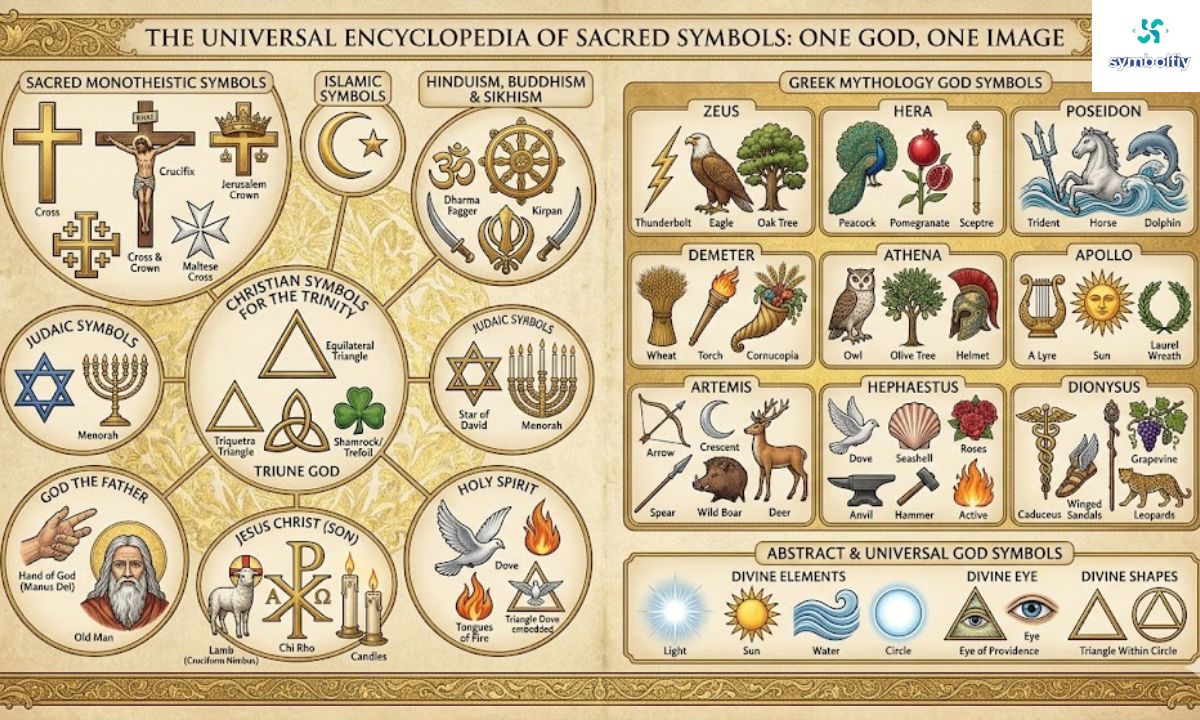
The cross is the most recognized Christian symbol in the world. It marks the place where Jesus died and rose again. For believers, it means forgiveness, love, and eternal hope. You will find it everywhere — on churches, necklaces, and gravestones.
🕊️ The Dove
The dove appeared when Jesus was baptized in the river Jordan. A dove flew down from heaven, showing God’s approval. Today it stands for the Holy Spirit, peace, and gentle divine presence. It is used in Christian art, weddings, and funerals.
🐑 The Lamb
Jesus is often called the “Lamb of God.” This image comes from Jewish tradition, where lambs were offered as sacrifices. The lamb symbolizes innocence, sacrifice, and salvation. It appears in early Christian catacombs and church windows.
🔺 The Triangle
An equilateral triangle — three equal sides — represents the Holy Trinity: God the Father, God the Son, and God the Holy Spirit. Each side is equal because all three are one God. It is one of the oldest Christian symbols still used today.
👁️ Eye of Providence
This is the all-seeing eye inside a triangle, often with rays of light around it. It means God sees everything and watches over all people. It appeared in Christian art long before it was used on the American dollar bill.
🤲 Hand of God (Manus Dei)
For the first eight hundred years of Christianity, the hand reaching from clouds was almost the only symbol used to show God the Father. It comes directly from Bible phrases like “the hand of the Lord.” It means divine power, protection, and ownership.
☧ Chi Rho
These are the first two Greek letters of the word “Christ” — X (Chi) and P (Rho). Emperor Constantine used this symbol on his soldiers’ shields before a great battle. It means “Anointed One” and is one of the earliest Christian monograms.
Alpha & Omega (Α Ω)
Alpha is the first Greek letter. Omega is the last. Together they mean God is the beginning and the end of all things. Jesus said this about himself in the Book of Revelation. The symbol reminds believers that God exists outside of time.
⚓ The Anchor
Early Christians used the anchor to hide their faith from Roman soldiers. An anchor looks like a cross if you look closely. It comes from Hebrews 6:19: “Hope as an anchor for the soul.” It means steady faith even in hard times.
🐟 Ichthys (Fish)
The fish symbol was a secret code among early Christians facing persecution. The Greek word for fish, ICHTHYS, spelled out “Jesus Christ, Son of God, Savior.” It is still found on car bumpers and Christian jewelry today.
🔥 Tongues of Fire
At Pentecost, the Holy Spirit appeared as flames above the heads of the disciples. Fire means God’s power, purification, and presence. It is used in churches today to represent the Spirit’s arrival and the birth of the Christian church.
🌟 Star of Bethlehem
This star led wise men to the baby Jesus. It is a symbol of Jesus as the light of the world and God’s announcement of salvation. You see it on top of Christmas trees and in Nativity scenes each December.
Jewish God Symbols
✡️ Star of David (Magen David)
Two interlocking triangles form this six-pointed star. One points up toward God; one points down toward humanity. Together they show the connection between the divine and the human. It appears on the flag of Israel and in synagogues worldwide.
🕎 The Menorah
The Menorah is a seven-branched lampstand. The center flame represents God’s eternal light. The other six branches hold the six directions of the universe. Moses made the first Menorah in the wilderness. It is also the official symbol of the State of Israel.
📜 Torah Scroll
The Torah scroll is not just a book — it is treated as a living symbol of God’s word and covenant with the Jewish people. Scrolls are handwritten, dressed in cloth, and carried with great honor in synagogues.
Islamic God Symbols
☪️ Crescent Moon and Star
This is the most widely recognized symbol associated with Islam, though it is not an official religious symbol from the Quran. It became linked to Islam during the Ottoman Empire. It often represents divine light and the lunar calendar used for Islamic holy days.
🖋️ Arabic Calligraphy
Islam forbids images of God, so calligraphy became the highest sacred art. The word “Allah” written in beautiful Arabic script is used on mosques, books, and jewelry. The letters themselves are considered a form of divine expression.
Hindu God Symbols
🕉️ Om (Aum)
Om is the sacred sound of the universe. Hindus believe it was the first sound at creation. It represents the three states of existence — waking, dreaming, and deep sleep — and the divine consciousness behind them all. It is chanted in prayers, yoga, and meditation daily.
🔱 Trishula (Trident)
The trident belongs to Lord Shiva. Its three prongs represent creation, preservation, and destruction — the three cycles of life. It also stands for past, present, and future. The Trishula is one of the most powerful divine symbols in Hinduism.
🌸 Lotus Flower
The lotus grows in muddy water but blooms beautifully above it. This is why it represents spiritual purity, divine beauty, and enlightenment. Many Hindu gods — including Brahma, Vishnu, and Lakshmi — are depicted sitting on lotus flowers.
🔯 Sri Yantra
The Sri Yantra is a geometric design made of nine interlocking triangles. It is one of the most complex and sacred Hindu symbols. It represents the cosmos, divine feminine energy, and the path toward spiritual liberation.
Buddhist Symbols
☸️ Dharma Wheel (Dharmachakra)
The eight spokes of this wheel represent the Noble Eightfold Path — the steps toward enlightenment. The circle means the perfection of the Buddha’s teachings. It has been a symbol of Buddhism for over 2,000 years.
🪷 Endless Knot
This interlocking pattern has no beginning and no end. It represents the interdependence of all things and the cycle of birth, death, and rebirth. It also symbolizes the Buddha’s endless compassion for all living beings.
Sikh Symbol
⚔️ Khanda
The Khanda is made of three elements. The double-edged sword in the center stands for divine justice and truth. The circle (Chakkar) represents the eternal nature of God — no beginning, no end. The two curved swords on the sides stand for spiritual and worldly balance.
Universal and Ancient Symbols
☀️ The Sun
Almost every ancient culture used the sun as a God symbol. It gives light, warmth, and life. In Egypt, Ra was the sun god. In Christianity, Jesus is called the “Sun of Righteousness.” The sun symbolizes divine energy, truth, and life itself.
⭕ The Circle
A circle has no beginning and no end. This makes it the perfect symbol for a God who is eternal. It appears in halos, mandalas, Dharma Wheels, and the Sikh Khanda. The circle means wholeness, unity, and the infinite.
🔺 The Triquetra
Three equal arcs connected in one continuous stroke. This Celtic-inspired shape represents the Trinity in Christianity but also appeared in Norse and pagan traditions long before. It means eternal unity and the power of three.
🍀 Shamrock (Trefoil)
Saint Patrick used a shamrock to explain the Holy Trinity to Irish people in the 5th century. One leaf, three parts — one God, three persons. The trefoil version appears carved in stone in Gothic churches across Europe.
🌀 The Labyrinth
Ancient cultures from Greece to Native America used the labyrinth as a sacred walking path. It represents the soul’s journey toward the divine center. Medieval Christians used labyrinth floors in cathedrals as a form of prayer and pilgrimage.
Ancient Cultures That Used These Symbols
Egyptian culture — Worshipped the sun god Ra and used the ankh as a symbol of eternal life and divine breath.
Celtic traditions — Used the triquetra, spirals, and knotwork to represent eternal divine energy and the power of three.
Greek mythology — Each god had sacred symbols: Zeus owned the thunderbolt, Poseidon the trident, and Athena the owl.
Christianity — Built a rich visual language using the cross, dove, lamb, fish, and triangle over 2,000 years of art and worship.
Buddhism — Developed symbols like the Dharma Wheel and lotus to guide followers toward enlightenment and away from suffering.
Native American traditions — Used the sun, eagle, and circle as symbols of the Great Spirit’s power over nature and all life.
Hinduism — Created some of the world’s most detailed sacred symbols, including the Om, Trishula, and Sri Yantra.
Why Symbols Still Matter Today
In a world full of screens and noise, God symbols offer a moment of stillness. People wear them as tattoos to carry their faith on their skin. Others place them in their homes to create a sense of the sacred. A simple symbol can say “I believe” without a single word. That quiet power has not faded.
Symbols also help people feel connected — to God, to their ancestors, and to millions of others who share the same faith. Whether someone meditates with an Om, wears a cross, or hangs a Star of David on their wall, the symbol becomes a daily reminder of something greater than themselves.
Frequently Asked Questions
What is the most universal symbol for God?
The circle — found in almost every religion and culture — is the most universal symbol for an eternal, all-encompassing God.
What symbol represents God the Father in Christianity?
The Hand of God (Manus Dei) and the equilateral triangle are the most traditional symbols for God the Father.
Why doesn’t Islam use images of God?
Islam practices aniconism — no visual depictions of God — and uses Arabic calligraphy instead to honor divine transcendence.
What does the Om symbol represent?
Om represents the sacred sound of creation, divine consciousness, and the unity of all existence in Hinduism.
Can I use sacred symbols from other religions?
You can, but always with respect — learn the meaning, understand the tradition, and never use sacred symbols as mere decoration without that understanding.
Conclusion
God symbols have guided humanity for thousands of years. From a simple cross to the complex Sri Yantra, each one tells a story of faith, hope, and the search for the divine.
They cross languages and borders because they speak directly to the heart. Whatever your belief, these symbols remind us that people everywhere have always looked up — and reached for something greater.