Japanese symbols cover far more than most people expect. A single search can lead you to kanji, lucky charms, animals, flower motifs, and even national flags. These groups work in different ways, yet many guides mix them together. That confusion causes wrong meanings, awkward designs, and tattoo regrets. This guide sorts Japanese symbols and meanings into clear categories. You will learn what each symbol stands for, where it comes from, and how to use it with care.
Thank you for reading this post, don't forget to subscribe!
“Japanese symbols” is an umbrella phrase, not one tidy category. It includes written characters, cultural motifs, lucky objects, religious items, and graphic patterns. Each type carries meaning in a different way, so it helps to know which one you are looking at first.
Use this chart as a quick reference. Each row shows the type, the Japanese text, the reading, a common association, and one caution.
Symbol
Japanese
Reading
Type
Common association
Caution
Strength
力
chikara
Kanji
Physical or inner power
Often read as “force,” not always “courage”
Love
愛
ai
Kanji
Affection, deep care
Different from 恋 (koi), romantic longing
Fortune
福
fuku
Kanji
Good fortune, blessing
Pairs with other characters in set phrases
Beckoning cat
招き猫
maneki-neko
Lucky object
Customers, prosperity
Paw meanings vary by region
Shrine gate
鳥居
torii
Architecture
Entry to sacred space
Not a good luck charm by itself
Amulet
お守り
omamori
Religious item
Protection for one purpose
Each one targets a specific goal
Koi fish
鯉
koi
Animal
Perseverance
Not the same word as 恋 (love)
Cherry blossom
桜
sakura
Nature
Fleeting beauty
Tied to impermanence, not only romance
Wave pattern
青海波
seigaiha
Pattern
Endless good fortune
Not the same as a single painted wave
National flag
日の丸
Hinomaru
Emblem
The nation
Not the rayed Rising Sun flag
Kanji, Kana, and Cultural Symbols
Japanese writing uses three scripts. Kanji are characters borrowed from Chinese, and each one carries meaning. Hiragana and katakana are sound-based scripts called kana. They spell syllables and have no meaning of their own.
That difference matters when you search for Japanese kanji symbols. A kanji can stand alone as a symbol of an idea. A kana letter cannot. If you want a character that “means” something, you almost always want kanji.
Cultural symbols are a separate group. A crane, a gate, or a wave pattern is not text. It carries meaning through history, religion, and art. Traditional Japanese symbols of this kind get their power from shared stories, not from spelling.
How Meanings and Readings Change
Most kanji have more than one reading. The on’yomi reading comes from the original Chinese sound. The kun’yomi reading is the native Japanese word. The character 生, for example, is read differently in different words.
Meaning also shifts with context. A character may have a core idea, but a word built from it can lean in another direction. That is why a single glyph rarely tells the whole story.
Three habits keep you accurate:
Check the character inside real words, not alone.
Separate the literal translation from the cultural feeling.
Treat any “one character, one meaning” claim with suspicion.
Japanese Symbols for Love, Strength, Luck, and Peace
Most readers arrive looking for a Japanese symbol for strength, love, good luck, or protection. These characters answer that need directly. Each is common in everyday writing, so reviewers and native readers recognize them instantly.
Meaning
Character
Reading
Note
Strength
力
chikara
Power, effort, force
Courage
勇気
yūki
A two-character word
Love
愛
ai
Broad, deep affection
Romantic longing
恋
koi
Closer to “being in love”
Fortune
福
fuku
Blessing, good fortune
Luck
運
un
Fate, chance, luck
Peace
平和
heiwa
A two-character word
Dream
夢
yume
Dream or aspiration
Heart
心
kokoro
Heart, mind, spirit
Notice that courage and peace are words, not single characters. Many lists blur this line and call everything a “single character.” Keep the difference clear, especially if you plan to use the text in a design.
The love entries need extra care. The character 愛 expresses love in a wide sense. The character 恋 describes romantic attachment. Both are pronounced differently from the fish 鯉, which also sounds like “koi.” Never imply that the fish character means love. Only the sound matches, and that wordplay is a joke, not a definition.
For protection, a single character is less common than an object. The next section covers the items that actually serve that role.
Japanese good luck symbols fall into two groups. Some bring fortune, and some guard against harm. Most are physical objects found in shops, homes, and shrines. Treat them as traditions and beliefs, not guaranteed results.
Maneki-Neko and Daruma
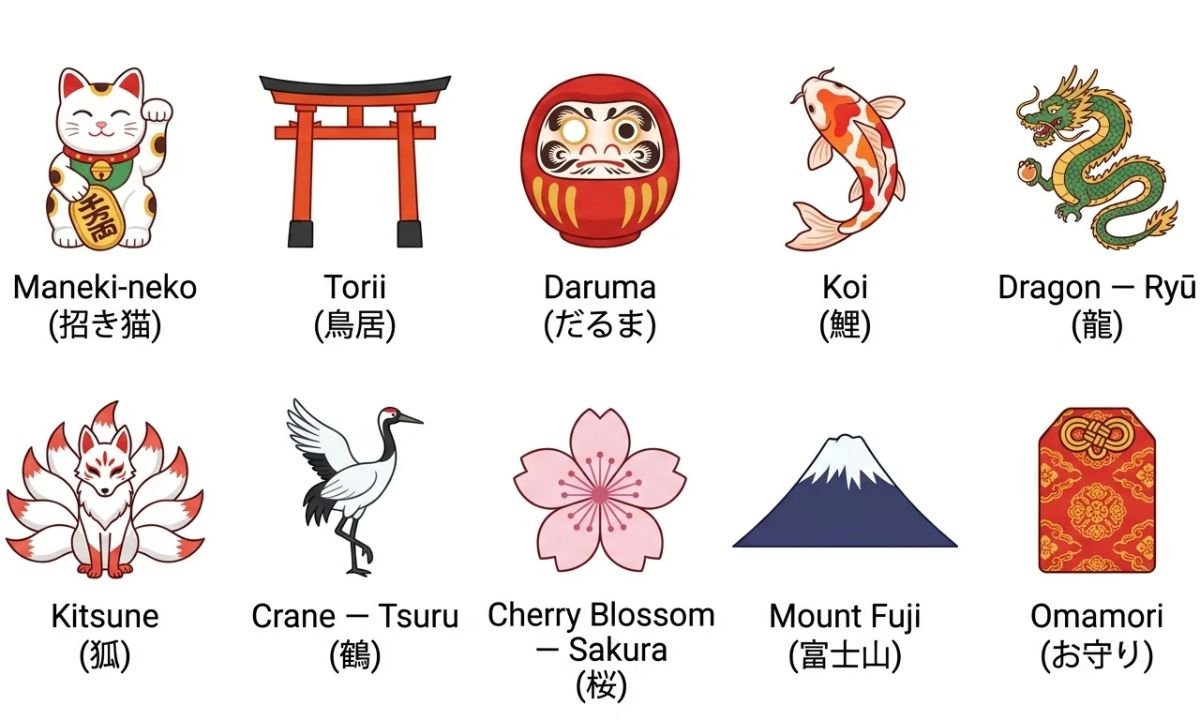
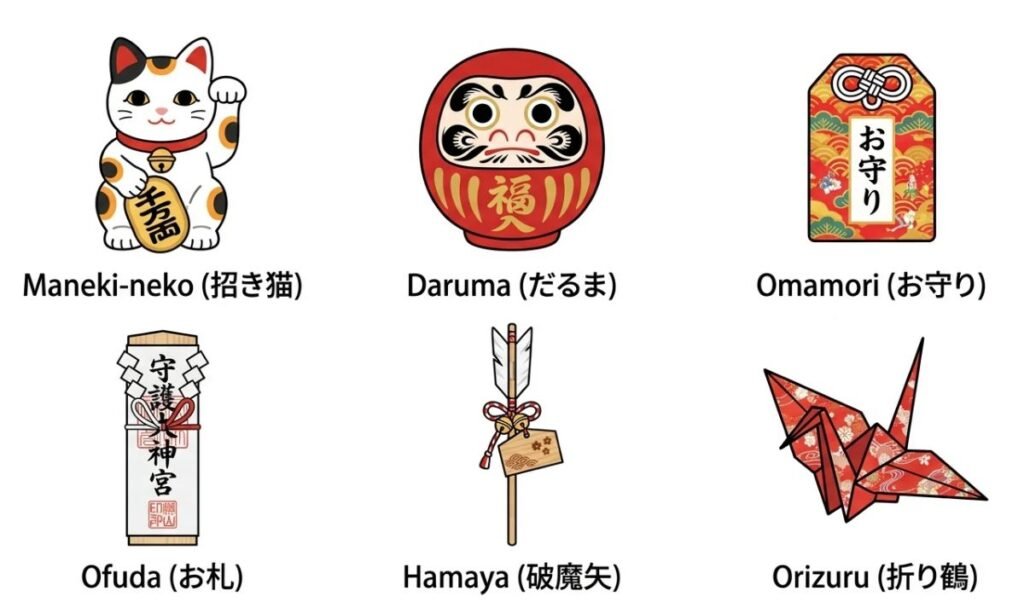
The maneki-neko is the beckoning cat seen near shop counters. Its raised paw invites visitors and money. Many people say the left paw calls customers and the right paw calls wealth. Interpretations differ, so the paw rule is a common belief, not a fixed law.
The daruma is a round doll modeled on the monk Bodhidharma. You paint one eye when you set a goal. You paint the second when you reach it. The doll also stands for resilience, because its weighted base lets it spring back upright. A well-known saying about falling seven times and rising eight comes from this idea.
Torii and Omamori
A torii is the gate at the entrance to a Shinto shrine. It marks the shift from everyday space to sacred space. People bow before passing through. The gate itself is not an amulet. It is a boundary.
An omamori is the actual protective charm. It is a small cloth pouch sold at shrines and temples. Each one has a purpose, such as safe travel, exam success, or health. People often return old charms after about a year and buy new ones. If you want a true Japanese symbol for protection, this is the best-known answer.
Japanese Animal Symbols
Animals appear everywhere in Japanese art, myth, and design. Each carries layered meaning. The same animal can seem kind in one story and tricky in another, so context decides the reading.
Koi, Dragons, and Tigers
The koi stands for perseverance. A famous legend says a koi that swims up a waterfall becomes a dragon. That story explains why koi appear in tattoos and prints about effort and growth.
The Japanese dragon, or ryū, links to water, rain, and protection. It is usually a wise and generous force, unlike many fire-breathing dragons in Western stories. The tiger, or tora, represents courage and defense against evil spirits.
Cranes, Foxes, and Snakes
The crane, or tsuru, signals longevity and good fortune. Tradition says it lives a thousand years. This belief inspired senbazuru, the practice of folding 1,000 origami cranes to make a wish. The cranes also became a peace symbol through the story of Sadako Sasaki, a girl who folded them while ill after the Hiroshima bombing.
The kitsune, or fox, is a messenger linked to the deity Inari. Foxes can protect, but folklore also shows them as tricksters. Snakes often suggest renewal, since they shed their skin. Present each as a tradition with two sides, not a simple good luck sign.
Nature, Patterns, and National Emblems
Nature gives Japanese cultural symbols some of their quietest and most lasting meanings. Patterns and emblems then turn these ideas into design.
Sakura, Lotus, Chrysanthemum, and Fuji
Sakura, the cherry blossom, stands for the brief nature of life. The blooms peak and fall within days. That idea of impermanence is deeper than simple romance.
The lotus comes from Buddhist tradition and signals purity, since it rises clean from muddy water. The chrysanthemum, or kiku, is tied to the imperial family. Mount Fuji represents endurance and sacred ground, and many people treat it as a spiritual destination.
Waves, Seigaiha, and Asanoha
People often confuse a famous wave painting with a wave pattern. Hokusai’s Great Wave is a single artwork. Seigaiha is a repeating pattern of overlapping arcs, and it suggests endless good fortune and calm.
Asanoha is a geometric pattern of star shapes based on the hemp leaf. Hemp grows fast and straight, so the pattern stands for healthy growth. It is often used on baby clothing for that reason. These patterns belong to the wagara family of traditional designs, which also includes kikkō (tortoise shell), shippō (linked circles), and uroko (scales).
The Hinomaru is Japan’s national flag, a red disc on white. The Rising Sun flag is a different design, with rays spreading out from the disc. Many people in East Asia link that rayed flag to Japan’s imperial military history, and it remains contested. Treat the two as separate flags, and think about the setting before using either.
Family crests, called mon, are small emblems used by families and businesses for centuries. They appear on kimono, gravestones, and gates. Each crest identifies a lineage, so using one casually can carry weight.
Spirits, Masks, and Warrior JapaneseSymbols
This group draws attention in tattoo shops and on clothing. It also invites the most misunderstanding, so a little background helps.
Oni, Hannya, Yōkai, and Shinigami
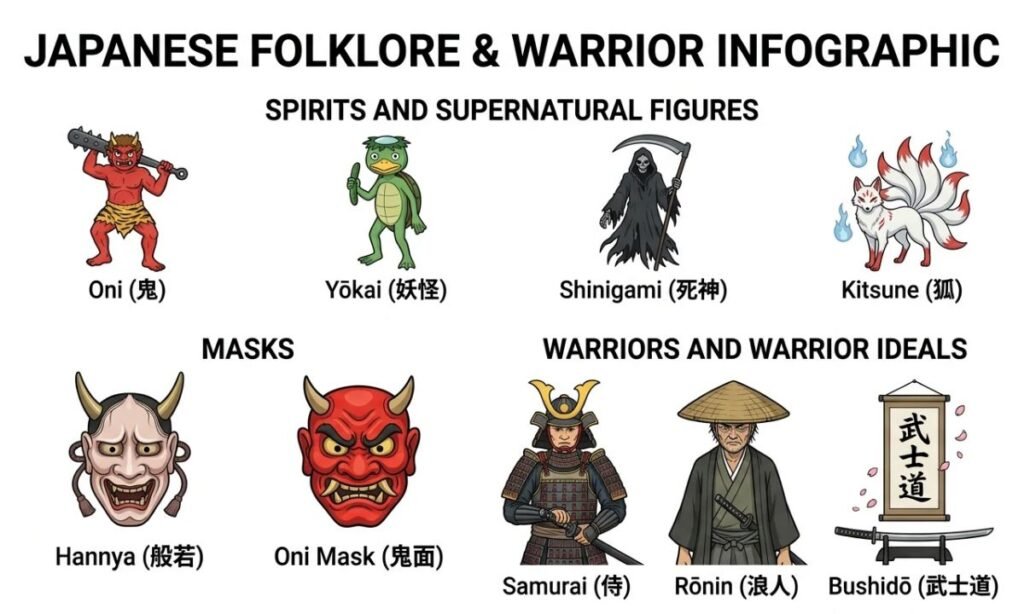
Oni are ogres from folklore. They can punish wrongdoers, yet some festivals treat them as protectors. The hannya is a Noh theatre mask that shows a woman turned into a demon by jealousy and grief. It is a symbol of deep emotion, not just a scary face.
Yōkai is the broad word for supernatural creatures and strange beings. Shinigami are death spirits, a more modern idea that grew through literature and pop culture. Do not treat them as ancient religious figures.
Samurai, Bushido, and Rōnin
The samurai were the warrior class of premodern Japan. Bushido means “the way of the warrior,” a code of conduct that stressed loyalty and discipline. Writers often romanticize it, and historians note that its form changed over time.
A rōnin was a samurai without a master. The word now suggests independence or a person without a clear place. Use these symbols with the full story in mind, because warrior imagery can read very differently across cultures.
Choosing Symbols for Tattoos and Clothing
Many searches for Japanese symbols for tattoos and Japanese symbols on clothing end in a design choice. That choice deserves care. A mistake on skin or fabric is hard to undo.
Follow this proofreading checklist before you commit:
Ask a native Japanese reader to review the exact text.
Ask what they checked: meaning, grammar, and natural wording.
Use complete words, not random single characters.
Pick a readable font, and confirm each stroke looks correct.
Keep a copyable text version, not only an image.
Avoid machine translation for anything permanent.
Be careful with trust claims such as “native-verified.” A real review names the reviewer and explains what was checked. Without that detail, the label is only marketing.
Also weigh the meaning against the setting. A character can read as elegant in one place and odd in another. Some symbols, such as religious items or the rayed flag, may offend people. Finally, remember that “soul kanji” is a product phrase, not a cultural category. Choose a symbol because you understand it, not because a label sounds deep.
Frequently Asked Questions
What is the Japanese symbol for good luck?
The kanji 福 (fuku) and 運 (un) signal fortune and luck, and the maneki-neko is the best-known lucky object.
What is the Japanese symbol for strength?
The kanji 力 (chikara) is the most direct symbol for strength, while 勇気 (yūki) expresses courage.
What Japanese symbol means protection?
The omamori amulet is the classic protection symbol, and the tiger is a common animal of defense.
What does a koi mean in Japan?
The koi stands for perseverance and success after effort, based on the legend of the fish that becomes a dragon.
What is the difference between kanji, hiragana, and katakana?
Kanji are meaning-based characters, while hiragana and katakana are sound-based scripts with no meaning of their own.
Conclusion
Japanese symbols make sense once you sort them by type: written characters, lucky objects, animals, nature and patterns, and spirits or warrior imagery. Each group carries meaning in its own way, and context shapes every reading, from the readings of a kanji to the story behind a crane or a mask.
The best choices come from separating literal translation, folklore, and design interpretation, then checking the details with a native reader before you commit to anything permanent. Treat luck and protection symbols as traditions, handle contested emblems like the Rising Sun flag with care, and use this guide as a base for choosing a symbol you truly understand.