Symbols are how people carry history without saying a word. In the Philippines, symbols are everywhere — stitched into flags, carved into wood, inked on skin, and woven into daily life. They hold centuries of struggle, faith, pride, and love.
Understanding Filipino symbols means understanding the Filipino soul. Whether you are a proud Filipino or just someone curious about one of Asia’s richest cultures, this guide opens a door to meanings that go far deeper than you might expect.
Filipino symbols represent identity, resilience, and a deep connection to both land and ancestors. The Philippines has been shaped by indigenous traditions, Spanish colonization, American influence, and Islamic culture from the south.
All of these layers live inside Filipino symbols. They do not just look beautiful. They carry memory. On a deeper level, Filipino symbols speak about community values — loyalty to family, courage in the face of hardship, faith in something greater, and respect for nature.
Whether it is an ancient tribal tattoo pattern or the national flag flying at sunrise, each symbol tells a story of a people who have survived and kept going.
25+ Filipino Symbols and Their Meanings
1. The Philippine Flag
The national flag is the most powerful Filipino symbol. Blue stands for peace and justice. Red represents courage and bravery. White signals equality and purity. The golden sun with eight rays honors the first provinces that rose up against Spanish rule.
The three stars represent Luzon, Visayas, and Mindanao. When the flag is flipped with red on top, it signals the country is at war. During World War II, Filipinos risked their lives just to keep this flag hidden and alive.
2. The Sun (Araw)
Long before the flag existed, the sun was sacred to early Filipinos. It symbolized life, energy, freedom, and spiritual power. Tribal communities across the archipelago revered the sun as a divine force.
Today the eight-rayed sun on the flag still carries that ancient meaning — a reminder that light, hope, and independence belong to the people.
3. Baybayin Script
Baybayin is the ancient pre-colonial writing system of the Philippines. Each character represents a syllable, not a single letter. Before Spanish missionaries arrived and replaced it with the Latin alphabet, Filipinos used Baybayin to record literature, commerce, and everyday life.
Today Baybayin is a powerful symbol of cultural revival. Many young Filipinos get it tattooed on their skin as a way of reclaiming something that was almost lost.
4. Sampaguita (National Flower)
This tiny white flower carries enormous meaning. Sampaguita represents humility, purity, and devotion. The name itself comes from a Filipino phrase meaning “I promise you,” connecting the flower to loyalty and love.
It is used in garlands offered to honored guests and placed at altars as a spiritual offering. The flower has been the national flower since 1934, declared during the Commonwealth era.
5. Narra Tree (National Tree)
The Narra is a hardwood tree known for its deep reddish color and extraordinary durability. It symbolizes strength, resilience, and the unbreakable Filipino spirit. For centuries, Narra wood was used in furniture, floors, and buildings.
The tree blooms with bright yellow flowers during the dry season. It became the national tree in 1934 alongside the sampaguita. Cutting one down today requires special government permission.
6. Philippine Eagle (Haribon)
This bird is one of the largest eagles on earth. Its wingspan can stretch up to seven feet. The Philippine eagle symbolizes strength, power, independence, and freedom. It lives deep in the forests of Mindanao and is critically endangered — fewer than 800 survive in the wild.
Killing one is a crime punishable by up to twelve years in prison. The eagle represents the fierce, proud spirit of the Filipino people.
7. Arnis (National Martial Art)
Arnis, also called eskrima or kali, is a Filipino martial art focused on self-defense using sticks, bladed weapons, and open-hand techniques. It is one of the oldest fighting systems in Southeast Asia.
Warriors used these skills long before foreign colonizers arrived. Arnis became the official national sport and martial art in 2009. It has since influenced martial arts styles worldwide and even appeared in Hollywood action films.
8. Sarimanok
The Sarimanok is a colorful mythical bird from the Maranao people of Mindanao. It is always depicted carrying a fish in its beak and decorated with flowing, ornate feathers. The name combines “sari” (cloth of many colors) and “manok” (chicken).
The Sarimanok symbolizes good fortune, divine blessing, and prosperity. It bridges the earthly and spiritual worlds. It gained national recognition through the work of National Artist Abdulmari Imao and now represents the beauty of Muslim Filipino culture.
9. Okir Patterns
Okir refers to the flowing geometric patterns found in Maranao art — on carvings, brass work, textiles, and architecture. These designs are built from leaf, vine, and spiral shapes arranged in careful symmetry. Okir symbolizes the belief that life flows continuously without end.
It appears on the royal Maranao house called the torogan. The patterns reflect a deep spiritual connection to nature, harmony, and the divine.
10. Carabao (Water Buffalo)
The carabao is the unofficial national animal of the Philippines. It has plowed rice fields and carried heavy loads for Filipino farmers for thousands of years. The carabao symbolizes hard work, patience, and the spirit of the common people.
It represents the bayanihan value — the idea that strength comes from working together. Though it has no official legal status as a national symbol, it lives deeply in Filipino hearts and art.
11. Philippine Pearl (South Sea Pearl)
The Philippine Pearl, also called the South Sea Pearl, is the national gem. It is found in the waters of the southern Philippines and is prized worldwide for its size and luster. The pearl represents natural beauty, rarity, and national pride.
It even appears on the Philippine 1,000 peso bill. The Philippines also holds the record for the world’s largest pearl ever found — the Pearl of Lao Tzu, weighing over 14 pounds.
12. Coat of Arms
The Philippine coat of arms is a layered historical symbol. It features the sun, three stars, an American bald eagle, and a Spanish lion. Each element reflects a chapter of Philippine history — independence, colonization, and the struggle between empires.
The three stars represent Luzon, Visayas, and Mindanao. The coat of arms appears on government documents and official seals as a mark of state authority.
13. Lupang Hinirang (National Anthem)
Originally composed in 1898, the national anthem was first written in Spanish, then English, and finally in Filipino. By law, it must be sung in Filipino only.
The song is not just a melody — it is a declaration of love for the homeland. Hearing it played at the start of a celebration or sporting event still gives Filipinos goosebumps across generations.
14. The Bamboo
Bamboo is not an official national symbol, but it holds deep cultural meaning. Filipinos say bamboo bends but does not break. This is a metaphor for the Filipino character — flexible, adaptable, and impossible to destroy.
Bamboo is used in construction, music, cooking, and traditional crafts. It represents the quiet strength of everyday Filipino life.
15. Filipino Sign Language (FSL)
Declared a national sign language in 2018, FSL is a landmark symbol of inclusion. It recognizes the Filipino Deaf community as a full and valued part of the national identity.
FSL has roots in French Sign Language and was shaped by American and local influences. Its recognition means Deaf Filipinos now have legal rights to FSL in courts, schools, and broadcast media.
16. Anito Figures
Anito are carved wooden or stone figures used in pre-colonial Filipino spiritual practice. Early Filipinos believed these figures housed the spirits of ancestors or nature beings. They were placed in homes, boats, and sacred spaces for protection and guidance.
Anito figures represent the Filipino belief in the living connection between the present world and the world of ancestors. They appear in museums today as some of the oldest known Filipino spiritual artifacts.
17. The Anahaw Leaf
The anahaw is a fan palm native to the Philippines. It is widely known as a national leaf, though it has no official legal status. The anahaw symbolizes grace, resilience, and connection to the natural world.
Its leaves were traditionally used to make fans, roofing, and baskets. The anahaw appears in logos, school materials, and cultural presentations as a quiet symbol of Filipino identity.
18. The Jeepney
The jeepney began as a converted American military jeep left behind after World War II. Filipinos repurposed these vehicles with bright colors, chrome decorations, and pop art imagery to create something entirely their own.
The jeepney symbolizes Filipino ingenuity, creativity, and the ability to make something beautiful out of what others leave behind. It is a rolling piece of folk art. A bill to declare it the national vehicle has been proposed but not yet passed into law.
19. Mango (National Fruit)
The Philippine mango is considered one of the sweetest in the world, especially those from Guimaras Island. The mango is widely recognized as the national fruit, though no law officially declares it so.
It represents abundance, sweetness, and national pride. The mango is a cultural comfort food — tied to childhood memories, summer festivals, and the warmth of Filipino home life.
20. The Barong Tagalog
The barong tagalog is the traditional formal shirt worn by Filipino men. Made from pineapple fiber or jusi cloth, it is delicate, lightweight, and embroidered with intricate designs.
The barong symbolizes Filipino elegance, dignity, and craftsmanship. It is worn at weddings, official ceremonies, and state events. Wearing it is considered a form of cultural pride and a statement of Filipino identity.
21. Bayanihan Spirit
Bayanihan refers to the traditional Filipino practice of neighbors helping one another — most famously the act of literally carrying a neighbor’s house to a new location together. As a symbol, bayanihan represents community, unity, and selfless cooperation.
It is the spirit that shows up during typhoons, disasters, and times of hardship. Bayanihan is not a visual symbol but a living cultural value that defines how Filipinos show up for each other.
22. Bangkilay (Lightning Symbol)
Bangkilay is an ancient tribal symbol represented as a zigzag line, associated with lightning and thunder. Tribal communities across the Philippines used it in tattoos and carvings to represent power and divine energy.
Lightning was seen as a message from higher forces. The Bangkilay appears in warrior tattoo traditions and is now revived in modern Filipino tribal art and jewelry.
23. The Nipa Hut (Bahay Kubo)
The bahay kubo is the traditional Filipino stilt house made from bamboo and nipa palm leaves. A famous folk song of the same name celebrates its simplicity and the abundance of vegetables grown around it.
The bahay kubo symbolizes humble living, harmony with nature, and the warmth of home. It represents a time before concrete walls — when Filipino life was built close to the earth and the community.
24. Jose Rizal (Implied National Hero)
Jose Rizal was a writer, doctor, and reformist who used his pen to fight Spanish colonial rule. He was executed in 1896 at the age of 35. While no law officially declares him a national hero, the National Historical Commission considers his heroism implied through existing legislation.
Rizal symbolizes intellectual courage, sacrifice, and the power of truth. His face appears on the Philippine one-peso coin.
25. Warrior Tattoo Patterns (Batok)
The Kalinga and other indigenous groups of the Cordillera mountains practiced an ancient tattoo tradition called batok. These tattoos marked a warrior’s achievements, spiritual status, and identity.
Geometric lines, chevrons, and nature patterns were applied using thorns and hand-tapping methods. Batok symbolizes bravery, honor, and belonging. The late Apo Whang-Od, a traditional Kalinga mambabatok, became an internationally recognized keeper of this tradition and is considered a living national treasure.
26. The Sun and Three Stars
Seen together, the sun and three stars form one of the most recognizable symbols in Philippine visual culture. Beyond the flag, this combination appears on monuments, logos, and everyday items. Spiritually, the stars guide travelers home.
Historically, they represent the unity of three island groups standing together. Emotionally, they are a symbol of hope and the idea that no matter how divided the islands, the Filipino people share one light.
Ancient Cultures That Used These Symbols
Filipino symbols did not develop in isolation. Many connect to broader traditions across Asia and beyond.
Indigenous Austronesian cultures — The earliest Filipino symbols came from Austronesian peoples who settled the archipelago thousands of years ago. Tattoo patterns, sun worship, and animist spiritual symbols are shared across Austronesian cultures from Taiwan to Indonesia.
Maranao and Islamic traditions — The okir pattern and Sarimanok come from the Islamic influences that reached Mindanao between the 13th and 15th centuries. Arab missionaries brought ornamental art forms that blended with local Maranao identity.
Spanish colonial culture — Four centuries of Spanish rule left deep marks on Filipino symbolism. Christian crosses merged with indigenous sun imagery. Catholic saints absorbed qualities of ancient spirits. The coat of arms carries the Spanish lion.
American colonial influence — The American period introduced the bald eagle into the Philippine coat of arms and left behind the jeepney. It also shaped the modern educational system where many national symbols were formally taught.
Southeast Asian shared heritage — Filipino tribal patterns share similarities with Indonesian batik and Malaysian weaving traditions, reflecting ancient trade routes and shared migration histories across the region.
Why Symbols Still Matter Today
In a world that moves fast and forgets easily, symbols slow people down and make them remember. Filipino symbols carry the emotional weight of history without needing a history book.
When a Filipino sees the sampaguita garland placed around someone’s neck, or hears the first notes of Lupang Hinirang, something deeper than knowledge stirs inside them. That feeling is what symbols are for.
Today, Filipino symbols are more relevant than ever. In the diaspora — among Filipinos living in the United States, Europe, and the Middle East — symbols like Baybayin tattoos and tribal patterns serve as anchors to home.
They are a way of saying, “This is who I am, no matter where I am.” Symbols are also showing up in fashion, visual art, and activism, with young Filipinos using traditional designs to push back against cultural erasure and celebrate what makes them distinct.
Frequently Asked Questions
What are the 12 official national symbols of the Philippines?
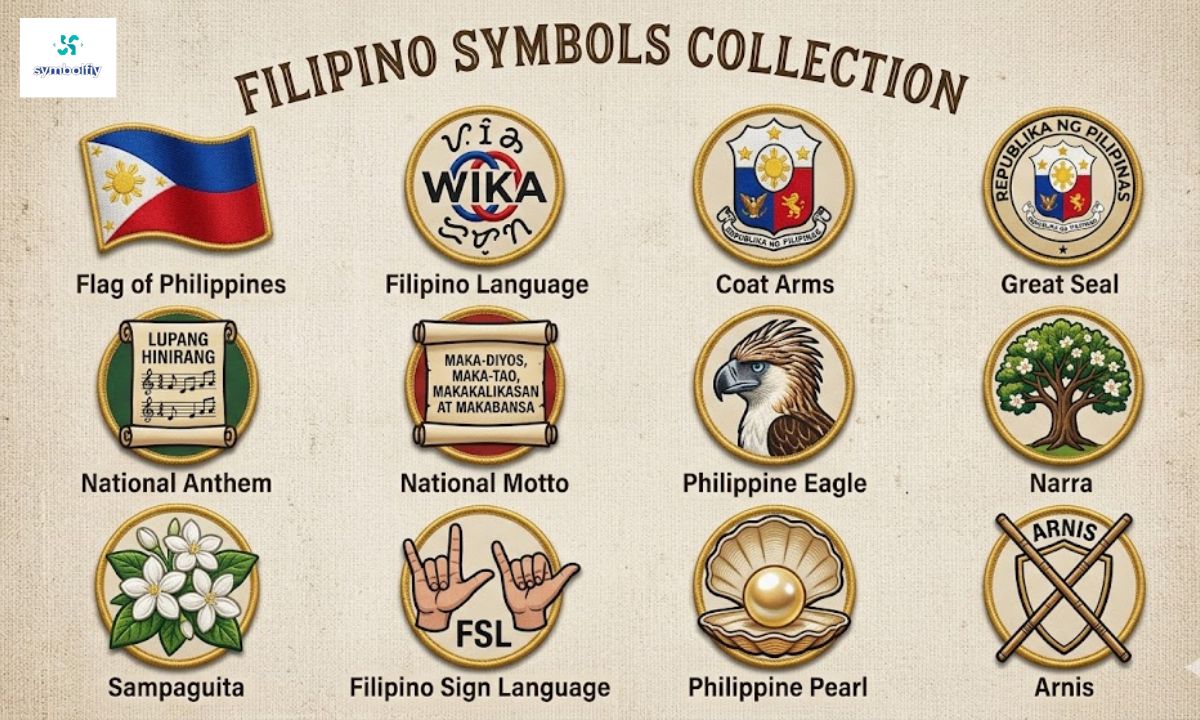
The 12 official symbols include the flag, language, coat of arms, great seal, national anthem, national motto, sampaguita, narra tree, Philippine eagle, Philippine pearl, arnis, and Filipino Sign Language.
What does the Sarimanok represent?
The Sarimanok is a mythical bird from the Maranao people that symbolizes good fortune, prosperity, and divine blessing.
Is the carabao an official national symbol?
No, the carabao is widely recognized as a cultural symbol but has no official legal status as a national symbol.
What is Baybayin used for today?
Baybayin is used in tattoos, art, activism, and education as a symbol of cultural identity and pre-colonial Filipino heritage.
What does bayanihan mean as a symbol?
Bayanihan is a cultural value representing community spirit, unity, and helping others without being asked.
Conclusion
Filipino symbols are more than decoration. Each one is a compressed story of survival, love, faith, and identity. From the ancient batok tattoos of Kalinga warriors to the bright okir carvings of Maranao royal homes, from the tiny white sampaguita to the fierce Philippine eagle — these symbols say what words sometimes cannot. They remind every Filipino, wherever they are in the world, that they come from something remarkable.