Before there were job titles or org charts, there were symbols. A carved stone, a raised staff, a particular animal on a shield — these were enough for people to know who led and who followed.
That instinct hasn’t gone away. Today we respond to logos, uniforms, and flags the same way our ancestors responded to crowns and scepters. Leadership symbols tap something deep in us — a need for direction, trust, and order. Understanding them doesn’t just explain history. It shows you how authority actually works.
Leadership symbols represent more than power. They communicate responsibility, vision, and the weight that comes with being in charge.
Historically, they were used to close the gap between ordinary people and those who led them — to make authority feel real, earned, and sometimes divine. A symbol could do in an instant what a long speech couldn’t.
On a deeper level, they speak to universal human needs. We look for certainty when things are uncertain. We want to believe someone capable is steering the ship. These symbols have always answered that need — across cultures, across centuries, in war and in peace.
25+ Leadership Symbols and Their Meanings
1. The Crown
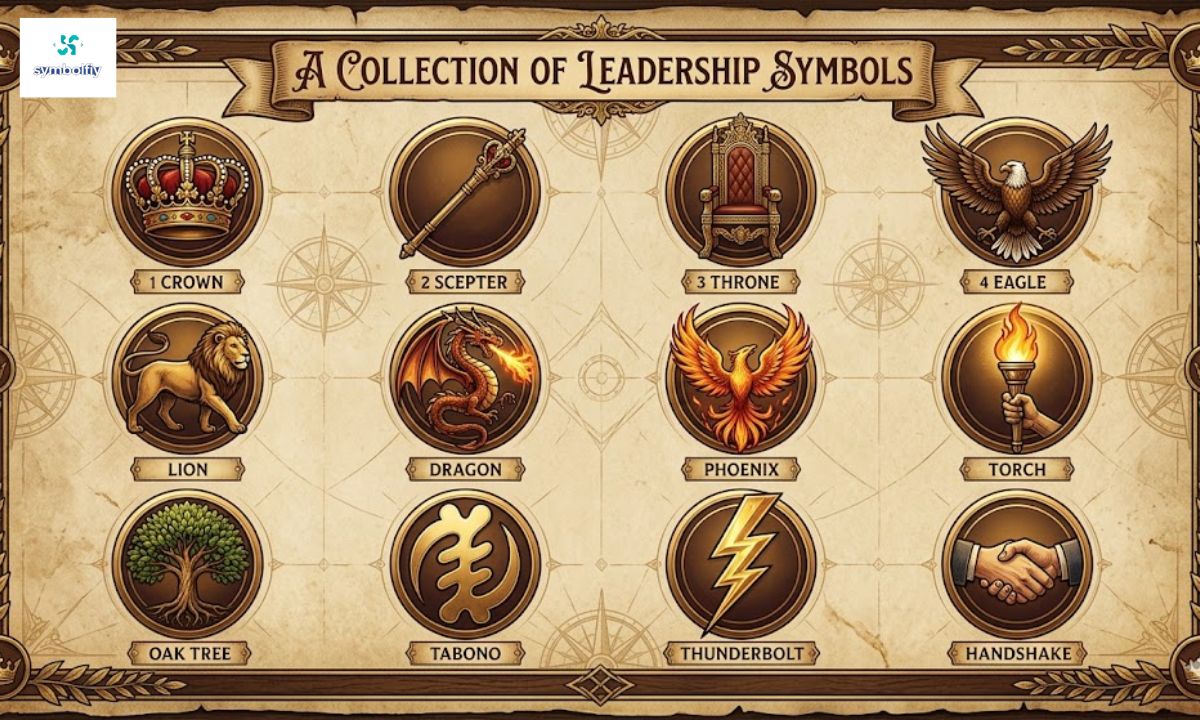
The crown is probably the oldest and most universal leadership symbol on earth. It sits above the head — literally elevated — to mark someone as set apart from everyone else. In ancient Egypt, different crown shapes meant different types of authority.
In medieval Europe, a crown wasn’t just jewelry — it meant the ruler held a divine mandate to govern. Today, the crown appears in logos, branding, and tattoos as a shorthand for excellence, authority, and earned status.
2. The Eagle
Origin: Used across empires — Roman, Aztec, American, and Egyptian
Cultural note: In Aztec culture, soldiers earned eagle imagery by proving themselves in battle The eagle soars higher than almost anything else. That height is the point — it represents the ability to see the full picture, not just the ground level. As a leadership symbol, it says: this person sees what others miss.
3. The Lion
The lion has represented courageous leadership across virtually every major culture. In African traditions, the lion is the undisputed king of the natural world.
In heraldry and royal coats of arms across Europe, it stood for nobility and fearless command. The lion doesn’t just project strength — it projects calm, confident authority. It doesn’t need to prove itself to every challenger. That’s exactly what good leadership looks like.
4. The Scepter
Origin: Ancient Egypt, Mesopotamia, and medieval European courts
Meaning: The right to rule, command authority, moral power
Historical note: Egyptian pharaohs carried the crook and flail — tools of a shepherd and farmer — to show they both guided and sustained their people The scepter is authority made physical. Holding it was a public declaration: this person makes the final call. Even today, the idea of “holding the scepter” means holding ultimate control.
5. The Throne
The throne is more than a seat. Its elevation, position, and design all sent deliberate messages about the person sitting in it. Raised platforms, ornate carvings, and placement at the center of a room all said: this is where power lives.
In modern contexts, the corner office and the head of the boardroom table serve the same symbolic function. The physical space itself becomes a leadership signal.
6. The Oak Tree
Origin: Celtic, Norse, and Greek traditions
Meaning: Strength, endurance, deep roots, wisdom that builds over time
Cultural connection: The ancient Celts held the oak as sacred — “dara” in Irish means oak, giving us the Dara Knot symbol of inner strength The oak doesn’t grow fast. It grows deep. As a leadership symbol, it represents the kind of authority that earns trust slowly and holds firm through every kind of storm.
7. The Compass
The compass points the way when everything else is disorienting. As a leadership symbol, it stands for vision, direction, and the ability to navigate uncertainty.
It’s one of the most popular modern leadership tattoo designs for this reason — it captures the idea of guiding others toward a goal, even when the path isn’t obvious. Leaders who carry this symbol are saying they know where they’re going.
8. The Dragon
Origin: Chinese imperial tradition, Celtic mythology
Historical background: Chinese emperors used the dragon as their personal royal emblem — it connected them to heaven and cosmic order In the East, dragons are protectors and bringers of good fortune. In Celtic tradition, they guarded sacred knowledge. As a leadership symbol, the dragon represents a force that commands respect not through aggression alone, but through its sheer presence and wisdom.
9. The Laurel Wreath
Ancient Greece gave us this one. Laurel wreaths were placed on the heads of victors — athletes, generals, and poets. The key word is earned. Unlike a crown, which could be inherited, the laurel wreath was a reward for achievement.
It became the symbol of leadership that comes from proving yourself, not just being born into the right family. That meaning has stuck for over two thousand years.
Meaning: Enlightenment, passing knowledge forward, guiding through darkness
Modern use: Education, graduation ceremonies, national movements The torch is uniquely about leadership that serves others. It doesn’t hoard light — it spreads it. Educational institutions have long used the torch in their crests for exactly this reason. It’s the symbol of the mentor, the teacher, and the leader who lifts people up.
11. The Sword
The sword represents decisive authority — the power and responsibility to make hard calls. In Japanese samurai tradition, a warrior’s sword was inseparable from his honor and discipline.
In medieval European kingdoms, the sword was used in coronation ceremonies to represent the monarch’s duty to protect the realm. A broken sword meant defeat. A clean, sheathed sword meant order and peace maintained through strength.
12. The Mountain
Origin: Universal across cultures
Meaning: Vision from the summit, endurance through difficulty, unshakable stability
Spiritual significance: Mountains appear in nearly every religious tradition as places where humans meet divine wisdom — Moses at Sinai, Buddha’s enlightenment, the Hindu Himalayas Leaders who climb mountains don’t stop when it gets hard. The mountain as a symbol captures exactly that: reaching the top requires more than ability. It requires will.
13. The Wolf
Wolves are misunderstood as pure symbols of aggression. In leadership symbolism, they represent something more nuanced — pack loyalty, strategic intelligence, and collective survival.
A wolf pack leader doesn’t just dominate. It protects, plans, and holds the group together. Native American traditions revered the wolf as a teacher and pathfinder. As a leadership symbol, the wolf speaks to those who lead through earned trust rather than brute force.
14. The Flag
Origin: Ancient military and tribal traditions worldwide
Meaning: Collective identity, shared purpose, rallying point for unified action
Modern context: National flags, corporate standards, and team banners all carry the same core message Flags tell people where they belong and what they stand for. In battle, soldiers followed their flag even through chaos. In modern organizations, a strong flag — literal or metaphorical — gives people something larger than themselves to work toward.
15. The Staff or Rod
From Moses to shepherds to Roman magistrates, the staff has meant leadership for thousands of years. It guides those ahead, supports those who struggle, and marks the leader’s presence.
The shepherd’s crook became one of the most enduring leadership symbols in religious tradition — the good leader as caretaker and guide, not just commander. Many religious leaders still carry a staff today for exactly that reason.
16. Chess
Origin: India, 6th century
Meaning: Strategy, foresight, the ability to think multiple moves ahead
Modern interpretation: Used widely in business and leadership development imagery Chess became a leadership symbol because every move has consequences you must anticipate before you make them. It represents the intellectual side of leadership — patience, planning, and the willingness to sacrifice short-term comfort for long-term success.
17. The Star
Stars guided ships across oceans before GPS existed. They appeared on flags, military insignia, and royal seals as symbols of destiny, guidance, and something greater to aim for.
The five-pointed star appears in the symbolism of dozens of nations and organizations. As a personal leadership symbol, the star says: I help others find their direction.
18. The Phoenix
Origin: Egyptian and Greek mythology
Meaning: Transformation, rising after failure, the courage to start over stronger
Leadership application: Represents leaders who turn setbacks into comebacks What makes the phoenix a leadership symbol specifically is this: it doesn’t just survive. It transforms completely and returns more powerful. Great leaders who’ve navigated major failures often identify strongly with this symbol. It captures the truth that real authority is built through difficulty, not despite it.
19. The Shield
The shield is the protection half of leadership. Every group needs someone who will stand between them and danger. In heraldry, shields carried a family’s entire identity — values, history, allegiances, and honor — in one design. As a modern symbol, the shield speaks to the leader as protector: someone who takes the hit so others don’t have to.
20. The Elephant
Origin: Hindu tradition, African and Asian cultures
Cultural connection: In Hindu tradition, the elephant-headed god Ganesha is the remover of obstacles — prayed to before any major undertaking Elephants remember everything. They lead their herds through decades of experience. As a leadership symbol, the elephant represents the kind of authority that comes from accumulated wisdom rather than force.
21. The Key
Keys represent access — the authority to open what others can’t. In medieval castles, the keeper of the keys was one of the most trusted figures in the entire household.
Keys also represent delegation: handing someone a key means trusting them with something important. As a leadership symbol, the key captures both responsibility and the power to unlock potential in others.
22. The Anchor
Origin: Maritime traditions, early Christian symbolism
Meaning: Stability, groundedness, holding firm under pressure
Spiritual note: In early Christianity, the anchor was used as a hidden cross symbol, representing hope and steadfast faith A good leader doesn’t drift when conditions get rough. The anchor as a symbol says the same thing: you are the stable point others attach themselves to when everything else is moving.
23. The Hawk
Where the eagle represents grand imperial power, the hawk is sharper and more focused. In ancient Egypt, the god Horus — the divine ruler and protector — was depicted as a hawk. The hawk sees precisely, moves quickly, and acts with purpose. As a leadership symbol, it represents the executive mind: focused attention, quick judgment, and decisive action.
24. The Color Purple
Origin: Ancient Mediterranean cultures
Meaning: Royalty, high authority, elevated status
Historical note: Purple dye was so expensive in the ancient world that only the wealthiest rulers could afford it — wearing it was itself a symbol of extraordinary power Today, purple still carries that inherited authority. Many judicial robes, academic hoods, and religious vestments use purple to communicate elevated responsibility. In branding, it conveys prestige and depth.
25. The Bridge
The bridge is an underappreciated leadership symbol but a powerful one. It connects two places that couldn’t otherwise reach each other.
As a symbol of servant leadership and collaborative authority, the bridge represents the leader who brings people together, closes gaps, and builds paths forward. It’s especially relevant for leaders who define themselves by building teams and breaking down silos.
26. The Sun
Almost every ancient civilization worshipped the sun as a symbol of supreme authority. Egyptian pharaohs were considered sons of Ra, the sun god. The Aztec emperor was the earthly representative of the sun.
In Japanese tradition, the emperor descended from Amaterasu, the sun goddess. The sun gives light, drives growth, and makes life possible — all things the best leaders aspire to do for those around them.
Ancient Cultures That Used Leadership Symbols
Ancient Egypt — Pharaohs carried the crook and flail, wore elaborate crowns, and were depicted with the hawk god Horus. Their symbols directly linked political authority to divine approval.
Ancient Greece — The laurel wreath separated earned leadership from inherited power. Athena’s owl and Zeus’s thunderbolt represented wisdom and ultimate authority respectively.
Roman Empire — The eagle became the standard of Roman legions — one of the most recognizable leadership symbols in history. Purple robes marked the emperor’s station.
Chinese Imperial Tradition — The dragon was the emperor’s exclusive emblem, representing his connection to cosmic order. No one else could use it without facing severe punishment.
Celtic Traditions — The oak tree, the Dara Knot, and the stag all carried leadership meaning. Celtic warriors also used animal symbols on their shields to project strength before battle.
Native American Traditions — The eagle feather was among the most sacred leadership symbols, earned through acts of bravery and service. The wolf represented the guide, not the conqueror.
Medieval Europe — Coats of arms turned leadership symbolism into a full system. Every family’s shield told a story — their values, their battles, their authority.
Why Leadership Symbols Still Matter Today
We haven’t outgrown symbols — we’ve just updated them. A company logo, a military badge, a sports team’s crest, a graduation cap — these are the same signals that crowns and staffs once sent.
They tell people what group they belong to, who holds authority, and what values that authority is supposed to stand for. The medium has changed. The psychological function hasn’t.
On a personal level, people still reach for these symbols when they want to express something about themselves. Leadership tattoos featuring lions, compasses, or phoenixes are more popular than ever.
Executives use them in personal branding. Athletes wear them before competition. These aren’t coincidences — they’re evidence that symbols still work as tools for identity, motivation, and declaring who you intend to be.
Frequently Asked Questions
What is the most widely recognized leadership symbol?
The crown — it has represented authority across more cultures and time periods than any other single symbol.
Why do animals represent leadership qualities?
Animals embody specific natural traits — courage, vision, loyalty — that humans recognize as leadership qualities and borrow as shorthand.
What does a compass symbolize in leadership?
Direction and vision — the ability to guide others through uncertainty toward a clear goal.
Do leadership symbols appear in dreams?
Yes — dreaming of a crown, throne, or eagle often reflects emerging confidence or a growing sense of personal authority.
What is the difference between a power symbol and a leadership symbol?
Power symbols emphasize control and dominance; leadership symbols focus on responsibility, guidance, and service to others.
Conclusion
Leadership symbols have carried human authority across thousands of years and dozens of civilizations — and they still do. Whether it’s the eagle on a national seal, the compass in a tattoo, or the lion on a company logo, these images do what words often can’t: they communicate trust, direction, and strength in a single glance. The symbols change with the times. The need they fill never does.