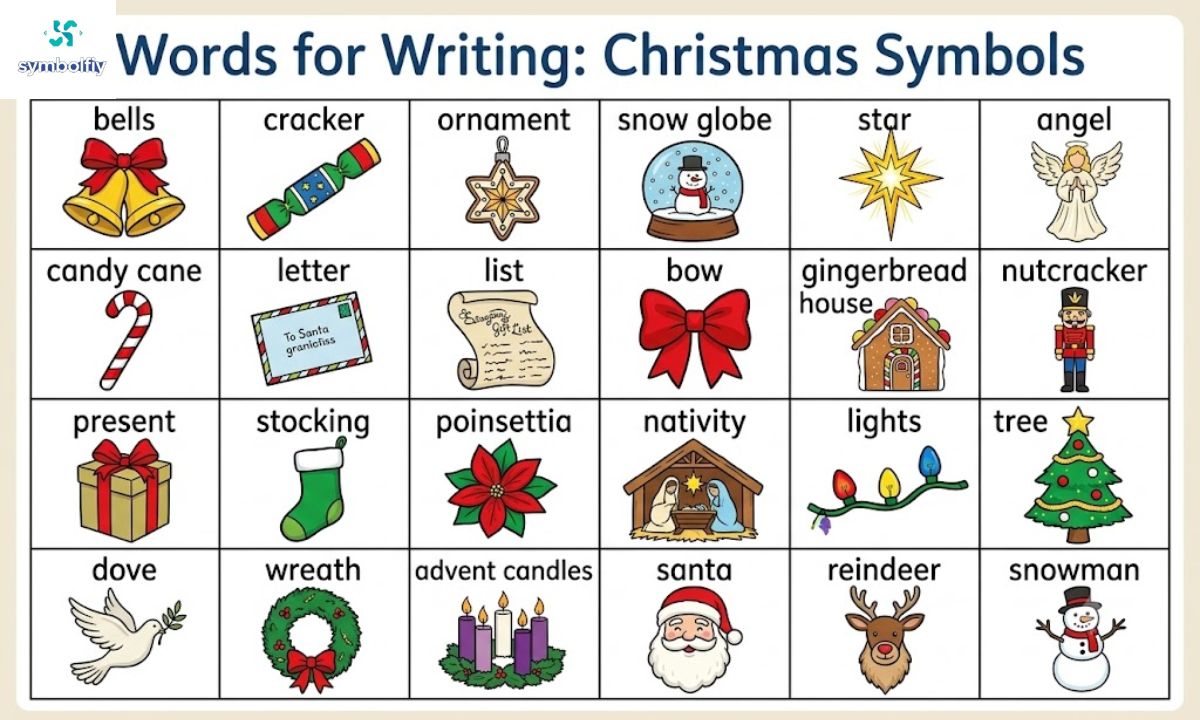
Christmas is one of the most symbol-rich times of year. Every decoration on your door, every light on your tree, and every shape on a card carries a story.
These symbols were not invented randomly — they grew from thousands of years of faith, folk tradition, and human longing for light in the darkest season. Understanding what they mean makes the holiday richer, deeper, and more personal.
Christmas symbols are visual stories about faith, hope, love, and life. Many of them carry Christian meanings tied to the birth of Jesus — his purity, his sacrifice, and his light in the world.
Others grew from ancient pagan midwinter traditions that celebrated the return of the sun after the shortest days of the year. Over centuries, these two streams blended into the celebration we know today.
On a deeper level, Christmas symbols speak to things every human heart desires: warmth in the cold, light in darkness, love from others, and hope for the future. That is why they feel meaningful even to people who may not practice a religion. They touch something universal — the need to gather, celebrate, remember, and believe.
25+ Christmas Symbols and Their Meanings
Core Christian Christmas Symbols ✝️
These symbols come directly from the story of Jesus’ birth and the Christian faith that grew around it.
Christmas Star ⭐
The star of Bethlehem sits at the very heart of the Christmas story. According to the Bible, a bright star guided the three wise men to the place where Jesus was born. The star represents divine guidance, hope, and the light of God breaking into the world. Today it tops Christmas trees as a reminder of that sacred night.
Nativity Scene 🏚️
The nativity scene shows baby Jesus lying in a manger, surrounded by Mary, Joseph, shepherds, and the Magi. Saint Francis of Assisi is credited with creating the first living nativity in 1223. It is the most direct symbol of the Christmas story. It reminds believers of humility — God choosing to be born not in a palace, but in a stable.
Angels 👼
Angels appear throughout the Christmas story — announcing Jesus’ birth to Mary, speaking to Joseph in dreams, and singing glory over the fields. In Christmas symbolism, angels represent divine joy, peace, and the good news that changed the world. They are placed on treetops and used in decorations as messengers of hope.
Candles 🕯️
Candles at Christmas carry the meaning of Jesus as “the Light of the World.” In early Christian homes, candles were lit to welcome Christ’s presence. The warm glow of a candle in winter is a powerful image of warmth defeating cold, and hope defeating despair. Many churches still hold candlelight services on Christmas Eve.
Christmas Colors — Red, Green, and Gold 🔴🟢🟡
Red represents the blood of Jesus shed on the cross — a reminder that Christmas leads to Easter. Green stands for eternal life, seen in evergreen plants that stay alive even through winter’s death. Gold represents the royalty of Jesus and the gifts of the Magi. Together, these three colors tell the whole gospel story.
The Dove 🕊️
The dove is a symbol of the Holy Spirit and peace. In the Christmas season it represents God’s peace coming to earth through Jesus. In art, a white dove is often shown over the manger or near angels. It carries the simple message of goodwill to all — the very heart of the Christmas season.
Plant-Based Christmas Symbols 🌿
Plants play a surprisingly deep role in Christmas traditions, blending pagan and Christian meanings across centuries.
Christmas Tree 🎄
The evergreen fir tree is the most recognized Christmas symbol in the world. It stays green even in deep winter, making it a natural symbol of everlasting life. Saint Boniface introduced the fir tree to German Christians in the 700s as a sign of faith. The triangular shape is also said to represent the Holy Trinity — Father, Son, and Holy Spirit.
Holly 🌿
Holly’s sharp, pointed leaves are linked to the crown of thorns placed on Jesus at the crucifixion. Its bright red berries represent drops of his blood. But holly was also used by ancient Celtic peoples as a powerful winter plant. It was hung in homes for protection and to honor the winter season. Today it decorates wreaths, cards, and doorways.
Poinsettia 🌺
The poinsettia comes from Mexico, where it is called Flor de Nochebuena — “Flower of Christmas Eve.” A Mexican legend tells of a poor girl who had nothing to give at a Christmas service.
She gathered weeds, and they miraculously transformed into the beautiful red flower at the altar. Its star shape recalls the Star of Bethlehem, and its red color symbolizes Christ’s sacrifice.
Mistletoe 🌱
Mistletoe is a plant of many meanings. Ancient Druids saw it as sacred — a plant of peace, healing, and protection. Norse mythology tied it to love and reconciliation. When Christians adopted midwinter customs, mistletoe became a symbol of love and goodwill. Today, the tradition of kissing under the mistletoe is a lighthearted carry-over of these ancient ideas about peace between people.
Ivy 🌿
Ivy clings to walls and stays green through the coldest winters. This made it a symbol of eternal life, faithfulness, and friendship across many ancient cultures. In Christian symbolism, ivy represents the soul clinging to God for support. It was often used alongside holly in church and home decorations from at least the 15th century in England.
Christmas Wreath ⭕
The wreath is a circle — and circles have no beginning or end. That makes it a perfect symbol of eternity and God’s never-ending love. Evergreen wreaths represent life that continues even in winter. In early Christian homes the wreath was a symbol of Christ’s victory over death. Today it hangs on doors as a welcoming sign of peace, warmth, and the Christmas season.
Pinecone 🌲
Pinecones were symbols of fertility, growth, and renewal in many ancient cultures including Roman and Greek. Their spiral pattern was seen as a sign of divine order in nature. At Christmas, pinecones appear in wreaths and garlands as natural emblems of abundance and the promise of new life — very fitting for a season that celebrates a birth.
Classic Christmas Decorations 🎁
These symbols are deeply tied to the festive, visual side of Christmas — what most people see when they picture the holiday.
Christmas Lights ✨
Electric Christmas lights replaced real candles on trees in 1882. But the meaning stayed the same — light breaking through the dark. In Christian tradition, lights on the tree represent Jesus as the light of the world entering a dark season. The warm glow of a lit house in winter carries a powerful emotional message: someone is home, and you are welcome here.
Christmas Bells 🔔
Church bells rang for centuries to announce important events — and the birth of Christ was the most important of all. Bells at Christmas represent joy, celebration, and the announcement of good news. In medieval times, bells broke the silence of the night to proclaim Christmas morning. Today they appear in carols, decorations, and door wreaths as symbols of that same joyful proclamation.
Christmas Ornaments / Baubles 🔴
The very first Christmas tree decorations were apples, hung on the tree to represent the forbidden fruit in the Garden of Eden — a reminder of why Jesus came. Over time, apples were replaced by glass balls. Ornaments today represent the beauty, abundance, and light of the Christmas season. Each one hung with care is a small act of celebration.
Tinsel ✨
Tinsel was originally made from strips of real silver, hung on trees to reflect candlelight and make the tree shimmer like ice. In some traditions it represented the rain of God’s blessings falling on earth. Today it is purely decorative, but its shimmer still adds that magical quality to the Christmas tree that makes children (and adults) stop and stare.
Christmas Star Topper ⭐
The star placed at the very top of the Christmas tree holds a place of honor because it represents the Star of Bethlehem — the highest, most important sign of the whole Christmas story. Some families use an angel topper instead, representing the angel who announced Jesus’ birth. Either way, the tree topper says: this is what all of this is about.
Cultural Christmas Symbols 🎅
These symbols grew more from cultural tradition than scripture, but they carry their own meaningful stories.
Santa Claus 🎅
Santa Claus is based on Saint Nicholas, a real 4th-century bishop in what is now Turkey. He was famous for his generosity — secretly leaving bags of gold for poor families. Over centuries, his story merged with Norse mythology and modern folklore to create the jolly figure in red we know today. He represents the spirit of giving without expecting anything in return.
Reindeer 🦌
Reindeer entered Christmas mythology through the 1823 poem “A Visit from St. Nicholas” (known as “‘Twas the Night Before Christmas”). These animals represented safe, swift travel through the winter night. Reindeer are symbols of endurance, freedom, and the magic of Christmas Eve. Rudolph, with his red nose, was added in 1939 as a symbol of courage and being different.
Christmas Stockings 🧦
The stocking tradition connects directly to Saint Nicholas. Legend says he secretly tossed bags of gold through the window of a poor family, and the coins fell into stockings left by the fire to dry. The Christmas stocking became a symbol of charity — giving privately, with no fanfare. Today, filling stockings is a beloved tradition of surprise and small joys.
Gifts and Presents 🎁
Gift-giving at Christmas honors the gifts brought by the Magi — gold, frankincense, and myrrh — to the baby Jesus. More broadly, it reflects God’s gift of his son to the world. Gifts represent love made visible. The act of choosing something for someone says: I know you, I thought of you, and I care about you. That is a deeply human and spiritual act.
Christmas Cards 💌
The first printed Christmas card was created in England in 1843. Cards quickly became a way of saying: I am thinking of you this season. They often show nativity scenes, winter landscapes, or festive symbols. In a world that moved fast even before the internet, Christmas cards were a deliberate pause to honor relationships and spread goodwill.
The Yule Log 🪵
The Yule log has Norse and Germanic pagan roots. At the winter solstice, a large log was carefully chosen and burned to encourage the sun to return. Christians later gave it new meaning — the log’s fire represented Jesus as the light of the world warming the home. Today in France it lives on as the Bûche de Noël, a log-shaped Christmas cake.
Gingerbread Man 🍪
Gingerbread has been made since ancient times, but gingerbread men became popular in England during Queen Elizabeth I’s reign in the 1500s. Ginger was prized as a warming winter spice. The gingerbread man became a symbol of festive warmth, playfulness, and the sweet comfort of the Christmas season. He is one of the most joyful, childlike symbols of the holiday.
Candy Cane 🍬
The candy cane is shaped like the letter J — for Jesus — or like a shepherd’s staff. Its white color represents purity, and its red stripes represent Christ’s blood. Some stories say a choirmaster in 17th-century Germany made the first candy canes to keep children quiet during long Christmas services. Whether or not that is true, the candy cane has become one of the sweetest symbols of the season.
Snowflake ❄️
The snowflake has no single religious origin, but its six-pointed symmetry and unique beauty make it a natural symbol of winter wonder. No two snowflakes are alike — which makes them a symbol of individuality and the idea that every person is unique and precious. At Christmas, snowflakes represent the quiet magic of winter and the beauty of the season.
Snowman ⛄
The snowman is a purely cultural Christmas symbol — a figure built from snow by children having fun in winter. But emotionally, the snowman represents joy, togetherness, and the playful side of the season. Building a snowman is a family activity, a shared memory, and a reminder that Christmas is about being present with the people you love.
Christmas Colors — White and Silver ⚪
White at Christmas represents purity, peace, and the freshness of new snow. It connects to the idea of Christ’s purity and the clean start his birth offered the world. Silver carries similar meanings of clarity and preciousness. Together, white and silver balance the warmth of red and green with a cool, peaceful tone that reflects the still, holy night of Christmas.
Spiritual and Lesser-Known Christmas Symbols 🌟
The Advent Wreath 🕯️
The Advent wreath holds four candles, one lit each week in the four weeks before Christmas. Three are purple (representing hope, peace, and joy) and one is pink (for love). The circle again represents eternity. Lighting the candles is a spiritual practice of patient waiting — building anticipation for the coming of the light.
The Chi-Rho Symbol ☧
Chi-Rho (☧) is one of the oldest Christian symbols — the first two letters of “Christ” in Greek. It appears in ancient church art and manuscripts. At Christmas, it shows up subtly in decorations and cards. It is a reminder that the word “Christmas” itself contains the name of Christ — and that the holiday’s deepest meaning is found there.
Garland 🌿
Like the wreath, garland made from evergreen branches carries the meaning of eternal life and ongoing celebration. It was used in ancient Roman Saturnalia festivals to decorate public spaces, and Christians later adapted the tradition. Draped along mantels, banisters, and doors, garland signals that the whole home is wrapped in the joy of the season.
Ancient Cultures That Used These Symbols
Christmas symbols have roots in many ancient traditions. Here is how different cultures helped shape what we celebrate today.
Ancient Romans — Celebrated Saturnalia (December 17–24) with decorated public spaces, candles, evergreens, and gift-giving. Many of these customs merged into early Christmas celebrations.
Celtic / Druid traditions — Held mistletoe and holly as sacred plants of midwinter. Druids hung mistletoe in homes for protection and peace, and decorated with evergreens to honor nature’s survival through winter.
Norse / Germanic peoples — Celebrated Yule at the winter solstice with Yule logs, feasting, and candles to encourage the sun’s return. Reindeer were revered animals in Norse culture.
Early Christians — Gave new meaning to existing symbols — turning evergreens into signs of eternal life, lights into the Light of the World, and midwinter gatherings into celebrations of Christ’s birth.
Medieval Catholic Church — Created the nativity scene, advent practices, and church bell traditions. Monks wrote carols and developed the visual language of Christmas that spread across Europe.
Mexican / Latin American culture — Gave the world the poinsettia as a Christmas symbol, along with posadas (processions re-enacting Mary and Joseph’s search for shelter) and vibrant nativity traditions.
Victorian England — Popularized the Christmas tree, Christmas cards, Santa Claus stories, and the modern gift-giving tradition. Much of what we think of as “traditional” Christmas actually comes from the Victorian era.
Why Christmas Symbols Still Matter Today
In a world full of screens and noise, Christmas symbols cut through to something real. They are objects and images that carry weight — not because a marketing department decided so, but because generations of people found meaning in them. When you hang a star, light a candle, or hang stockings by the fireplace, you are participating in something much larger than yourself. That feeling of connection to history and tradition is deeply meaningful in any age.
On a personal and spiritual level, Christmas symbols give people a language for things that are hard to say in plain words. Hope. Peace. Love. Light after darkness. These are not small ideas — they are the things human hearts most need.
Whether you hang a wreath for its Christian symbolism, its beauty, or simply because it feels like Christmas, the symbol does its work. It reminds you of what matters most.
Frequently Asked Questions
What are the main Christmas symbols?
The most common ones are the star, Christmas tree, holly, wreath, candles, candy cane, angels, Nativity scene, and Santa Claus.
What does the Christmas star represent?
The star represents the Star of Bethlehem that guided the Magi to Jesus — a symbol of divine light, guidance, and hope.
What is the Christian meaning of the Christmas tree?
The evergreen tree represents eternal life and God’s everlasting love, with its triangular shape also symbolizing the Holy Trinity.
Why is red and green used for Christmas?
Red represents Christ’s blood and sacrifice, while green represents eternal life seen in plants that stay green through winter.
What does the candy cane symbolize at Christmas?
The candy cane’s J shape represents Jesus or a shepherd’s staff, its white color means purity, and its red stripes symbolize Christ’s blood.
Conclusion
Christmas symbols are far more than decorations. Each one carries centuries of meaning — from ancient forests and medieval manuscripts to church altars and family living rooms. Whether you celebrate for faith, family, or both, these symbols speak a language of hope, love, and light that never goes out of date. The more you know about them, the richer the season becomes.