Squid Game is more than a TV show. It uses symbols to tell a deeper story about power, class, and human nature. Every shape, color, mask, and number in the series was chosen carefully. These symbols pull from Korean culture, philosophy, and even ancient traditions. Once you understand what they mean, the show hits completely differently.
Squid Game symbols represent a system built on control. The geometric shapes on the masks, the colors the workers wear, the numbers on the players — all of it adds up to a language of power and hierarchy.
Creator Hwang Dong-hyuk designed each symbol to reflect how society sorts people into levels without their consent.
On a deeper level, these symbols mirror real life. The people at the top hide their faces. The people at the bottom follow orders without knowing why. That is not just a TV plot — it is a comment on how systems of power actually work in the modern world.
25+ Squid Game Symbols and Their Meanings
The Three Core Shapes ○ △ □
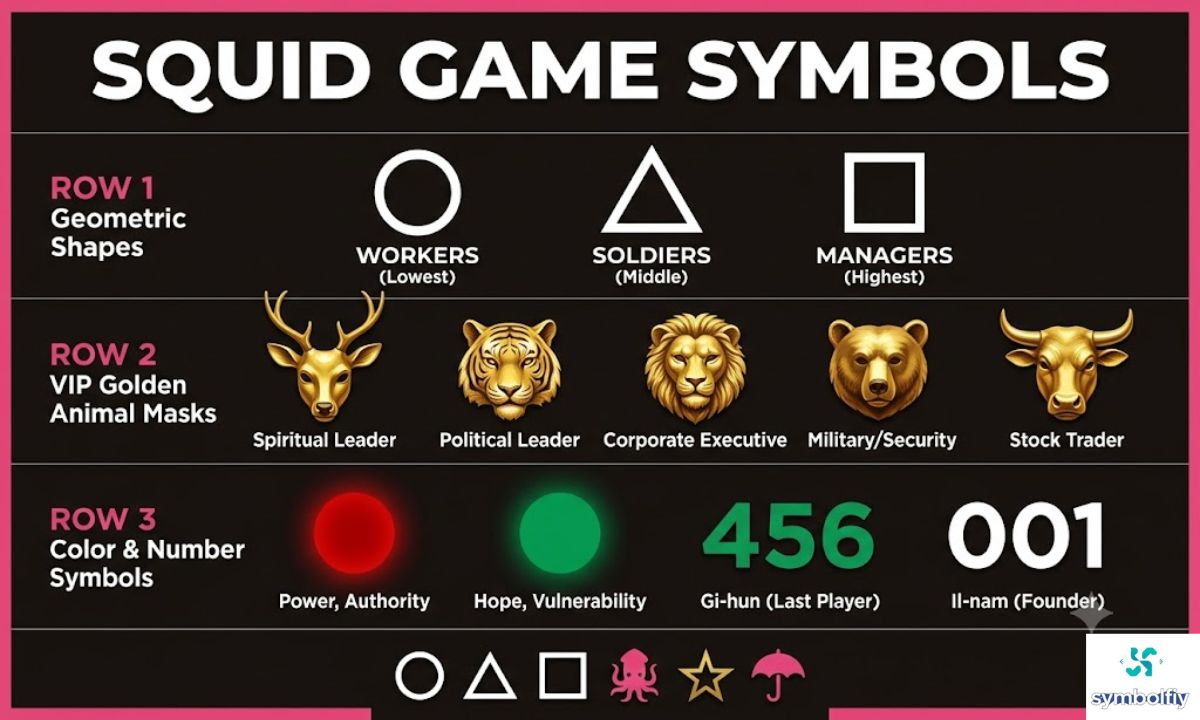
These three shapes run the entire operation in Squid Game. They appear on the masks of every worker inside the game and define who gives orders and who follows them.
○ Circle — Workers (Lowest Rank)
The circle has no beginning and no end. In Squid Game, workers with circle masks do the most basic and brutal tasks — cleaning blood, moving bodies, serving food. They have no authority and ask no questions. The circle in philosophy often represents unity and wholeness, but here it means the opposite: invisibility and disposability.
△ Triangle — Soldiers (Middle Rank)
Triangles point upward, which has always suggested direction and force. Triangle-masked soldiers are the armed enforcers of the games. They carry weapons and keep order. They can give commands to circle workers but must obey anyone wearing a square. The triangle sits in the middle of the hierarchy — powerful enough to hurt, not powerful enough to decide.
□ Square — Managers (Highest Rank)
The square is the most structured shape. Four equal sides, total balance. Square-masked managers oversee operations, communicate with the Front Man, and run the games. They represent order, authority, and institutional control. Among the pink-jumpsuit workers, a square mask means the highest rank.
○△□ Together — “OJM” in Korean Hangul
This is one of the most clever details in the show. When you read the three shapes as Korean letters, circle = “O,” triangle = “J,” square = “M.” That spells OJM — the initials of “Ojingeo Geim,” which means Squid Game in Korean. The creator confirmed this at a 2021 Netflix press conference. The masks are literally wearing the show’s name.
The Cheon-Ji-In Philosophy
In Korean thought, there is an old concept called “cheon-ji-in” — heaven, humanity, and earth. The circle represents heaven (cheon), the triangle represents humanity (in), and the square represents earth (ji). Hwang Dong-hyuk built this ancient philosophical idea directly into the mask system. The show’s hierarchy is rooted in something much older than Netflix.
VIP Animal Masks 🦌 🐯 🦁 🐻 🐂
The VIPs are the wealthy elites who watch the games for entertainment. Their gold animal masks are loaded with meaning.
🦌 Deer Mask
In Korean shamanic tradition, the deer connects humans to the heavens. It is a divine animal, considered a bridge between the spiritual world and the physical one. The VIP wearing a deer mask may represent a religious or spiritual kind of authority — someone who believes they are above ordinary moral rules.
🐯 Tiger Mask
The Siberian tiger is the national animal of South Korea. It appears in Korean folklore as a guardian and a symbol of courage. A VIP in a tiger mask suggests political power — someone with national or governmental authority watching people die for sport.
🦁 Lion Mask
The lion has always meant royalty and corporate dominance across cultures. In Squid Game, the lion mask likely represents an executive-level power player — someone who built wealth through business and sees the games as just another investment.
🐻 Bear Mask
The bear symbolizes raw strength and aggression. It is associated with military force and physical dominance. The bear-masked VIP probably comes from a background tied to security or armed power.
🐂 Bull Mask
The bull is a direct financial symbol. It comes straight from Wall Street — a bull market means rising stocks and profit. This VIP is almost certainly from the world of finance, watching human suffering the same way they watch market fluctuations.
🦉 Owl Mask — Oh Il-nam (Player 001)
The owl is the symbol of hidden knowledge. It sees in the dark and stays quiet. Oh Il-nam, the founder of the games, wears an owl mask as a VIP. He is the man who knows everything while appearing to know nothing. Intelligence concealed behind silence.
Color Symbols 🔴🟢⚫
🔴 Red — Guards and Workers
Red is the color of power, danger, and control. Every guard and worker wears red jumpsuits. In Korean culture, red has traditionally represented wealth and celebration — but in Squid Game, it is turned into a symbol of enforcement and fear. Red means authority. Red means you are not the one in danger.
🟢 Green — Players
Green means life, growth, and hope. The players wear green tracksuits. It is the color of nature, of survival instinct. But green also means vulnerable — something that can be cut down. The players hope to live while the system treats their lives as expendable. Green is both hopeful and fragile at the same time.
⚫ Black and Gold — VIPs
Black represents power without accountability. Gold represents extreme wealth. Together, they signal a level of privilege so far above the games that the people wearing these colors do not even see the players as human. This is the visual language of moral corruption dressed up as luxury.
🩷 Pink — The System Itself
The pink jumpsuits worn by lower-level workers sit between red and white — between power and innocence. Pink in this context represents the system operating as normal, doing its job cleanly and without emotion. It is the color of institutional indifference.
Number Symbols 🔢
456 — Seong Gi-hun
Gi-hun is player 456 because he was the last person recruited before the games began. He is also the last one standing. The number 456 connects to the prize: 45.6 billion Korean won. His PIN number is also 456. He represents the average person — someone without special skills or connections, just a person trying to survive a system that was never designed for him to win.
001 — Oh Il-nam
001 is the first number — the beginning. Oh Il-nam founded the organization, so his number signals that he started everything. He is the origin point of the entire nightmare. Symbolically, 001 represents the god of this small, twisted universe — the one who set the rules before anyone else arrived.
12:00 — Midnight
The games begin and end at midnight. In storytelling and folklore, midnight is the threshold moment — when the old day dies and the new one begins. It is the hour of transformation and no return. Gi-hun’s arc in the show also ends at midnight when player 001 finally dies.
The Squid Game Diagram 🦑
The squid game itself — the final game in Season 1 — is played on a diagram drawn on the ground. It combines a square, a triangle, and circles. This is the same shape children in Korea used to draw when playing the traditional game “ojingeo” in the streets.
Hwang Dong-hyuk drew this as a child. The fact that the entire dark series is named after a simple kids’ drawing is one of the show’s most haunting details.
Wall Drawings (Season 2) 🎮
In Season 2, new drawings appear on the walls of the game facility. Some of them look like a chessboard or the Korean board game Go (also called Baduk). Chess and Go are both strategy games about domination — you win by controlling space and eliminating your opponent’s pieces. The drawings hint at how the organizers see the games: as calculated moves, not human tragedy.
Player Icons 📊
Small icons on screens throughout the facility track which players are still alive and which have been eliminated. These icons reduce human beings to data points — a direct visual metaphor for how the VIPs and organizers see the contestants. Not people. Just numbers on a board.
Cultural Roots Behind These Symbols
Squid Game did not create its symbols from nothing. They connect to real traditions and ideas.
Korean culture — The shapes, the squid game diagram, and the “cheon-ji-in” philosophy all come directly from Korean tradition. The show is deeply rooted in its home culture.
Korean shamanism — The deer mask’s divine symbolism comes from Muism, Korea’s indigenous shamanistic tradition, where deer are spiritual messengers.
Greek mythology — The owl as a symbol of hidden wisdom connects to Athena, goddess of intelligence. Oh Il-nam’s owl mask carries this weight.
Christianity — The number 001 as an “omniscient” figure echoes monotheistic ideas of an all-knowing creator watching over created beings.
Buddhism — Themes of suffering, impermanence, and the trap of desire run through the entire series. Players chase money and pay with their lives.
Financial culture — The bull mask pulls directly from Western stock market symbolism, connecting global capitalism to the show’s critique of wealth and exploitation.
Why These Symbols Still Matter Today
Squid Game became a global phenomenon because its symbols say something true. The shapes on the masks are not just costume design — they show how real institutions work.
The people at the top stay hidden. The people in the middle enforce rules they did not make. And people at the bottom follow orders and pay the price.
That is why these symbols show up everywhere now — in tattoos, fan art, Halloween costumes, and memes. They give people a visual shorthand for something they already feel.
When someone puts a circle, triangle, or square in their artwork, they are not just referencing a show. They are making a statement about power, identity, and where they fit in a system that was designed before they arrived.
Why does the show use a circle, triangle, and square?
They spell “OJM” in Korean Hangul — the initials of “Ojingeo Geim,” meaning Squid Game in Korean.
What does player 456 represent?
He is the last player recruited and the last survivor, and his number connects to the 45.6 billion won prize.
What do the animal masks mean?
Each animal represents a type of elite power — deer (spiritual), tiger (political), lion (corporate), bull (financial), owl (intellectual).
Why is red used for the guards and green for the players?
Red signals authority and danger; green signals hope and vulnerability — the two sides of an unequal system.
Conclusion
Every symbol in Squid Game was chosen on purpose. The shapes, colors, animals, and numbers all work together to build a world that feels uncomfortably close to reality. When you understand what each one means — the philosophical roots, the cultural references, the deliberate hierarchy — the show becomes a lot more than entertainment. It becomes a mirror.