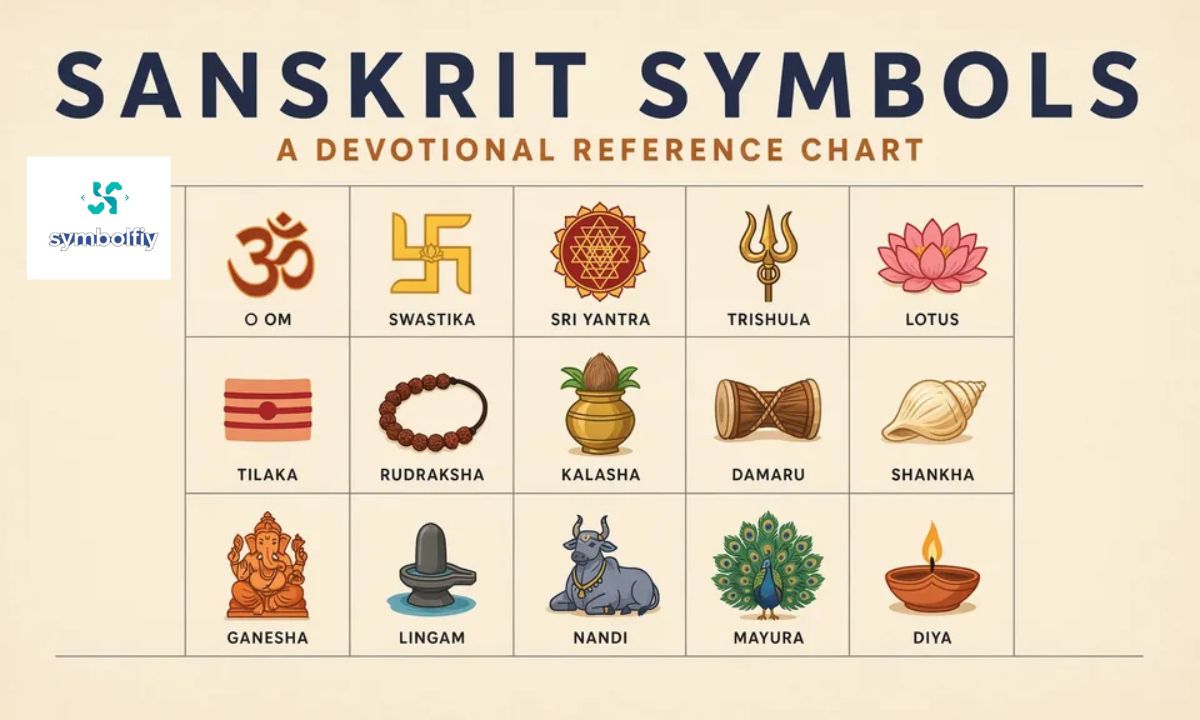
Sanskrit is one of the oldest languages on earth, and its symbols carry far more than words. Each sign, letter, and sacred mark holds layers of spiritual, philosophical, and cultural meaning built up over thousands of years.
People across the world wear these symbols as tattoos, use them in meditation, paint them on temple walls, and carry them as jewelry — not just because they look beautiful, but because they mean something deep. Understanding what Sanskrit symbols actually represent helps you connect with that meaning honestly and respectfully.
Sanskrit symbols represent the meeting point of sound, thought, and spiritual reality. In Hindu and Buddhist philosophy, spoken sound is not just communication — it is vibration, and vibration shapes consciousness.
Each Sanskrit symbol is tied to a specific energy, deity, concept, or state of being. That is why Sanskrit is often called a sacred language rather than just an ancient one. Its symbols were designed to carry meaning at every level.
On a broader scale, Sanskrit symbols stand for the core values of Eastern spiritual traditions — truth, liberation, compassion, duty, and cosmic order.
They have shaped philosophy, art, architecture, yoga, medicine, and daily life across South and Southeast Asia for over three thousand years. Today they continue to influence how millions of people understand themselves and the world.
25+ Sanskrit Symbols and Their Meanings
Sacred Sound Symbols
ॐ Om (Aum)
Om is the most recognized Sanskrit symbol in the world. Its shape — a combination of curves, a hook, and a dot — contains deep meaning in every stroke.
Origin: Rooted in the Vedas, the oldest Hindu scriptures, dating back over 3,000 years
Spiritual meaning: The primal sound of the universe; the vibration from which all creation arose
Historical background: Used at the beginning and end of prayers, mantras, and sacred texts across Hindu, Buddhist, and Jain traditions
Religious connection: In Hinduism, the three curves represent waking, dreaming, and deep sleep states; the dot represents pure consciousness (turiya)
Modern interpretation: The global symbol of yoga, meditation, and Eastern spirituality
Emotional symbolism: Peace, unity, and the feeling of being part of something infinite
ह्रीं Hreem (Bija Mantra of the Goddess)
Hreem is a one-syllable seed mantra (bija) associated with the Divine Feminine and cosmic creative power.
Origin: Found in Tantric and Shakta traditions of Hinduism; one of the most powerful bija mantras in the tradition
Spiritual meaning: The sound of the Divine Mother — Mahamaya, the great creative force behind all existence
Historical background: Used in advanced Tantric rituals and goddess worship for thousands of years
Religious connection: Central to the worship of Durga, Kali, Lakshmi, and the universal mother goddess
Modern interpretation: Used in mantra meditation to invoke feminine spiritual power and inner transformation
Emotional symbolism: Creativity, power, and deep inner awakening
क्लीं Kleem (Bija Mantra of Attraction)
Kleem is a bija mantra associated with attraction, love, and the fulfillment of desires.
Origin: Rooted in Vedic and Tantric traditions; linked to Lord Krishna and the goddess Kali in different contexts
Spiritual meaning: The sound of attraction — drawing positive energy, love, and abundance toward the practitioner
Historical background: Found in ancient Sanskrit texts as a mantra for cultivating devotion and desire for liberation
Religious connection: Associated with Krishna’s magnetic divine love and with Kamadeva, the god of desire
Modern interpretation: Used in mantra practices focused on relationships, self-love, and personal magnetism
Emotional symbolism: Love, connection, and the pull of the heart toward what truly matters
ऐं Aim (Bija Mantra of Saraswati)
Aim is the seed syllable of Saraswati, the goddess of knowledge, learning, and creative arts.
Origin: Vedic tradition; one of the classical bija mantras of the Shakta system
Spiritual meaning: The power of sound and speech; the activation of intelligence and creative expression
Historical background: Recited by students, scholars, musicians, and teachers before learning or performing
Religious connection: Directly associated with Saraswati; also used as a mantra for the guru principle
Modern interpretation: Chanted before study, writing, music, or any creative work to invoke clarity and inspiration
Emotional symbolism: Curiosity, intellectual confidence, and the joy of learning
श्रीं Shreem (Bija Mantra of Lakshmi)
Shreem is the seed sound of Lakshmi, the goddess of wealth, beauty, and abundance.
Origin: Ancient Vedic and Tantric sources; one of the most widely chanted bija mantras in Hindu practice
Spiritual meaning: Abundance at all levels — material, spiritual, emotional, and relational
Historical background: Used in rituals for prosperity, health, and well-being across Hindu traditions for millennia
Religious connection: The core mantra of Lakshmi worship; also invoked during Diwali celebrations
Modern interpretation: Popular in abundance meditation and manifestation practices globally
Emotional symbolism: Gratitude, beauty, and the feeling of being genuinely blessed
Sacred Concepts as Symbols
धर्म Dharma
The word Dharma written in Devanagari script is itself a sacred symbol representing one of the most important concepts in Eastern philosophy.
Origin: Sanskrit root “dhr” meaning to hold or support; found throughout the Vedas, Upanishads, and Bhagavad Gita
Spiritual meaning: The cosmic law that holds all things in order; your individual duty aligned with that law
Historical background: Central to Hindu, Buddhist, and Jain philosophy; the Buddha’s first teaching is called the Dharmachakra Pravartana — the Turning of the Wheel of Dharma
Religious connection: The Dharma Wheel (Dharmachakra) is one of the Eight Auspicious Symbols of Buddhism
Modern interpretation: Used broadly to mean living rightly, acting with integrity, and following one’s true purpose
Emotional symbolism: Responsibility, purpose, and the quiet strength of doing what is right
कर्म Karma
Karma is perhaps the most globally recognized Sanskrit concept, carried into almost every major world language.
Origin: Sanskrit root “kri” meaning action; foundational concept in Hindu, Buddhist, and Jain traditions
Spiritual meaning: The law of cause and effect — every action creates a corresponding result across this life and future lives
Historical background: Described in detail in the Upanishads and the Bhagavad Gita as the mechanism governing rebirth
Religious connection: Central to all Indian spiritual traditions; the Bhagavad Gita’s entire framework rests on right action (karma yoga)
Modern interpretation: Used globally to mean “what goes around comes around”; deeply embedded in popular culture
Emotional symbolism: Accountability, justice, and the power of conscious choice
मोक्ष Moksha
Moksha is the ultimate goal of Hindu spiritual life — liberation from the cycle of birth, death, and rebirth.
Origin: One of the four purusarthas (life goals) in Hindu philosophy alongside Dharma, Artha, and Kama
Spiritual meaning: Complete freedom of the soul from the cycle of samsara (rebirth); union with Brahman, the universal consciousness
Historical background: Explored in depth in the Upanishads and remains central to Vedanta philosophy
Religious connection: Each major Hindu path — Jnana (knowledge), Bhakti (devotion), Karma (action), and Raja (meditation) yoga — leads toward moksha
Modern interpretation: Used in spiritual contexts to represent ultimate freedom, self-realization, and inner peace
Emotional symbolism: Release, completeness, and the end of suffering
अहिंसा Ahimsa
Ahimsa means non-violence — and it is one of the most powerful ethical principles to come from Sanskrit tradition.
Origin: Present in the earliest Hindu scriptures; elevated to a central principle by Jain philosophy and later by Mahatma Gandhi
Spiritual meaning: The refusal to cause harm — to any living being, in thought, word, or action
Historical background: Gandhi’s use of Ahimsa in the Indian independence movement showed the world the political and social power of nonviolent resistance
Religious connection: The first and most important of the Yamas (ethical restraints) in Patanjali’s Yoga Sutras
Modern interpretation: Central to veganism, environmental ethics, and nonviolent activism worldwide
Emotional symbolism: Gentleness, compassion, and the courage to protect rather than destroy
सत्य Satya
Satya means truth — and in Sanskrit tradition, truth is not just a virtue but a living spiritual force.
Origin: From the Sanskrit root “sat” meaning being, existence, and truth; found throughout Vedic literature
Spiritual meaning: Living in alignment with reality; speaking and acting truthfully as a spiritual practice
Historical background: The second of the Yamas in Patanjali’s Yoga Sutras; Gandhi combined it with Ahimsa in his concept of Satyagraha (truth-force)
Religious connection: In Advaita Vedanta, “Sat-Chit-Ananda” (Being-Consciousness-Bliss) is the description of ultimate reality
Modern interpretation: Used in yoga and mindfulness communities as a reminder to live honestly and authentically
Emotional symbolism: Integrity, clarity, and the peace that comes from living without deception
Sacred Geometry Symbols
🔺 Sri Yantra
The Sri Yantra is the most complex and revered of all sacred geometry symbols in the Hindu tradition.
Origin: Found in ancient Tantric texts; said to represent the cosmic form of the goddess Tripura Sundari
Spiritual meaning: The nine interlocking triangles represent the union of Shiva (masculine) and Shakti (feminine) — the entirety of existence
Historical background: Used in advanced Tantric meditation for thousands of years; one of the most studied examples of sacred geometry in the world
Religious connection: Central to Sri Vidya, one of the most sophisticated schools of Hindu Tantric practice
Modern interpretation: Popular in meditation spaces, spiritual jewelry, and sacred art worldwide
Emotional symbolism: Balance, cosmic order, and the harmony of opposites
🌸 Mandala
The Sanskrit word Mandala means “circle” — and it represents the cosmos, wholeness, and the cyclical nature of existence.
Origin: Found in Vedic ritual diagrams; later developed extensively in Hindu and Buddhist Tantric traditions
Spiritual meaning: A map of the universe and of the inner self; used as a meditation aid to focus the mind toward center
Historical background: Tibetan Buddhist monks spend weeks creating intricate sand mandalas only to destroy them — teaching impermanence
Religious connection: Used in Hindu puja (worship), Buddhist meditation, and Navajo sand painting traditions across cultures
Modern interpretation: Widely used in art therapy, mindfulness practice, and as decorative spiritual art
Emotional symbolism: Wholeness, inner peace, and the integration of all parts of the self
🔺 Yantra
A Yantra is a geometric spiritual diagram used as a focus for meditation and ritual in Hindu practice.
Origin: Ancient India; described in Tantric texts as the “body” of a deity — a visual mantra
Spiritual meaning: Each yantra corresponds to a specific deity and is believed to embody that deity’s energy in geometric form
Historical background: Yantras were inscribed on copper, gold, or stone and used in temple worship, home altars, and personal practice
Religious connection: Every major Hindu deity has an associated yantra; the most famous is the Sri Yantra for the Divine Mother
Modern interpretation: Used in home meditation spaces and spiritual jewelry as a focus for specific intentions
Emotional symbolism: Focus, intention, and the directing of energy toward a specific purpose
✡ Shatkona (Star of David / Six-Pointed Star)
The Shatkona — two interlocking triangles — is a sacred geometry symbol that appears in both Hindu and Jewish traditions independently.
Origin: Ancient India; used in Hindu iconography as a symbol of the union of Shiva and Shakti long before its association with Judaism
Spiritual meaning: The upward triangle represents fire, masculine energy, and Shiva; the downward triangle represents water, feminine energy, and Shakti
Historical background: Appears in Hindu temple architecture and Tantric yantras; became the Star of David in Jewish tradition through separate development
Religious connection: Used in the Anahata (heart chakra) symbol in yoga; central to Jewish identity as the Magen David
Modern interpretation: A cross-cultural reminder that sacred geometry appears independently across traditions
Emotional symbolism: Balance, union, and the harmony of complementary forces
Spiritual Icon Symbols
🪷 Lotus (Padma)
The lotus is one of the most universally recognized sacred symbols in all of Eastern spirituality.
Origin: Native to South and Southeast Asia; sacred in Hindu, Buddhist, and Jain traditions for thousands of years
Spiritual meaning: Spiritual purity rising above suffering; the capacity for beauty and enlightenment even in muddy conditions
Historical background: Hindu gods like Brahma, Vishnu, and Lakshmi are depicted seated on or holding lotuses; the Buddha is often shown the same way
Religious connection: The thousand-petaled lotus (Sahasrara) is the crown chakra — the center of divine consciousness in yoga
Modern interpretation: One of the most popular tattoo symbols globally; widely used in wellness, yoga, and mindfulness branding
Emotional symbolism: Resilience, purity, and the ability to bloom through difficulty
🔱 Trishula (Trident of Shiva)
The three-pronged trident is the weapon and symbol of Lord Shiva — one of the principal deities of Hinduism.
Origin: Associated with Shiva in the earliest Hindu texts; also appears in connection with the sea god Poseidon in Greek mythology
Spiritual meaning: The three prongs represent the three aspects of time (past, present, future) and the three gunas (qualities of nature): Sattva, Rajas, and Tamas
Historical background: Carried by Shaivite ascetics and priests; inscribed on temples and sacred objects across the Indian subcontinent
Religious connection: Inseparable from Shiva; also associated with the goddess Durga who carries it in battle against demonic forces
Modern interpretation: Popular in Hindu devotional tattoos and sacred art worldwide
Emotional symbolism: Power, transformation, and the destruction of ignorance
🐚 Shankha (Sacred Conch)
The conch shell is one of the Eight Auspicious Symbols of Buddhism and a sacred icon in Hinduism.
Origin: Used in Vedic rituals dating back thousands of years; found in depictions of Vishnu who holds it as one of his four attributes
Spiritual meaning: The sound of the conch (Om-like vibration) is believed to purify the environment and ward off negative energy
Historical background: Blown at the start of battles in ancient India; used in temple worship to call devotees to prayer
Religious connection: One of Vishnu’s four sacred objects; one of the Eight Auspicious Symbols (Ashtamangala) in Tibetan Buddhism
Modern interpretation: Used in Hindu and Buddhist ceremonies; the spiral shape is associated with sacred geometry and cosmic order
Emotional symbolism: Purification, awakening, and the call to spiritual attention
🌞 Surya (Sun Symbol)
The sun as a sacred Sanskrit symbol represents divine light, consciousness, and the source of all life.
Origin: Sun worship is among the oldest spiritual practices; Surya is one of the principal Vedic deities
Spiritual meaning: Illumination of both the outer world and inner consciousness; the dispeller of darkness and ignorance
Historical background: The Surya Namaskar (Sun Salutation) in yoga is a sequence of poses offered to the rising sun, rooted in ancient Vedic practice
Religious connection: Surya appears in the Rigveda as one of the Adityas; the Gayatri Mantra — arguably the most important Vedic mantra — is a prayer to the sun
Modern interpretation: The sun symbol appears widely in yoga branding, spiritual jewelry, and sacred art
Emotional symbolism: Vitality, clarity, and the confidence that comes with inner light
🐄 Nandi (Sacred Bull)
Nandi, the sacred white bull, is the vehicle (vahana) and gatekeeper of Lord Shiva.
Origin: Present in Shaivite Hindu tradition since ancient times; Nandi figures sit at the entrance of virtually every Shiva temple
Spiritual meaning: Loyalty, strength, and the pure devotion of the soul seeking the divine
Historical background: Nandi statues face the inner sanctum of Shiva temples — symbolizing the gaze of total devotion
Religious connection: Represents Jiva — the individual soul — gazing eternally at Shiva (universal consciousness)
Modern interpretation: Symbol of strength, patience, and unwavering faith in spiritual communities
Emotional symbolism: Devotion, steadfastness, and the strength to remain loyal to what you love
Chakra Symbols
🔴 Muladhara (Root Chakra)
The first chakra symbol features a four-petaled lotus with a downward-pointing triangle inside a square.
Origin: Described in Tantric and yogic texts including the Sat-Chakra-Nirupana; located at the base of the spine
Spiritual meaning: Survival, groundedness, and the foundation of physical and spiritual existence
Historical background: The chakra system as a formal diagram dates to early medieval Indian Tantric texts, though its roots are much older
Religious connection: Central to Kundalini yoga; the dormant spiritual energy (Kundalini Shakti) is said to rest here
Modern interpretation: Used in energy healing, yoga, and wellness practices to address feelings of insecurity or instability
Emotional symbolism: Safety, stability, and the deep human need to feel rooted
🟠 Svadhisthana (Sacral Chakra)
The second chakra symbol shows a six-petaled lotus with a crescent moon inside — the center of creativity and emotion.
Origin: Named from Sanskrit meaning “one’s own abode”; located in the lower abdomen
Spiritual meaning: Creativity, pleasure, sexuality, and the flow of emotions and relationships
Historical background: Described in detail in Tantric yoga texts as the seat of the water element
Religious connection: Associated with Varuna, the Vedic god of water and cosmic order
Modern interpretation: Central to body-positive spiritual practices, creative arts therapy, and emotional healing work
Emotional symbolism: Pleasure, flow, and the permission to feel fully
🟡 Manipura (Solar Plexus Chakra)
The third chakra symbol shows a ten-petaled lotus with a downward-pointing triangle — the center of personal power.
Origin: Sanskrit for “city of jewels”; located in the solar plexus region
Spiritual meaning: Personal will, self-confidence, discipline, and the transformation of energy into action
Historical background: Associated with the fire element and the planet Mars in traditional yogic cosmology
Religious connection: Connected to Agni, the Vedic fire god, and to the transformative power of tapas (spiritual heat)
Modern interpretation: Focal point for confidence, boundary-setting, and motivation in modern wellness culture
Emotional symbolism: Courage, self-worth, and the power to act on your convictions
💚 Anahata (Heart Chakra)
The fourth chakra symbol is a twelve-petaled lotus surrounding two interlocking triangles — the Shatkona — representing love.
Origin: Sanskrit for “unstruck sound”; located at the center of the chest
Spiritual meaning: Unconditional love, compassion, empathy, and the bridge between the lower and higher chakras
Historical background: In Tantric tradition, the heart chakra is where the individual soul (jivatman) resides
Religious connection: The flame of divine love (hridaya) in the heart is central to Bhakti (devotional) yoga philosophy
Modern interpretation: The most referenced chakra in wellness culture; associated with self-love, healing relationships, and forgiveness
Emotional symbolism: Love, healing, and the capacity to give and receive openly
💙 Vishuddha (Throat Chakra)
The fifth chakra symbol features a sixteen-petaled lotus with a downward-pointing triangle and a circle — representing pure communication.
Origin: Sanskrit for “especially pure”; located at the throat
Spiritual meaning: Authentic self-expression, truth in speech, and the power of sound and vibration
Historical background: Associated with the ether element and the power of mantra — sound as a spiritual force
Religious connection: Directly linked to the practice of chanting, mantra recitation, and sacred storytelling in Hindu tradition
Modern interpretation: Used in practices focusing on finding one’s voice, honest communication, and creative expression
Emotional symbolism: Confidence to speak truth and the freedom of authentic expression
🔵 Ajna (Third Eye Chakra)
The sixth chakra symbol is a two-petaled lotus containing an Om symbol and an inverted triangle — the seat of intuition.
Origin: Sanskrit for “command” or “perceive”; located between the eyebrows
Spiritual meaning: Intuition, inner wisdom, the ability to perceive beyond the physical senses
Historical background: The third eye concept appears across cultures — from Shiva’s third eye of destruction to the pineal gland in Western esoteric thought
Religious connection: Shiva’s third eye burns with spiritual fire; opening this chakra is said to bring direct spiritual perception
Modern interpretation: Central to meditation practices focused on developing intuition, clairvoyance, and inner guidance
Emotional symbolism: Clarity, insight, and the trust to follow your inner knowing
🌸 Sahasrara (Crown Chakra)
The seventh chakra symbol is a thousand-petaled lotus — the ultimate spiritual symbol of human enlightenment.
Origin: Sanskrit for “thousand-petaled”; located at the crown of the head
Spiritual meaning: Pure consciousness, unity with the divine, and the complete flowering of spiritual awakening
Historical background: The goal of Kundalini yoga is for the spiritual energy to rise from Muladhara to Sahasrara, resulting in liberation
Religious connection: The crown chakra represents union with Brahman — the universal consciousness — and is the ultimate destination of the spiritual journey
Modern interpretation: Used in meditation focused on spiritual connection, transcendence, and feelings of oneness
Emotional symbolism: Peace, completeness, and the experience of pure presence
Auspicious and Protective Symbols
卍 Swastika (Svastika)
The Swastika is one of the oldest and most widespread symbols in human history — and one of the most misunderstood.
Origin: Sanskrit “svastika” meaning “that which is associated with well-being”; used in India for at least 5,000 years
Spiritual meaning: In its original form, good luck, prosperity, and the eternal cycle of life; the four arms represent the four directions and cosmic order
Historical background: Used across Hinduism, Buddhism, and Jainism as a sacred auspicious symbol long before its appropriation by the Nazi regime in the 20th century
Religious connection: Still actively used as a sacred symbol in Hindu, Buddhist, and Jain temples and ceremonies today — especially in South and East Asia
Modern interpretation: Requires very careful cultural context; its original sacred meaning remains alive in Asian spiritual traditions while its Nazi association makes its use extremely sensitive in Western contexts
Emotional symbolism: In its original meaning — well-being and the turning of the cosmic wheel of life
🕉 Aum Namah Shivaya Symbol
The five-syllable mantra Na-Ma-Shi-Va-Ya written in Sanskrit is one of the most important devotional symbols in Shaivism.
Origin: Found in the Krishna Yajurveda’s Shri Rudram; one of the most ancient and important Hindu mantras
Spiritual meaning: The five syllables correspond to the five elements (earth, water, fire, air, ether) and the five acts of Shiva (creation, preservation, destruction, concealment, grace)
Historical background: Chanted continuously by Shaivite devotees for thousands of years; inscribed on temples across India
Religious connection: The central mantra of Shaivism; said to purify the practitioner and invoke Shiva’s grace
Modern interpretation: Used globally in yoga classes, kirtan music, and personal meditation practice
Emotional symbolism: Surrender, devotion, and the profound peace of letting go
🪬 Rudraksha (Sacred Seed Symbol)
The Rudraksha bead — seed of the Elaeocarpus tree — is a sacred symbol of Shiva’s tears and divine connection.
Origin: Named from Sanskrit “Rudra” (Shiva) and “aksha” (eye or tear); found in Himalayan and Southeast Asian forests
Spiritual meaning: Each bead is said to carry Shiva’s protective energy; wearing them is believed to calm the mind and protect the wearer
Historical background: Described in the Shiva Purana as being born from Shiva’s tears of compassion; worn by yogis, sadhus, and devotees for thousands of years
Religious connection: Central to Shaivite practice; different numbers of facets (mukhis) correspond to different deities and benefits
Modern interpretation: Widely worn as spiritual jewelry across Hindu communities and globally in wellness culture
Emotional symbolism: Protection, calm, and the feeling of divine presence around you
☸ Dharma Wheel (Dharmachakra)
The eight-spoked wheel is one of the most important symbols of Buddhism and represents the Buddha’s first teaching.
Origin: Pre-Buddhist India; the wheel (chakra) was already a royal and cosmic symbol before the Buddha; adopted and transformed by early Buddhism
Spiritual meaning: The Buddha’s Noble Eightfold Path — the practical guide to ending suffering and achieving liberation
Historical background: Emperor Ashoka, who spread Buddhism across Asia in the 3rd century BCE, placed the Dharma Wheel at the center of India’s national flag
Religious connection: One of the most important Buddhist symbols globally; its eight spokes represent the eight steps of the Eightfold Path
Modern interpretation: Still on the Indian national flag; widely used in Buddhist art, tattoos, and spiritual spaces worldwide
Emotional symbolism: Direction, the courage to walk a spiritual path, and the possibility of liberation
🙏 Anjali Mudra Symbol
The pressed-palms gesture written or depicted as a Sanskrit spiritual symbol represents the core of devotional practice.
Origin: Ancient India; the gesture of pressing palms together is described in early Vedic and Buddhist texts
Spiritual meaning: The union of individual self with universal self; honoring the divine in another and in oneself
Historical background: Used as both a spiritual gesture and a social greeting across South and Southeast Asia for thousands of years
Religious connection: Used in Hindu puja (worship), Buddhist prayer, yoga practice, and daily greeting across the region
Modern interpretation: “Namaste” — the verbal companion to Anjali Mudra — has become a globally recognized word and gesture
Emotional symbolism: Reverence, humility, and the recognition of shared humanity and divinity
Additional Sanskrit Symbols
✨ Bindu (Sacred Dot)
The Bindu is a single dot — the simplest and most profound symbol in Sanskrit tradition.
Origin: Sanskrit meaning “point” or “drop”; central to both Hindu cosmology and Tantric sacred geometry
Spiritual meaning: The point of creation — the place before manifestation; the center of the universe and of the self
Historical background: In sacred geometry, the Bindu is the center point of the Sri Yantra; in cosmology, it represents the moment before the Big Bang
Religious connection: In Shaivism, the Bindu represents Shiva as pure consciousness in his most concentrated form; the bindi worn on the forehead marks this sacred spot
Modern interpretation: The tilaka (forehead dot) worn in Hindu culture is a physical expression of the Bindu; the bindi is now both spiritual and cultural
Emotional symbolism: Concentration, origin, and the reminder that everything begins and returns to a single point
🌙 Chandra (Moon Symbol)
The crescent moon is a recurring Sanskrit symbol associated with Shiva, time, and the inner mind.
Origin: Present in Vedic cosmology; the moon god Chandra is one of the Navagrahas (nine celestial bodies) in Hindu astrology
Spiritual meaning: The cooling, receptive, reflective aspect of consciousness; the inner world of dreams, intuition, and emotion
Historical background: Shiva wears the crescent moon in his hair as Chandrashekhara — the one who holds the moon; this represents his mastery over time and mind
Religious connection: The crescent appears in Svadhisthana (sacral chakra) and is associated with the lunar cycle in Hindu ritual calendars
Modern interpretation: Moon symbolism is central to modern spiritual practice including astrology, lunar rituals, and feminine spirituality
Emotional symbolism: Intuition, cyclical change, and the gentle wisdom of reflection
🔥 Agni (Fire Symbol)
Agni — the sacred fire — is both a Vedic deity and one of the most important symbols in Sanskrit spiritual tradition.
Origin: One of the most important deities in the Rigveda; fire worship is among the oldest human spiritual practices globally
Spiritual meaning: Purification, transformation, and the divine witness — fire is the medium through which offerings reach the gods
Historical background: The Vedic fire ritual (yajna) is the heart of ancient Hindu worship; the sacred fire is treated as a living deity
Religious connection: Agni is the messenger between humans and gods; every Hindu ceremony from birth to death involves fire
Modern interpretation: The inner fire of spiritual practice (tapas) — the discipline and heat that transforms the practitioner
Emotional symbolism: Purification, passion, and the courage to let what no longer serves you burn away
🌿 Tulsi (Sacred Basil Symbol)
The Tulsi plant, depicted in sacred art and symbolism, is one of the most beloved sacred symbols in Hindu daily life.
Origin: Revered in Hinduism for thousands of years; considered the earthly manifestation of the goddess Tulsi (a form of Lakshmi)
Spiritual meaning: Purity, devotion, and divine protection; the presence of Tulsi in a home is said to bring peace and ward off negative energy
Historical background: Nearly every traditional Hindu household keeps a Tulsi plant and performs daily worship around it
Religious connection: Sacred to Vishnu; Tulsi leaves are offered in Vishnu and Krishna worship and used in Ayurvedic medicine
Modern interpretation: The Tulsi plant and its symbol appear in Hindu homes, temples, and healing traditions worldwide
Emotional symbolism: Devotion, healing, and the sacred nature of everyday life
∞ Ananta (Infinity / Eternal Serpent)
Ananta — meaning “endless” in Sanskrit — is the cosmic serpent upon whom Vishnu rests between creations.
Origin: Found in the Puranas; Ananta (also called Shesha) is the serpent of eternity who supports the universe
Spiritual meaning: Infinite time, endless cycles of creation and dissolution, and the support beneath all existence
Historical background: Depicted in Hindu art as a massive multi-headed serpent forming a coiled bed for Vishnu in the cosmic ocean
Religious connection: Represents the infinite aspect of God (Ananta Narayana — the Endless One); also the endless nature of the Vedic scriptures
Modern interpretation: The infinity symbol concept resonates with the Sanskrit Ananta; used in spiritual contexts to represent timelessness
Emotional symbolism: Eternity, continuity, and the peace of knowing existence has no true end
Ancient Cultures That Used Sanskrit Symbols
Sanskrit symbols did not develop in isolation. They grew from and influenced many traditions across Asia and beyond.
Ancient India (Vedic civilization): The origin of all Sanskrit symbols; developed the sacred language, the chakra system, mudras, mantras, and yantra geometry across thousands of years.
Buddhism: Adopted and transformed many Sanskrit symbols; the Dharma Wheel, the Om, the lotus, the conch, and Bodhisattva mudras all traveled with Buddhism from India to Tibet, China, Japan, and Southeast Asia.
Jainism: Shares sacred symbols with Hinduism including the Swastika (as an auspicious sign), the lotus, and the hand symbol (representing Ahimsa).
Tibetan Buddhism: Developed one of the most elaborate symbol systems in the world, built on Sanskrit foundations — including the Tibetan script derived from Sanskrit, mandalas, thangkas, and the eight auspicious symbols.
Southeast Asian traditions: Hindu and Buddhist Sanskrit symbols spread to Cambodia, Indonesia, Thailand, and Bali through trade and religious exchange; Angkor Wat is decorated with Sanskrit inscriptions and iconography.
Greek and Persian connections: Some scholars note parallels between Vedic and Greek cosmological symbols, suggesting early cultural exchange along ancient trade routes.
Why Sanskrit Symbols Still Matter Today
Sanskrit symbols have not faded with the ancient world — they have traveled into it. Hundreds of millions of people incorporate Om, chakra symbols, the lotus, and sacred mantras into daily life through yoga, meditation, tattoos, jewelry, and home decor.
These symbols work because they connect people to something older and larger than themselves. In a world that often feels fragmented, they offer coherence — a sense of participating in a tradition with deep roots.
On a personal level, people turn to Sanskrit symbols when they want to mark something meaningful. A lotus tattoo can represent surviving a difficult time. A Hamsa pendant can be a daily reminder of protection and faith.
Chanting a bija mantra during meditation is not just repetition — it is an act of intention. Sanskrit symbols matter today because meaning matters, and these symbols have been trusted carriers of meaning for longer than most civilizations have existed.
Frequently Asked Questions
What is the most important Sanskrit symbol?
Om (ॐ) is considered the most sacred and universally recognized Sanskrit symbol across Hindu, Buddhist, and Jain traditions.
What does the lotus mean in Sanskrit tradition?
The lotus (Padma) represents spiritual purity, resilience, and the ability to achieve enlightenment despite worldly difficulties.
Is the Swastika a Sanskrit symbol?
Yes — Svastika is a Sanskrit word meaning well-being; it was a sacred symbol in Indian traditions thousands of years before its misuse in the 20th century.
What are bija mantras?
Bija mantras are single-syllable seed sounds in Sanskrit believed to carry concentrated spiritual energy for specific deities or intentions.
Can anyone use Sanskrit symbols?
Yes, but with respectful awareness of their meaning and origins; understanding a symbol’s cultural and spiritual context is the most respectful way to use it.
Conclusion
Sanskrit symbols are living pieces of one of humanity’s oldest and most sophisticated spiritual traditions. Whether you encounter them in a yoga studio, a museum, a temple, or on someone’s skin, they carry thousands of years of thought, devotion, and meaning.
Learning what they truly represent — not just what they look like — is an act of respect for the traditions that created them and a gift to your own understanding of the world. Treat them with care, learn their stories, and they will give something back.