Symbols have always been a way for humans to carry big meaning in a small space. A tiny icon can tell a story, show belonging, or mark something as rare and special.
Pokémon card set symbols work exactly the same way — each one is a unique badge that tells collectors where a card came from, how rare it is, and what era of the game it belongs to.
For millions of fans around the world, these symbols are not just labels — they are memories, milestones, and markers of a lifelong passion.
Pokémon card set symbols represent identity and belonging. Every card in a set shares the same symbol — it is like a family crest that connects all cards from the same expansion. When you see a familiar symbol, you instantly know the card’s origin, its era, and roughly how rare it might be.
Beyond collecting, these symbols carry emotional weight. A Base Set star might remind someone of opening their first pack as a child. A Sword and Shield logo might represent a new chapter of the game.
These tiny icons hold nostalgia, history, and the ongoing story of one of the world’s most beloved franchises.
25+ Pokémon Card Set Symbols and Their Meanings
Rarity Symbols — What the Shapes Mean
Every Pokémon card has a rarity symbol at the bottom. These shapes tell you how easy or hard a card is to find in a booster pack. Learning these is the very first step for any collector.
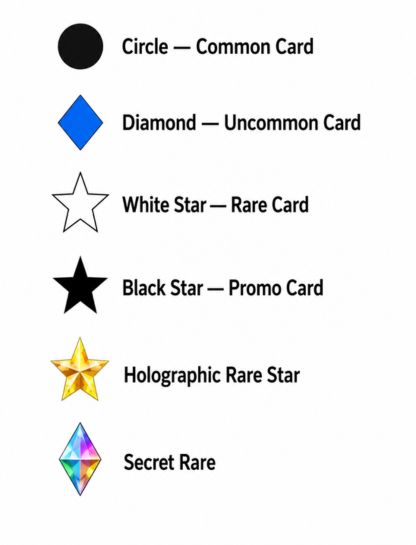
⚫ Circle — Common Card
The circle is the most basic rarity symbol. It appears on common cards — the ones you find most often in any booster pack. Common cards are plentiful, but many carry strong nostalgic value for longtime fans who remember pulling them as kids.
🔷 Diamond — Uncommon Card
The diamond sits one step above the circle. Uncommon cards appear less frequently in packs. They are not as hard to find as rare cards, but they are not guaranteed in every pack either. Many strong playable cards carry the diamond symbol.
⭐ White Star — Rare Card
The white star marks a rare card. Every booster pack is guaranteed to contain at least one rare card. These are the cards most players hope to find, and they often include holographic versions that shine and shimmer under light.
🌟 Black Star — Promo Card
The black star does not come from a booster pack. It marks a promotional card — one given away at events, tournaments, store openings, or bundled with merchandise. Black star promos are special because they cannot be found in regular packs at all.
✨ Holographic Rare Star
Some rare cards carry an extra shine — a holographic pattern that makes the artwork glow. These are among the most desired cards in any set. The symbol matches the regular rare star, but the card’s surface makes it unmistakable.
💎 Secret Rare
Secret rare cards go beyond the official card count of a set. If a set has 150 cards, secret rares might be numbered 151 and higher. These are the hardest cards to pull and among the most valuable in any collection.
Wizards of the Coast Era Symbols (1999–2003)
This was the golden age of Pokémon cards. Wizards of the Coast published the original sets, and their symbols were simple, clean, and iconic. Many collectors consider these the most meaningful symbols in the entire history of the game.
⭐ Base Set — Black Star
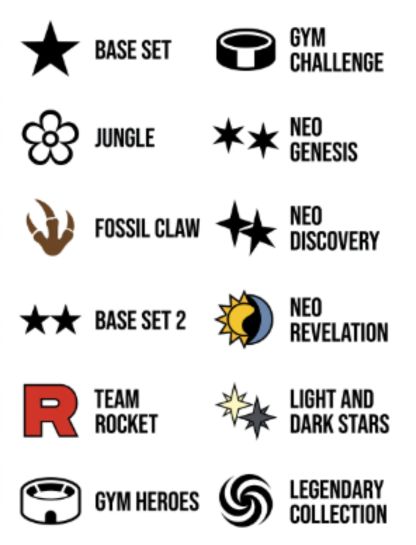
The original. The black star symbol on Base Set cards marked the very beginning of the Pokémon Trading Card Game in 1999. Cards from this set — especially holographic ones — are among the most valuable and nostalgic in the world.
🌸 Jungle — Hollow Flower
The Jungle set symbol is a flower with a hollow inside, inspired by Vileplume. It was the first expansion after Base Set and introduced new Pokémon to the card game. The hollow flower gave collectors their first taste of set symbol variety.
🦴 Fossil — Fossil Claw
The Fossil set uses a claw or fossil bone as its symbol. This set introduced fossil Pokémon like Aerodactyl, Kabutops, and Lapras. The symbol perfectly matches the prehistoric theme of the expansion.
⭐⭐ Base Set 2 — Double Star
Base Set 2 used a symbol similar to the original Base Set but with slight variations. It was a reprint set combining cards from Base Set and Jungle, made to give new players easier access to earlier cards.
🚀 Team Rocket — “R” Logo
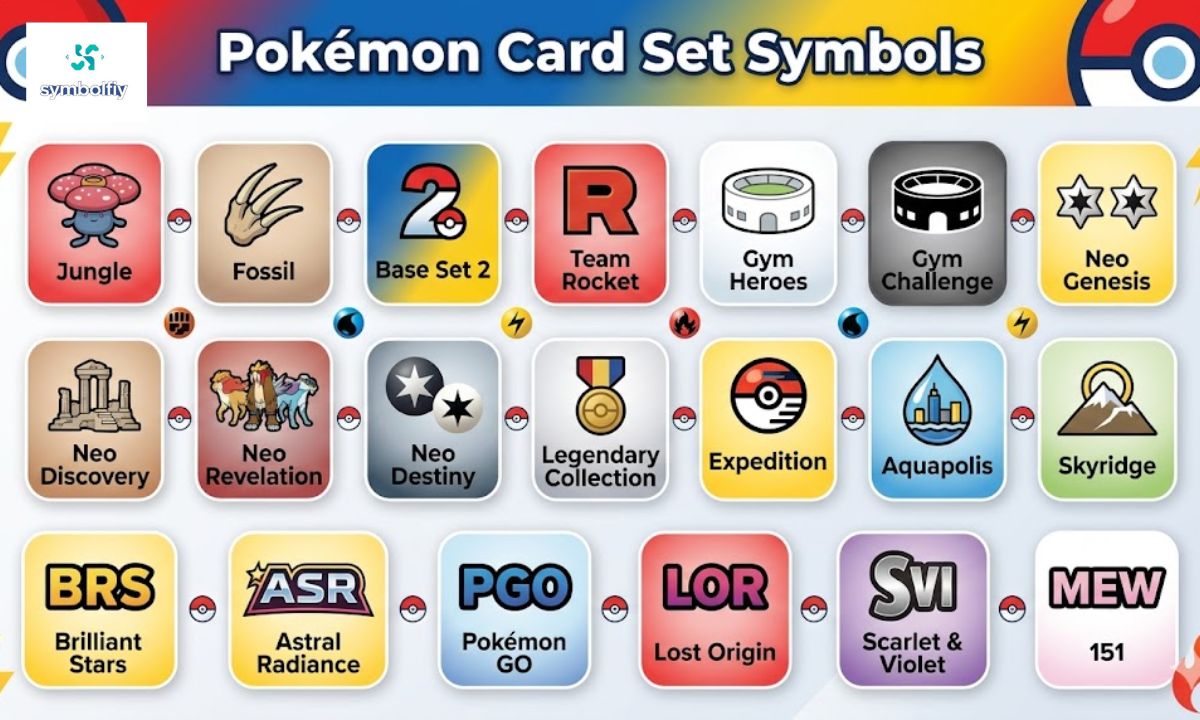
The Team Rocket set symbol is a stylized “R” — the iconic logo of the villainous Team Rocket organization. This was the first set to feature Dark Pokémon and brought a darker, edgier tone to the card game.
🏟️ Gym Heroes — White Stadium
Gym Heroes introduced Gym Leader cards for the first time. Its symbol is a white stadium outline, representing the Pokémon Gym battles central to the set’s theme.
🏟️ Gym Challenge — Black Stadium
Gym Challenge followed Gym Heroes and used the same stadium shape — but filled in black. The contrast between the two stadium symbols makes them easy to tell apart while keeping the connected theme clear.
🌱 Neo Genesis — Two Stars
Neo Genesis launched the second generation of Pokémon cards, introducing Johto Pokémon. Its symbol features two stars, marking a new beginning for the franchise and the arrival of beloved Pokémon like Togepi and Ampharos.
🔍 Neo Discovery — Two Stars Variation
Neo Discovery continued the second-generation storyline. Its symbol also features two stars but with a different arrangement. This set introduced more Johto Pokémon and focused heavily on evolution chains.
🌙 Neo Revelation — Sun and Moon Hybrid
Neo Revelation brought legendary Pokémon like Ho-Oh and Lugia to the card game. Its symbol reflects cosmic and celestial themes — mirroring the heavenly nature of the legendary Pokémon featured in the set.
🌟 Neo Destiny — Light and Dark Stars
Neo Destiny was the final Neo-era set and introduced both Light and Dark Pokémon. Its symbol carries a star-based design representing the dual nature of the set — light versus shadow, good versus evil.
🎴 Legendary Collection — Swirl Design
The Legendary Collection used a swirl symbol and was released as a special reprint set. It brought back fan-favorite cards in a reverse holographic format for the first time, making ordinary cards shimmer and shine.
E-Series Era Symbols (2002–2003)
The E-Series sets introduced a new mechanic: e-Reader dot codes printed on cards. The symbols in this era reflected that technological shift.
🔵 Expedition — “E” Pokéball
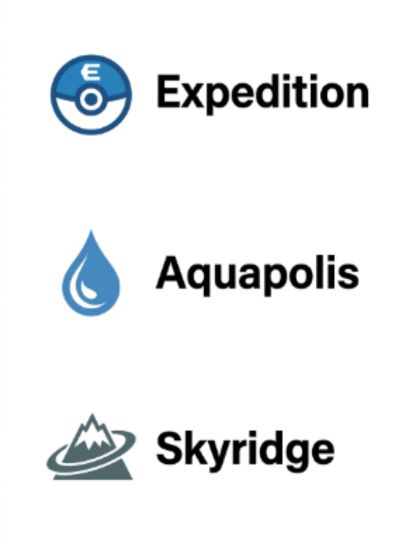
Expedition’s symbol is a Pokéball shaped into the letter “E,” representing the new e-Reader era. This was a dramatic shift in card design and mechanics. The E Pokéball is one of the most distinctive symbols in early Pokémon card history.
🌿 Aquapolis — Water Drop
Aquapolis featured Water and Grass type themes prominently. Its symbol reflects the aquatic and nature-based Pokémon in the set. It expanded the e-Reader mechanic and added new gameplay depth.
⛰️ Skyridge — Mountain with Ring
Skyridge was the final Wizards of the Coast set before the license moved to Nintendo. Its symbol shows a mountain with a ring or orbit around it — reflecting the set’s sky and aerial Pokémon theme. It is now one of the rarest and most collectible sets.
EX Era Symbols (2003–2007)
After Wizards of the Coast, Nintendo took over publishing. The EX era introduced powerful EX Pokémon cards and brought a fresh visual style to set symbols.
💫 EX Ruby and Sapphire — Ruby/Sapphire Gem
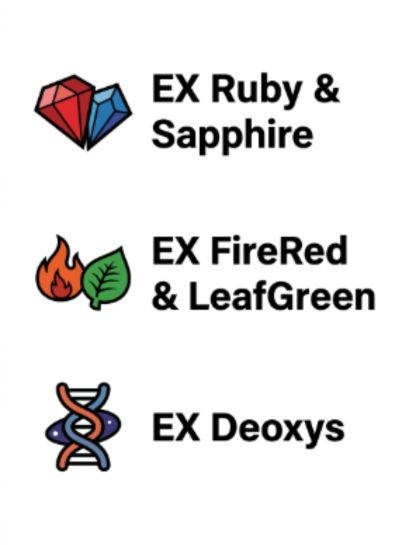
This set launched the third-generation card game alongside the Ruby and Sapphire games. The symbol reflects gem-like shapes that match the Hoenn region’s themes of nature, power, and discovery.
🔥 EX FireRed and LeafGreen — Classic Flame and Leaf
This set was a nostalgic throwback to the original games. Its symbol uses a flame and leaf combination — iconic imagery from the very first Pokémon games that started it all in 1996.
🌊 EX Deoxys — Space/DNA Theme
EX Deoxys featured the legendary space Pokémon Deoxys. Its symbol reflects a cosmic, DNA-inspired design — matching the alien, ever-changing nature of Deoxys itself.
Diamond and Pearl Era Symbols (2007–2011)
The Diamond and Pearl era introduced the Sinnoh region and brought new Pokémon and gameplay mechanics. Set symbols became more detailed and thematic.
💎 Diamond and Pearl — Diamond Shape
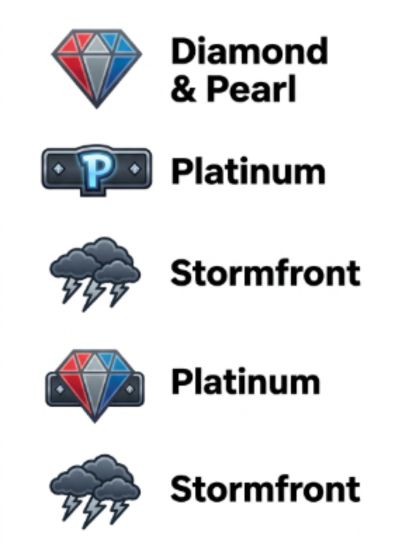
The base Diamond and Pearl set symbol uses a simple but bold diamond shape, representing the Sinnoh region’s themes of space, time, and ancient power.
🌌 Platinum — Platinum Bar
The Platinum set used a sleek platinum bar symbol, reflecting the rare and powerful nature of the Distortion World storyline and Giratina — the game’s mysterious legendary Pokémon.
🏔️ Stormfront — Storm Clouds
Stormfront’s symbol captures the electric, dramatic energy of a coming storm. This set featured powerful Dragon and Electric Pokémon and is remembered for strong holographic cards.
HeartGold SoulSilver Era Symbols (2010–2011)
This era revisited the beloved Johto region, bringing nostalgia and new gameplay features together.
💛 HeartGold SoulSilver — Heart and Soul Crest
The base HGSS symbol combines elements of a heart and a celestial crest — representing the emotional depth of revisiting Johto. Many fans consider this one of the most beautifully themed eras in card history.
🏺 Undaunted — Ancient Crest
Undaunted featured legendary Pokémon and a strong atmosphere of mystery. Its ancient crest symbol reflects the deep history of the Johto region and the legendary beasts at the heart of the set.
XY Era Symbols (2013–2016)
The XY era introduced the Kalos region and a new card mechanic — EX Mega Evolution cards. Symbols became more stylized and modern.
🔵 XY Base Set — X and Y Cross
The base XY symbol features an X and Y cross design — clean, simple, and modern. It marked the beginning of the sixth-generation card game and introduced Mega EX Pokémon to collectors.
🌟 XY Evolutions — Classic Callback Symbol
XY Evolutions was a special set that recreated the original Base Set with modern card standards. Its symbol reflects the original Base Set design — a nostalgic tribute that made it one of the most popular sets ever released.
Sun and Moon Era Symbols (2017–2019)
The Sun and Moon era brought the Alola region to cards, introduced GX Pokémon, and featured some of the most vibrant artwork in card history.
☀️🌙 Sun and Moon Base — Sun and Moon Icons
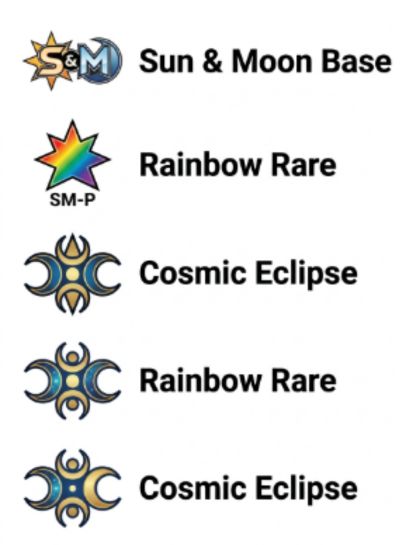
The base Sun and Moon symbol uses the sun and moon together — reflecting the day/night duality of the Alola region and the legendary Pokémon Solgaleo and Lunala.
🌈 Rainbow Rare — Special Foil Symbol
Rainbow rare cards carry a special multicolored foil treatment that makes them visually unlike anything else in the game. These are among the most striking and collectible cards in the modern era.
🔮 Cosmic Eclipse — Cosmic Orbit Symbol
Cosmic Eclipse closed the Sun and Moon era with breathtaking full-art cards. Its symbol features a cosmic orbit theme — reflecting the Tag Team mechanic and the grandeur of the final set in the series.
Sword and Shield Era Symbols (2020–2023)
The Sword and Shield era was huge — it launched during a global card collecting boom and introduced VMAX Pokémon with towering, dynamic artwork.
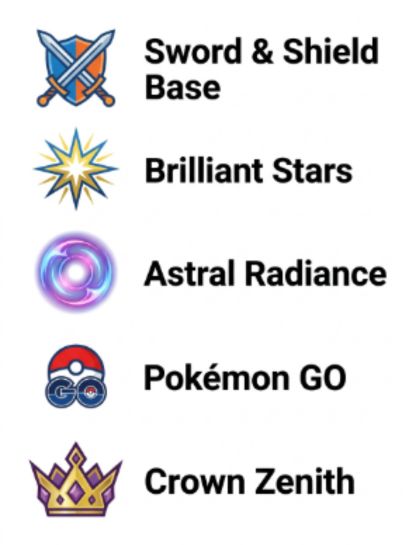
⚔️🛡️ Sword and Shield Base — Sword and Shield Icons
The base Sword and Shield symbol combines a sword and shield — representing the Galar region’s medieval, British-inspired themes and the legendary Zacian and Zamazenta.
✨ Brilliant Stars — Star Burst
Brilliant Stars introduced ASTRAL Radiance energy and the V-STAR mechanic. Its burst star symbol reflects the shining, explosive energy of the new card type.
🌌 Astral Radiance — Radiance Rings
Astral Radiance featured Hisuian Pokémon from the ancient past. Its symbol uses flowing radiance rings — reflecting the mystical, timeless atmosphere of the Hisui region.
🎮 Pokémon GO — Pokéball App Icon
The Pokémon GO collaboration set used a symbol inspired by the mobile game’s iconic interface. This crossover set was unique because it connected the card game to the real-world catching experience of Pokémon GO.
👑 Crown Zenith — Crown Jewel
Crown Zenith was the grand finale of the Sword and Shield era. Its crown symbol represents the peak of the era — packed with reprints, special art cards, and celebrations of the entire Sword and Shield journey.
Scarlet and Violet Era Symbols (2023–Present)
The newest era brought the Paldea region and replaced set symbols with three-letter abbreviations. This was a major design shift that changed how collectors identify cards.
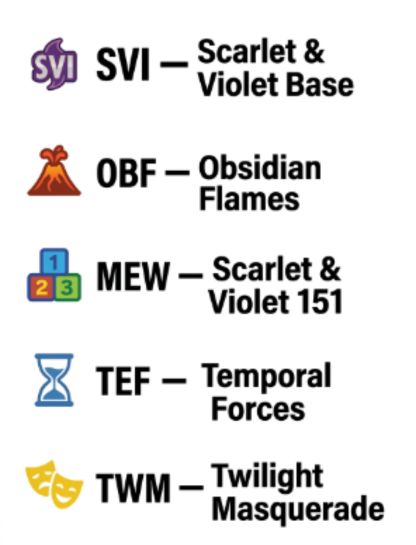
🟣 Scarlet and Violet Base (SVI)
SVI marks the beginning of the ninth-generation card game. It introduced ex Pokémon (lowercase “ex”) — a callback to the original EX era but with modern power levels and stunning full-art designs.
🌋 Obsidian Flames (OBF)
OBF features Terastallized Pokémon with fire typing. Its flame and obsidian theme reflects dark, volcanic energy. This set is notable for the ultra-rare Charizard ex cards that became wildly popular.
🔢 Scarlet and Violet 151 (MEW)
MEW celebrates the original 151 Pokémon with modern card treatments. Every original Pokémon from Bulbasaur to Mew appears in this set — making it one of the most nostalgic modern releases ever printed.
⏳ Temporal Forces (TEF)
Temporal Forces explores time-travel themes with ancient and future Pokémon forms. Its symbol abbreviation TEF reflects the temporal, time-shifting nature of the set’s storyline and artwork.
🎭 Twilight Masquerade (TWM)
Twilight Masquerade draws on mystery, disguise, and performance themes. Its cards feature stunning masked artwork and introduce new mechanic combinations that have excited both collectors and competitive players.
Pokémon TCG Sets Released and Coming in 2026
The Pokémon Trading Card Game entered a new chapter in 2026 by moving beyond the Scarlet & Violet era. The focus shifted to the Mega Evolution series, bringing back Mega Evolution Pokémon with updated mechanics and artwork.
Collectors also have the highly anticipated 30th Anniversary releases to look forward to. These sets celebrate three decades of Pokémon while introducing fresh expansions for both players and collectors.
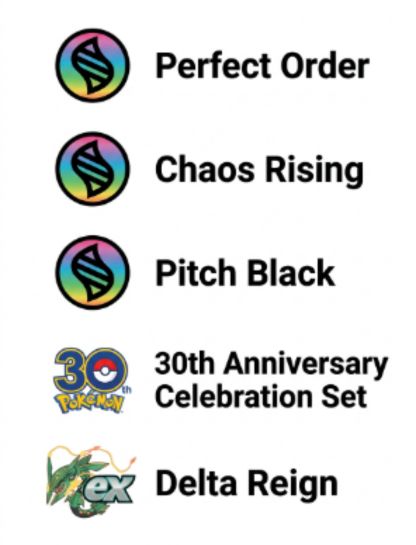
Mega Evolution—Perfect Order
Released on March 27, 2026, Perfect Order launched the new Mega Evolution era. It introduced powerful Mega Evolution Pokémon ex cards and established the foundation for the year’s new gameplay mechanics.
Mega Evolution—Chaos Rising
Released on May 22, 2026, Chaos Rising expanded the Mega Evolution lineup with additional Pokémon, Trainer cards, and strategic combinations. The set quickly became popular among competitive players and collectors alike.
Mega Evolution—Pitch Black
Released on July 17, 2026, Pitch Black continued the Mega Evolution series with darker-themed Pokémon and impressive artwork. Several chase cards from this expansion have attracted strong collector interest.
30th Anniversary Celebration Set
Scheduled for September 16, 2026, this worldwide release celebrates 30 years of the Pokémon franchise. The set is expected to feature special anniversary cards, nostalgic artwork, and exclusive collectible items.
Delta Reign (Mega Rayquaza ex)
Expected to release on November 6, 2026, Delta Reign is anticipated to showcase Mega Rayquaza ex as its headline card. Fans expect powerful new cards, premium illustrations, and exciting additions to the Mega Evolution era.
Cultural Connections to Symbol Systems Like These
Humans have been using symbol systems to organize knowledge and show identity for thousands of years. Pokémon set symbols fit into this ancient tradition in fascinating ways.
Ancient Egypt: Egyptians used hieroglyphic symbols to mark ownership, show meaning, and identify origin — exactly what set symbols do on cards.
Heraldry and Coats of Arms: Medieval European families used unique crests and symbols to identify their lineage — just as each Pokémon set has a unique symbol no other set shares.
Japanese Mon (Family Crests): Japanese culture has a long tradition of mon — simple, elegant symbols representing families and clans. The clean design of early Pokémon set symbols reflects this tradition beautifully.
Celtic Knotwork: Celtic symbols used interlocking patterns to represent connection and continuity — similar to how Pokémon set symbols connect all cards within a shared expansion family.
Chinese Seal Stamps: Ancient Chinese culture used carved seal stamps to mark authenticity and origin on documents and artwork — a direct parallel to how set symbols verify a card’s identity.
Native American Totems: Totem symbols carried the identity and story of a community. In the same way, a Pokémon set symbol carries the identity and story of an entire expansion.
Why Symbols Still Matter Today
In the digital age, symbols carry more meaning than ever. A single icon can communicate instantly across languages, cultures, and generations. For Pokémon collectors, set symbols are a visual language — one glance tells you everything you need to know about a card’s history, rarity, and value.
These symbols also carry deep personal meaning. The sight of a Base Set star or a Team Rocket “R” can instantly transport a collector back to childhood.
Tattoos of Pokémon symbols, jewelry featuring set logos, and artwork celebrating iconic card designs all show how deeply these small icons are woven into people’s identities. A symbol is never just a symbol — it is a story, a memory, and a piece of who you are.
Frequently Asked Questions
Where is the set symbol located on a Pokémon card?
It sits at the bottom right of the card, right next to the collector number.
What does a black star mean on a Pokémon card?
It means the card is a promotional card — not found in regular booster packs.
What is a secret rare Pokémon card?
A card numbered beyond the set’s official total count — the rarest and most valuable type.
When did Pokémon card set symbols start?
They began with the Base Set in 1999, when Wizards of the Coast launched the first Pokémon TCG.
Why did Scarlet and Violet replace symbols with abbreviations?
The new era uses three-letter codes like SVI and OBF to make digital identification and tournament tracking easier.
Final Words
Pokémon card set symbols are more than collector tools — they are a living archive of 25+ years of creativity, storytelling, and shared passion.
From the simple black star of the original Base Set to the bold three-letter codes of the Scarlet and Violet era, every symbol marks a moment in time and connects millions of people to the game they love.
Whether you are a seasoned collector or just opening your first pack, understanding these symbols transforms every card from a piece of cardboard into a piece of history.