Symbols carry power. They help us understand gods, forces, and ideas that words alone cannot fully explain. Ares, the Greek god of war, is one of the most intense figures in mythology.
His symbols are not just images — they carry deep meaning about courage, death, fear, and the raw force of battle. Learning about these symbols can help you understand ancient Greek culture, spiritual ideas, and even modern art and identity.
Ares represents the violent, chaotic side of war. He is not a symbol of strategy or wisdom. He stands for raw anger, bloodlust, and the brutal reality of battle. The Greeks both feared and respected him. He was necessary — war existed — but he was never fully trusted, even by the other gods.
His symbols carry emotional and spiritual weight. They remind us of power, danger, and the cost of conflict.
Many of these symbols are still used today in military culture, tattoos, and modern art. They connect us to something ancient and primal — the part of human nature that has always had to face violence and survive it.
25+ Ares Symbols and Their Meanings
Weapons of War
⚔️ Spear
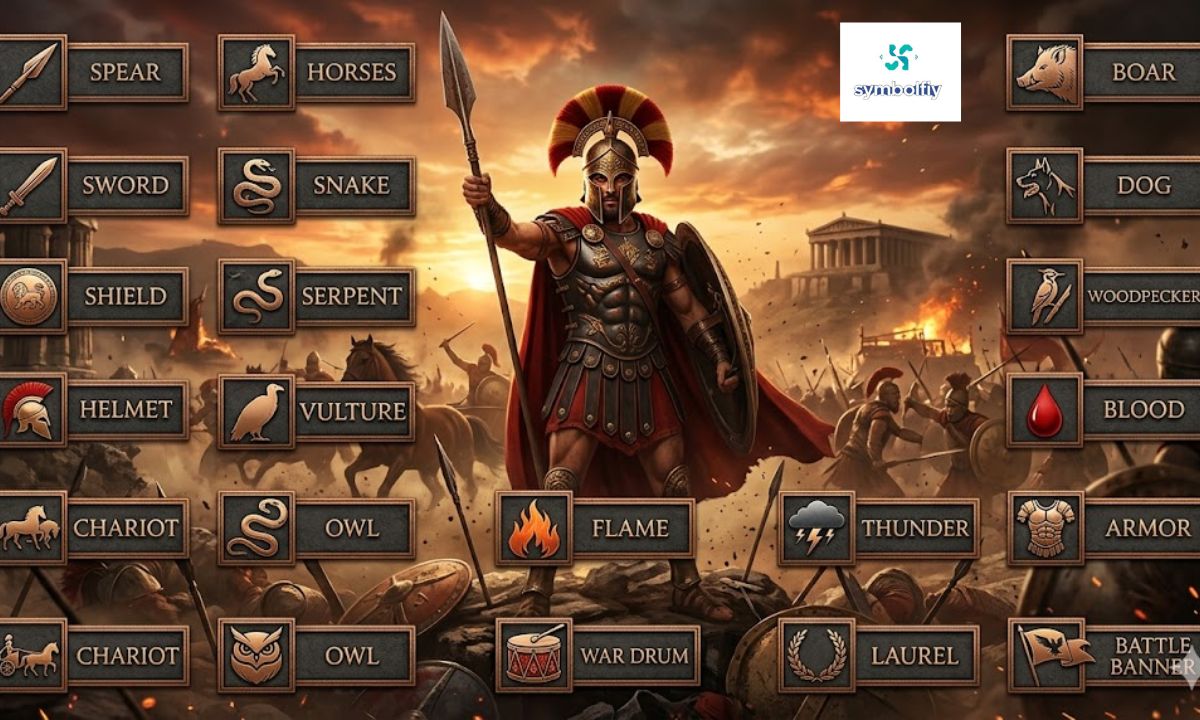
The spear is Ares’ most well-known weapon. It stands for direct, aggressive force — no tricks, just raw power. In ancient Greece, the spear was the main weapon of warriors, making it a perfect symbol for the god of war.
🗡️ Sword
The sword represents close combat and personal bravery. Ares was said to carry a sword into battle, using it when fighting got fierce and close. It also symbolizes death by the blade — a warrior’s fate.
🛡️ Shield
The shield is a symbol of both protection and war. For Ares, it shows that war has two sides — you must be ready to both attack and defend. The shield also links him to armor, warrior identity, and martial pride.
🏹 Arrows
Arrows sometimes appear in art connected to Ares, especially in scenes of battle chaos. They represent ranged violence, sudden death, and the unavoidable nature of war — you cannot always see what is coming.
🪓 Battle Axe
The battle axe appears in some ancient depictions of Ares. It represents brutal, crushing force. Unlike the spear, the axe is a symbol of destruction and raw physical dominance in combat.
⛓️ Chains
Chains appear in one famous myth where Ares was captured and chained by the giants Otus and Ephialtes. As a symbol, chains represent the idea that even war can be bound, limited, or stopped by greater power.
Armor and Battle Gear
🪖 Helmet
The helmet is one of the clearest symbols of Ares. It marks him as a warrior. In Greek art, Ares almost always wears a crested war helmet. It stands for readiness, martial identity, and the warrior spirit.
🛡️ Breastplate / Body Armor
Full body armor symbolizes Ares’ role as a fully prepared war god. It also represents strength, invincibility, and the discipline warriors needed before going into battle.
🔥 Burning Torch
The torch appears in some myths and artworks connected to Ares. It symbolizes the destructive fire of war — cities burned, fields destroyed. Fire and war have always gone hand in hand.
Sacred Animals
🐍 Snake / Serpent
The serpent is sacred to Ares. It represents danger, hidden threat, and deadly surprise — all qualities found in warfare. The dragon of Ares (a giant serpent) guarded the sacred spring of Ares in Thebes. Snakes also connect Ares to chthonic (underworld) power.
🦅 Vulture
The vulture feeds on the dead after battle. As a sacred bird of Ares, it represents the brutal aftermath of war — death, decay, and the price of combat. The vulture does not fight; it waits. It is a reminder of what war leaves behind.
🐗 Boar
The boar is wild, aggressive, and dangerous. It charges without hesitation. Ares was closely linked to the boar because of its fearless, violent nature. In Greek mythology, boar hunts were some of the most dangerous tasks a warrior could face.
🐕 Dog
Dogs were war companions in ancient Greece. They guarded camps, tracked enemies, and fought alongside soldiers. As a symbol of Ares, the dog represents loyalty, aggression, and the warrior bond. Some ancient sources list dogs as among Ares’ most sacred animals.
🦅 Eagle
The eagle, though more closely linked to Zeus, appears occasionally in Ares imagery as a symbol of aerial power, sharp vision, and the ability to strike from above. It represents dominance and war strategy.
🐦 Woodpecker
This may seem surprising, but the woodpecker was indeed sacred to Ares. In ancient Italy and Greece, the woodpecker (especially in Roman tradition as Mars) was seen as a warrior bird — fierce, persistent, and fast-striking. It symbolizes relentless attack.
Battlefield and War Imagery
🔴 Blood
Blood is one of Ares’ most powerful symbols. It represents sacrifice, death, and the cost of war. Ancient Greeks described the battlefield as soaked in Ares’ influence when blood was shed. Red — the color of blood — is deeply connected to him.
🔥 Fire
Fire destroys everything in its path. Like war, it spreads fast and leaves ruin behind. Fire is used in battle — burning arrows, siege weapons, destroyed cities. For Ares, fire represents the all-consuming nature of conflict.
⚓ Chariot
Ares rode into battle on a war chariot pulled by fire-breathing horses. The chariot is a symbol of war power, speed, and dominance. It shows Ares arriving at battle — unstoppable, terrifying, and ready to fight.
🐴 Horses
The horses of Ares are legendary — Phobos (Fear), Deimos (Dread), Aithon (Blazing), and Phlogios (Fiery). Horses represent speed, power, and the chaos of a cavalry charge. They are deeply connected to battle throughout Greek culture.
⛰️ The Battlefield Itself
The battlefield is Ares’ sacred space. It is where he feels most alive. Symbolically, the battlefield represents the meeting point between life and death — where bravery and terror exist at the same moment.
Mythological Figures and Family
😱 Phobos (Fear)
Phobos is the son of Ares and a spirit who personifies fear. As a symbol, Phobos represents the psychological side of war — the terror that paralyzes soldiers before battle even begins. He rode alongside his father on the chariot.
😨 Deimos (Dread)
Deimos is Phobos’ twin brother — another son of Ares. He represents ongoing dread and the constant anxiety of war. Together, Phobos and Deimos show that war is as much a mental battle as a physical one.
⚡ Eris (Discord)
Eris, the goddess of strife, worked alongside Ares as a companion in battle. She represents the chaos and disagreement that leads to war in the first place. Her presence next to Ares shows that conflict starts before the first sword is raised.
💀 Enyo
Enyo was a goddess of war who fought alongside Ares. She represents the destructive, violent aspect of combat — the burning of cities and the destruction of armies. She is sometimes called Ares’ companion or sister.
Colors and Materials
🔴 Red
Red is the main color of Ares. It represents blood, fire, passion, and aggression. In art, Ares is often shown in red armor or surrounded by red imagery. Red still symbolizes war and danger in cultures around the world today.
🟣 Purple / Crimson
In ancient Sparta — a city deeply devoted to Ares — warriors wore crimson cloaks. Purple and crimson represent military pride, courage under fire, and the warrior class. These colors were not just fashion; they were identity.
⚙️ Bronze and Iron
Metal weapons and armor were sacred to Ares. Bronze came first in early Greek warfare; iron came later. These metals represent human mastery of war — the ability to forge weapons and armor. Metal symbolizes both creation and destruction.
Plants and Natural Symbols
🌹 Blood-Red Flowers
In some myths, blood-red flowers grow where warriors fell. These flowers are connected to Ares as symbols of death in battle. They represent sacrifice, loss, and the tragic beauty that sometimes follows war.
🌿 Oak Tree
The oak tree appears in some traditions connected to war gods. It represents strength, endurance, and the ability to withstand storms. Warriors sought strength like oak wood — hard, unyielding, and deeply rooted.
🔥 Volcanic Rocks / Lava Stone
In some ancient Greek writings, volcanic regions were connected to Ares because of their fierce, destructive power. Lava and volcanic rock represent unstoppable natural force — much like war itself.
Sacred Places and Numbers
🏛️ Sparta
Sparta was Ares’ most devoted city. The Spartans worshipped him with great intensity. Sparta itself became a symbol of military culture, discipline, and the total devotion of a society to war. Even today, “Spartan” means tough and warrior-like.
🏔️ Thrace
Thrace (a region in northern Greece and Bulgaria) was considered the homeland of Ares. It was a wild, fierce land. Thrace represents the origins of war-worship in Greek culture — the primal, untamed side of conflict.
🔢 Number 7
In numerology tied to Greek mythology, the number 7 has been connected to Ares in some traditions. Seven represents completion and cycles — the full arc of war from beginning to end. It also appears in the seven-gated city of Thebes, closely linked to Ares myths.
Spiritual and Devotional Symbols
⚡ Lightning-Like War Cry
Though lightning belongs to Zeus, the war cry is Ares’ spiritual weapon. A battle shout was believed to carry his spirit into warriors. It represents the awakening of the warrior inside — the moment fear turns to action.
🌑 Dark Moon
Some devotional traditions connect Ares to the dark or new moon — a time of hidden danger and unseen threats. This moon phase represents the build-up before a strike, the silence before violence breaks out.
🩸 Blood Oath
In ancient warrior culture, oaths sworn in blood were considered sacred to Ares. The blood oath represents total commitment, warrior brotherhood, and the serious nature of a promise made in his name.
⚔️ Crossed Swords
Crossed swords have been a military symbol for centuries. They represent combat, battle readiness, and the meeting of two equal forces. This symbol is still widely used in military insignia and gravestone carvings today.
🔱 Trident-Like War Symbol
Some ancient art shows Ares with multi-pointed weapons or staffs. The triple-pointed symbol represents attack from multiple directions — total war with no escape. It also connects to destruction across land, sea, and sky.
🌋 Eruption / Chaos Symbol
Ares represents chaos in battle — unpredictable, explosive, and impossible to fully control. The volcano or eruption stands as a natural symbol for this energy: massive power that builds and then releases all at once.
Ancient Cultures That Used These Symbols
Greek mythology — Ares was one of the twelve Olympians. Greeks built temples to him (though fewer than other gods) and offered sacrifices before battle. His symbols appeared on shields, armor, and weapons.
Roman tradition (as Mars) — The Romans renamed Ares as Mars and elevated him even higher. Mars was the father of Romulus, the founder of Rome, making war sacred to Roman identity. His symbols are nearly identical to Ares’.
Spartan culture — The Spartans built a statue of a chained Ares, believing this kept his war spirit inside their city. Spartan warriors carried his symbols into every battle.
Thracian people — The Thracians of ancient northern Greece and Balkans were among the earliest devotees of Ares. They used war animal symbols — boars, wolves, and serpents — in their art and armor.
Celtic traditions — Celtic warriors used many similar symbols: the boar, the serpent, red colors, and powerful swords. While not directly worshipping Ares, their war-god figures share deep symbolic overlap.
Modern military culture — Crossed swords, helmets, eagles, and red colors appear in military insignia, flags, and medals worldwide. These symbols carry the spirit of Ares without the myth.
Why Symbols Still Matter Today
Ancient symbols never really disappear. They change shape, find new homes, and keep speaking to something deep inside us. The symbols of Ares show up in tattoos, military uniforms, video games, films, and art.
People still use the spear, helmet, eagle, and serpent to express strength, bravery, and the will to face danger. These symbols connect modern people to thousands of years of human experience.
On a personal level, many people feel drawn to Ares symbols during times of struggle. They represent the warrior mindset — the part of us that refuses to give up.
Whether you see them as spiritual tools, historical art, or personal identity markers, these symbols carry real emotional power. They remind us that we can face hard things and keep going.
Frequently Asked Questions
What is the most famous symbol of Ares?
The spear is widely considered his most iconic symbol — it represents direct, unstoppable force in battle.
What animals are sacred to Ares?
The serpent, vulture, boar, dog, and woodpecker are all considered sacred to Ares in ancient Greek tradition.
Is Ares the same as Mars?
Yes — Mars is the Roman name for the same war god, though the Romans gave him a more respected, fatherly role in their culture.
What do Phobos and Deimos represent?
They are Ares’ sons and represent fear and dread — the emotional horrors that war brings to both sides of a battle.
What colors are connected to Ares?
Red and crimson are his main colors, linked to blood, fire, war, and the scarlet cloaks worn by Spartan warriors.
Conclusion
Ares is not a gentle god. His symbols are sharp, fierce, and soaked in the reality of war. But they also carry a kind of respect for courage, strength, and survival.
From the spear and helmet to the serpent and vulture, each symbol tells a story about what ancient people believed — that war was real, powerful, and guided by a divine force.
Understanding these symbols helps us connect with history, culture, and the part of the human spirit that has always had to face darkness and find the strength to push through.