One Piece is not just an anime. It is a story built on symbols. Every flag, tattoo, and mark in Eiichiro Oda’s world carries a layer of meaning that goes deeper than cool design. Symbols have always been how humans express what they cannot say out loud — loyalty, grief, defiance, freedom.
In One Piece, they do exactly that. They tell you who a person belongs to, what they believe in, and what they are willing to die for. That is why fans connect with them so personally, and why so many people choose to wear them permanently on their skin.
One Piece symbols carry the same emotional weight as real-world emblems of belonging. A Jolly Roger is not just a pirate flag — it is a declaration. It says “we exist, we choose this life, and we stand together.”
Oda drew heavily from actual history, mythology, and cultural iconography when designing these symbols. That is why they feel so real even inside a fictional world.
On a deeper level, these symbols explore universal human themes: found family, the cost of freedom, loyalty beyond blood, and resistance against corrupt power.
Many symbols in One Piece echo spiritual concepts from Buddhism, Shintoism, and even ancient tribal traditions. When you understand their roots, the story hits differently.
25+ One Piece Symbols and Their Meanings
Jolly Rogers: Pirate Flags and Crew Symbols
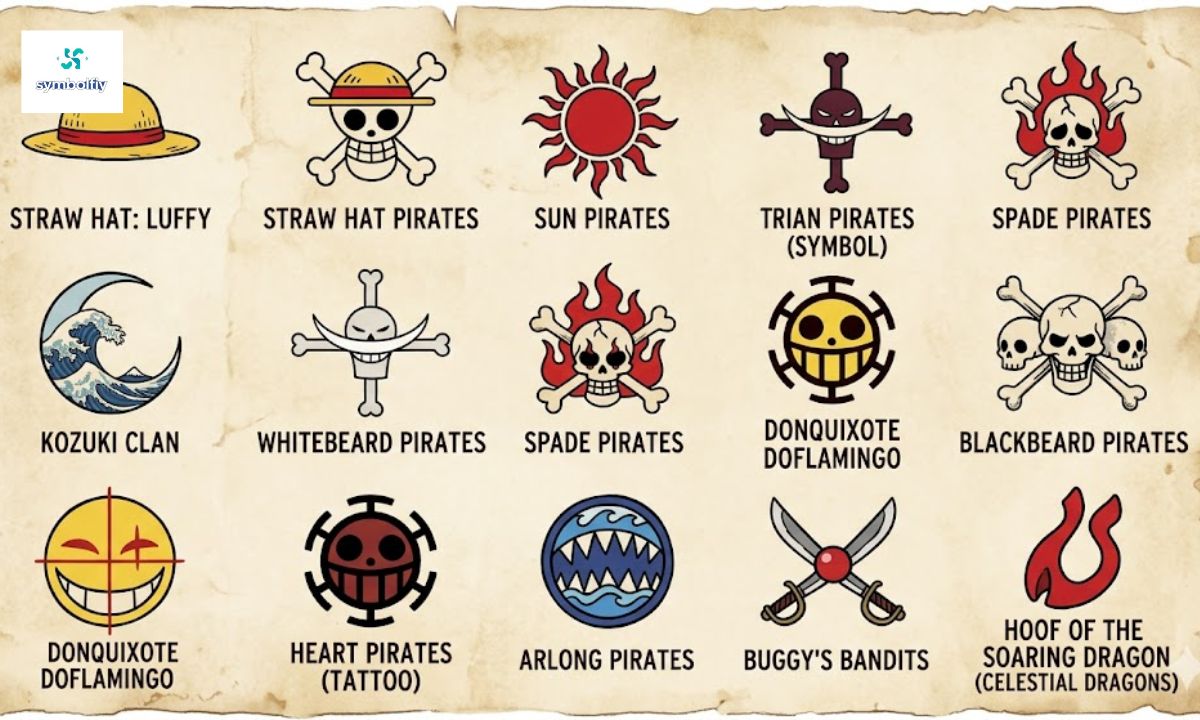
The Jolly Roger is the most iconic symbol system in One Piece. Every pirate crew has one, and each flag reveals something about the crew’s identity, values, and personality.
☠️ Straw Hat Jolly Roger
The Straw Hats’ flag shows a classic skull wearing Luffy’s signature straw hat, with crossed bones below.
Drawn by Luffy himself, imperfectly, which makes it perfectly him
The straw hat is the central symbol of the entire series — passed from Shanks to Luffy as a promise of reunion
Spiritually, the hat represents inherited dreams and the weight of someone else’s faith in you
Historically, skull-and-crossbone flags were used by real pirates like Calico Jack to signal defiance against naval authority
Emotionally, this flag represents freedom, joy, and the refusal to give up
🔥 Whitebeard Pirates’ Emblem
A purple cross with a curled mustache at the center, resembling a stylized swastika-like shape in its cross formation.
The cross shape draws from medieval European heraldry representing protection and power
The curled mustache personalizes it as Whitebeard’s own mark of authority
Spiritually, the symbol reflects the father archetype — Whitebeard was not a conqueror but a protector
The symbol has been debated because of its cross shape, but its cultural context is entirely within Oda’s fictional world
Emotionally, seeing this symbol means safety for those under Whitebeard’s protection and dread for everyone else
⚓ Red Hair Pirates’ Flag
Shanks’ crew flag shows a skull with a scar over its left eye and three red scratches on its right.
The scar mirrors the one Shanks received from Blackbeard, making it a symbol of survival and legacy
Red as a color carries spiritual weight across cultures — power, sacrifice, passion, and warning
Historically, scarred emblems in warrior traditions signal that a group has faced real danger and endured
Shanks’ flag is one of the most feared in the world of One Piece, which mirrors how real naval flags functioned as psychological weapons
Emotionally, it represents the calm kind of strength that doesn’t need to prove itself
💀 Blackbeard Pirates’ Flag
Three skulls arranged in a triangle, representing the crew’s three-pronged power structure.
The triple skull imagery connects to trinity symbolism found in Christianity, Celtic traditions, and Norse mythology
Blackbeard’s symbol reflects ambition without loyalty — three heads pulling in different directions
Spiritually, the number three in many cultures signals instability when unbalanced, which perfectly suits Blackbeard
The dark design language reads as a direct counter to Whitebeard’s more noble emblem
Emotionally, this flag creates a sense of unease — something powerful but deeply untrustworthy
🐉 Heart Pirates’ Flag (Law’s Crew)
A smiley face with a cross-shaped mouth and stitches, set against a spotted background.
The stitched smiley reflects Law’s surgeon identity — cheerful on the surface, surgical and cold underneath
Medical imagery mixed with death iconography connects to the archetype of the healer-destroyer found in Hindu mythology with Shiva
Spiritually, the smile and the cross suggest a character reconciling life and death, which defines Law’s entire arc
The spotted pattern mirrors the Jolly Roger tradition of using geometric design to communicate personality
Emotionally, it is unsettling in a way that feels intentional — Law’s crew operates in moral grey zones
⚡ Big Mom Pirates’ Flag
A round skull with big lips, wearing a Napoleon-style hat and flanked by candy-like horns.
Reflects Big Mom’s obsession with family, sweets, and control — all wrapped in a cheerful but suffocating aesthetic
The maternal imagery twisted into a pirate emblem echoes myths of devouring mother archetypes found in Greek mythology (Cronus) and Hindu tradition (Kali in her wrathful form)
Spiritually, the symbol warns that nurturing taken to an extreme becomes consuming
The candy horns reference her Devil Fruit power and her island’s sugar-coated tyranny
Emotionally, it creates a sense of forced cheerfulness — joy that hides danger
Character Tattoos and Personal Marks
Tattoos in One Piece are not decorative. They are declarations of identity, grief, and loyalty.
🔠 Ace’s “ASCE” Tattoo
Ace’s left bicep tattoo spells ASCE with the S crossed out — a tribute to his lost brother Sabo.
The crossed-out S is one of the most emotionally powerful details in the series
It connects to real-world mourning tattoos where names or initials of lost loved ones are marked on the body
Spiritually, the mark keeps the dead present — Sabo is gone but still carried on Ace’s skin
Historically, sailors tattooed their crews’ symbols on themselves to carry their crew wherever they went
The tattoo later became a symbol of grief for fans after Ace’s death in Marineford
☀️ Sun Pirates’ Mark (Fish-Man Sun Symbol)
A stylized sun tattooed over the slave brand — used by Fisher Tiger to free enslaved Fish-Men.
One of the most historically resonant symbols in all of One Piece
Fisher Tiger tattooed the sun over the World Government’s slave brand to reclaim identity and dignity
The sun is a liberation symbol across African, Indigenous, and South Asian cultures — it represents life returned and shame erased
Spiritually, covering a brand with a symbol of warmth and light is a reclamation of self
Emotionally, the sun mark turns something painful into something empowering
🐊 Crocodile’s Hook and Desert Kings Mark
The golden hook and Baroque Works’ criminal organization emblem blend desert imagery with authority.
Gold hooks historically symbolized power and replacement of something lost
The desert iconography connects to Middle Eastern and North African traditions of survival, mystery, and power in harsh conditions
Spiritually, the hook represents control — reaching out and pulling things toward yourself
Baroque Works used floral code names for agents, creating a duality of beauty and violence
Emotionally, the symbol communicates cold ambition dressed in elegance
🌸 Wano’s Kozuki Clan Symbol
The moon and flower crest of the Kozuki family — ancient Wano royalty tied to the Poneglyphs.
The Kozuki crest connects directly to the Void Century mystery, one of the deepest lore threads in One Piece
Moon symbolism appears in Japanese Shintoism (Tsukuyomi, the moon god) as a marker of wisdom and hidden knowledge
The flower element echoes the cherry blossom — a core Japanese symbol of beauty, impermanence, and sacrifice
Spiritually, the crest represents truth buried in time, waiting to be uncovered
Emotionally, it carries the weight of genocide — an entire family nearly erased by the World Government
🔱 World Government Symbol
Three circles connected by lines, forming a shape that resembles a claw or a trident from above.
One of the most politically loaded symbols in the series — the World Government represents institutional power over individual freedom
The three circles are said to represent the three powers: marines, Shichibukai, and Yonko — all controlled from above
Historically, similar triple-circle designs appear in ancient Rome and Byzantine seals representing governance and unity
Spiritually, the shape echoes a crown seen from below — oppressive by design
Emotionally, this symbol creates a feeling of surveillance and control wherever it appears
Revolutionary Army and Resistance Symbols
✊ Dragon’s Revolutionary Army Mark
A fist or claw-like symbol representing Dragon’s movement to overthrow the World Government.
The clenched fist is the oldest symbol of revolution worldwide — used in labor movements, anti-colonial resistance, and civil rights
Dragon’s mark is deliberately rough and aggressive compared to the World Government’s polished emblem
Spiritually, it echoes the concept of righteous anger — the kind of fury that exists to correct injustice
In Norse tradition, a raised fist toward the sky was a gesture invoking Odin’s judgment
Emotionally, it feels like hope with teeth
Devil Fruit and Power Symbols
🌊 Mera Mera No Mi (Ace’s Flame)
The fire spiral symbol associated with Ace’s Flame-Flame Fruit.
Fire across cultures represents both creation and destruction — Zoroastrianism treats it as divine, Buddhism uses it to represent transformation
Ace’s fire is warm, protective, and fierce — matching his personality exactly
The spiral shape echoes Celtic knotwork and Polynesian tattoo patterns that symbolize life cycles
Spiritually, fire that belongs to someone who dies becomes even more sacred — it carries grief and memory
After Ace’s death, the Mera Mera No Mi became one of the most emotionally charged symbols in the fandom
⚓ Gum-Gum (Gomu Gomu No Mi) Symbol
The rubber spiral or stretch symbol associated with Luffy’s Devil Fruit powers.
Rubber as a material symbolizes adaptability — the ability to bend without breaking
This connects to Taoist philosophy where flexibility and yielding are signs of strength, not weakness
The coiled or spiral form appears in ancient art from Egypt to the Americas as a symbol of energy in motion
Spiritually, Luffy’s power represents resilience — attacks bounce back, pain doesn’t stop him
Emotionally, it is the perfect symbol for someone who refuses to be changed by the world’s pressure
One Piece Symbols Across Cultures
Ancient Egypt — Sun symbols and eye motifs echo the Sun Pirates’ mark and the all-seeing implications of Poneglyph lore. The Eye of Horus parallels the World Government’s surveillance power.
Eastern Philosophy (Buddhism and Taoism) — The Void Century’s hidden truth mirrors Buddhist ideas of lost wisdom. Luffy’s flexibility echoes Taoist strength-through-yielding principles.
Medieval Europe — Jolly Roger flags and heraldic emblems directly parallel European coat-of-arms traditions. Whitebeard’s cross-shaped emblem draws from knight and crusader iconography.
African and Oceanic Cultures — The Sun Pirates’ mark directly mirrors how real African and Pacific Islander communities used body marking to reclaim identity after colonial violence. Fisher Tiger’s act of tattooing over slave brands mirrors real historical resistance practices.
Japanese Shinto and Buddhist Tradition — Wano’s arc is drenched in Japanese symbolism. The moon, cherry blossoms, and family crests all come from real Shinto and samurai cultural practice.
Native American and Indigenous Traditions — The spiral motif used in several One Piece emblems appears in Hopi, Maori, and Aboriginal art as a symbol of life force and cosmic energy.
Why One Piece Symbols Still Matter Today
One Piece has been running since 1997, and its symbols have only grown in cultural weight. Fans get Jolly Rogers tattooed not because they like the design but because they connect with what the crew represents.
The Straw Hat flag means found family. The sun mark means freedom reclaimed. These are not small things. They are the reasons people cry at fictional funerals and feel genuine loss when a character dies.
In the modern world, where identity can feel fragile and belonging is hard to find, One Piece symbols offer something rare — a clear visual language for what you believe in.
That is why they show up on skin, jewelry, art, and bedroom walls across every culture. Symbols outlast the stories they come from, and Oda understood that from the very beginning.
Frequently Asked Questions
What is the most recognized One Piece symbol?
The Straw Hat Jolly Roger is the most iconic symbol in the series worldwide.
Are One Piece symbols based on real history?
Yes — Oda drew from real pirate flags, tribal tattoos, and cultural emblems when designing them.
Why are tattoos important in One Piece?
They mark identity, loyalty, grief, and belonging — the same reasons people get real tattoos.
What does the sun symbol mean in One Piece?
It represents liberation, reclaimed identity, and the erasing of shame imposed by oppressors.
Why do fans get One Piece symbol tattoos?
Because the symbols represent values — freedom, loyalty, and chosen family — that fans carry personally.
Conclusion
One Piece symbols are a complete visual language built over decades. They encode loyalty, loss, power, and resistance into simple shapes that anyone can recognize.
From the Straw Hat’s cheerful skull to the sun mark burned over a slave brand, each symbol carries real emotional and cultural weight.
Understanding them deepens your connection to the story and reveals just how carefully Oda built this world. These are not just logos. They are declarations.