Some symbols hold more than beauty — they hold entire worlds. Voodoo symbols have crossed oceans, survived centuries of oppression, and kept a living faith alive when everything else was taken away. They are not dark or dangerous as movies suggest.
They are sacred. Each one is a doorway to a spirit, a prayer drawn in powder, a bridge between the living and the divine. If you have ever felt curious about these mysterious signs, this guide will show you what they truly mean.
Voodoo symbols, known as veves, are sacred drawings used in the religion of Haitian Vodou and related African diaspora traditions. Each veve is the spiritual signature of a specific spirit called a Lwa.
When a practitioner draws a veve on the ground using cornmeal, ash, or flour, it acts like a beacon — calling that spirit into the ceremony. It is not decoration. It is communication.
On a deeper level, these symbols represent the survival of an entire people. Enslaved Africans were stripped of language, freedom, and homeland. But they kept their faith alive through these symbols.
Every line carries history. Every curve holds memory. Voodoo symbols remind us that spiritual identity cannot be destroyed — only carried forward, generation after generation.
25+ Voodoo Symbols and Their Meanings
1. Papa Legba Veve
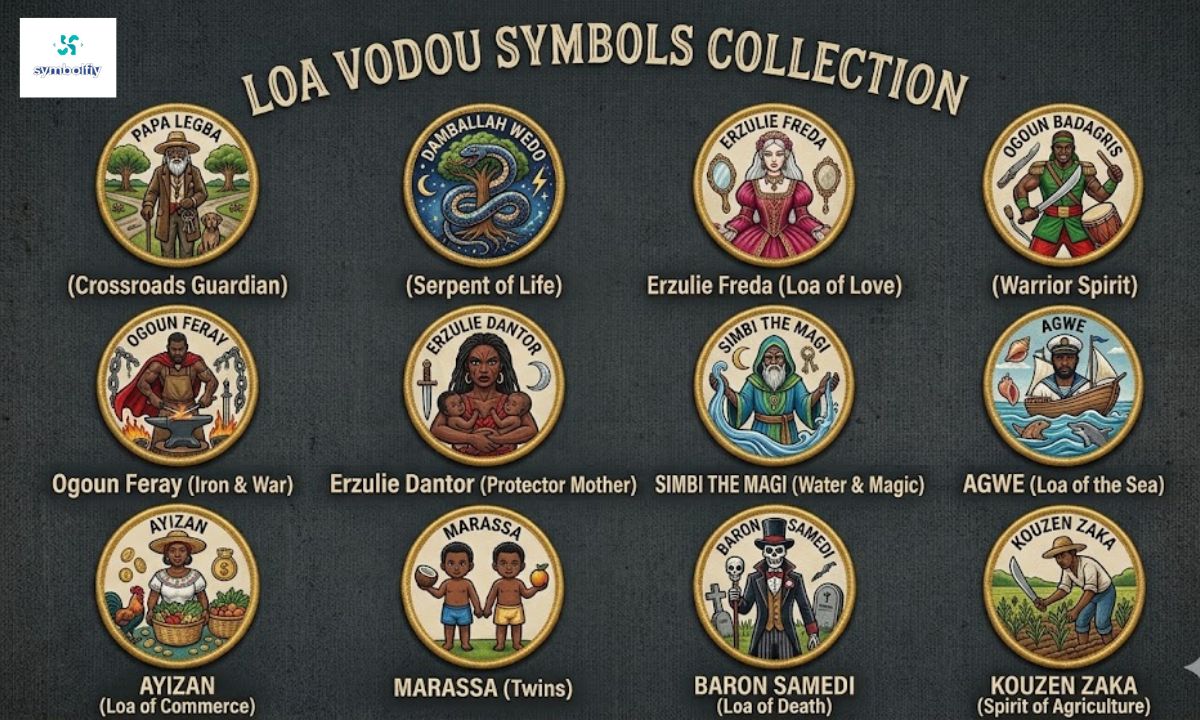
Papa Legba is the first Lwa called in every Vodou ceremony. He stands at the crossroads between the human world and the spirit world. Without his permission, no other spirit can enter. His veve shows a crossroads shape, a walking cane, and sometimes a key.
Spiritual meaning: Opens doors, removes obstacles, grants access to the divine
Cultural connection: Often linked to Saint Peter in Catholic syncretism, as both hold keys
Emotional symbolism: Hope, new beginnings, and the courage to make a choice
He is the gatekeeper of destiny. When life feels blocked, his symbol is called upon first.
2. Erzulie Freda Veve
Erzulie Freda is the Lwa of love, beauty, and luxury. Her veve features a decorated heart with intricate curls and sometimes a crown. She represents feminine power, desire, and romantic longing.
Spiritual meaning: Attracts love, beauty, and emotional abundance
Historical background: Rooted in West African feminine spirit traditions
Modern use: Her symbol appears in love rituals, spiritual jewelry, and Haitian art
She is generous but also known for jealousy. Her love is real, but she expects devotion in return.
3. Erzulie Dantor Veve
Erzulie Dantor is Erzulie Freda’s fierce counterpart. Her veve also features a heart, but it is pierced by a knife or dagger. She is the protector of women, children, and the vulnerable.
Spiritual meaning: Protection, justice, fierce maternal love
Cultural connection: Linked to the Black Madonna of Częstochowa in Catholic imagery
Emotional symbolism: The strength to fight for yourself and those you love
Where Freda offers soft love, Dantor offers fierce, unbreakable protection.
4. Baron Samedi Veve
Baron Samedi is the master of cemeteries and ruler of the dead. His veve shows a cross, a tomb, and coffin shapes. He rules over endings, transitions, and the cycle of life and death.
Spiritual meaning: Death, transformation, and spiritual rebirth
Historical background: One of the most widely known Lwa outside Haiti, often misrepresented in pop culture
Emotional symbolism: Facing death without fear, accepting change
He is not evil. And He guards the line between the living and the dead, making sure souls cross peacefully.
5. Maman Brigitte Veve
Maman Brigitte is Baron Samedi’s consort and co-ruler of the dead. Her veve features parallel lines, a heart, and small crosses. She is fierce, foul-mouthed, and fiercely protective of the graves of women.
Spiritual meaning: Protection of the dead, feminine power over death
Cultural connection: Uniquely, she is believed to have origins in Celtic tradition — tied to the Irish and Scottish goddess Brigid
Emotional symbolism: The fearless woman who protects even after death
She is the only major Lwa thought to have European roots, showing how Vodou absorbed many cultural streams.
6. Damballah Veve
Damballah is the great serpent spirit, one of the oldest and most revered Lwa. His veve shows two intertwined snakes or a single winding serpent.
Spiritual meaning: Creation, purity, wisdom, and ancestral life force
Historical background: Rooted in West African Dahomean religious tradition, where the rainbow serpent was sacred
Emotional symbolism: Peace, spiritual clarity, and connection to the source of all life
The snake here is not a symbol of evil. It is the original life force, pure and ancient.
7. Ayida Wedo Veve
Ayida Wedo is Damballah’s wife and the rainbow serpent. Together, they represent the full cycle of creation. Her veve often shows a rainbow arc combined with serpent forms.
Spiritual meaning: Balance, fertility, the union of heaven and earth
Cultural connection: In Dahomean tradition, the rainbow serpent couple represent cosmic harmony
Emotional symbolism: The beauty of opposites working together
She brings color and balance to Damballah’s pure white energy.
8. Ogou Feray Veve
Ogou Feray is the warrior Lwa, ruler of fire, iron, and strength. His veve shows crossed swords and geometric lines representing military power and elemental force.
Spiritual meaning: Courage, protection, victory in battle
Historical background: His energy is said to have moved through the Haitian Revolution, inspiring warriors against colonial forces
Emotional symbolism: The will to fight for what is right, even at great cost
He is fierce but just. His sword protects, not destroys without reason.
9. Ogou Badagri Veve
A calmer aspect of Ogou, Ogou Badagri is the wise general. His veve shows intertwined swords rather than crossed ones. He represents strategy, patience, and thoughtful power.
Spiritual meaning: Wisdom in conflict, leadership, and measured strength
Modern interpretation: Called upon when someone needs to navigate a difficult situation wisely, not just with force
He is the elder warrior who has seen enough battles to know that wisdom wins more than aggression.
10. Agwe Veve
Agwe is the Lwa of the seas and all waters. His veve resembles a boat or ship on waves. Coastal communities in Haiti have long honored him for safe passage and abundant fishing.
Spiritual meaning: Protection at sea, emotional balance, safe journeys
Cultural connection: Fishermen and sailors offer him champagne and toy boats set afloat on the water
Emotional symbolism: Finding calm in turbulent emotional waters
He is also believed to escort the souls of the dead to their resting place beneath the sea.
11. Simbi Veve
Simbi is the spirit of rivers, springs, and healing waters. His veve often includes flowing water shapes and crossed lines. The Simbi family of spirits are known for clairvoyance and spiritual sight.
Spiritual meaning: Healing, intuition, and clear vision
Cultural connection: Simbi spirits are associated with Kongo tradition and are considered among the most magically powerful Lwa
Emotional symbolism: The ability to see through confusion and find truth
Many practitioners call on Simbi before making important life decisions.
12. Kouzen Zaka Veve
Kouzen Zaka is the Lwa of agriculture, farming, and honest work. His veve shows farming tools — a machete, hoe, sickle, and a traditional straw bag called a djakout.
Spiritual meaning: Hard work, prosperity through honest effort, connection to the earth
Cultural connection: Celebrated on May 1st, the agricultural and labor festival
Emotional symbolism: Pride in work, patience, and the reward that comes from dedication
He represents the common farmer, the humble worker who feeds the world.
13. Ayizan Veve
Ayizan is the Lwa of markets, trade, and healing. Her veve features four intersecting lines forming a diamond, representing a palm leaf — her sacred tree.
Spiritual meaning: Commerce, purification, and spiritual initiation
Historical background: As the first mambo (Vodou priestess), she represents the beginning of Vodou tradition itself
Emotional symbolism: The power of new beginnings and spiritual authority
She is called upon before initiations and at the start of important ceremonies.
14. Papa Loko Veve
Papa Loko is the first houngan (Vodou priest) and keeper of Vodou traditions. His veve shows a snake coiled around a vertical axis and a cane — symbols of healing and spiritual authority.
Spiritual meaning: Wisdom, initiation, preservation of sacred knowledge
Cultural connection: He is believed to grant spiritual powers to new priests during initiation
Emotional symbolism: Trust in tradition, the safety of spiritual guidance
He guards the ounfò (Vodou temple) and ensures the ancient ways are passed down correctly.
15. Marasa Veve
The Marasa are sacred twin spirits. Their veve shows two connected figures tied together, reflecting their inseparable nature. They represent the duality of all things — good and evil, light and shadow, joy and sadness.
Spiritual meaning: Duality, magical power, the balance of opposites
Cultural connection: Human twins in Haiti are traditionally considered sacred and treated with special reverence
Emotional symbolism: The mystery of two things that are one
The Marasa are mischievous and unpredictable. They are feared as much as they are loved.
16. La Sirene Veve
La Sirene is the mermaid Lwa, ruler of the sea alongside Agwe. Her veve features a mermaid figure, waves, and sometimes a mirror or comb. She is beautiful, magnetic, and dangerous.
Spiritual meaning: Beauty, mystery, artistic talent, and hidden depths
Cultural connection: Connected to the African Mami Wata tradition of water spirit worship
Emotional symbolism: The call of the deep — creativity, emotion, and what lies beneath the surface
Artists, musicians, and dreamers often feel a strong connection to La Sirene.
17. Ghede Veve (The Gede Nation)
The Ghede are a family of death spirits led by Baron Samedi. Their collective veve often features crosses, skulls, and cemetery imagery. They are loud, rude, funny, and absolutely fearless.
Spiritual meaning: The dead who have nothing left to fear, keepers of raw truth
Historical background: The Ghede are considered uniquely Haitian — they were born in Haiti, not brought from Africa
Emotional symbolism: Liberation from social pretense, acceptance of death as part of life
They eat glass, mock the powerful, and speak only truth. They are deeply loved.
18. Milokan Veve
The Milokan veve is not one spirit but many. It is an extraordinary drawing that calls multiple Lwa into a single ceremony at once. These are among the most intricate and beautiful veves that exist.
Spiritual meaning: Unity of many divine forces, complex ceremonial power
Cultural connection: Used in major Vodou ceremonies where the help of many spirits is needed
Emotional symbolism: The feeling that the entire spirit world is listening
Milokan veves are considered master works of sacred art.
19. Met Kalfu Veve
Met Kalfu (Master Crossroads) is the dark mirror of Papa Legba. Where Legba opens crossroads with blessing, Kalfu commands the darker paths. His veve features crossed lines and sharp angular shapes.
Spiritual meaning: The shadow side of fate, control over dangerous spiritual forces
Cultural connection: Associated with the Petro nation of Lwa — the fiercer, more intense spirits
Emotional symbolism: Confronting what is dark within yourself in order to move forward
He is respected deeply but approached with caution.
20. Marinette Veve
Marinette is a fierce Petro Lwa associated with freedom, liberation, and wild nature. Her symbol reflects raw, untamed power. She is said to have been invoked at the Bwa Kayiman ceremony — the spiritual event that launched the Haitian Revolution in 1791.
Historical background: Deeply tied to Haitian independence — one of the most politically charged Lwa
Emotional symbolism: The moment a person decides they will no longer be controlled
She is dangerous and powerful, but her cause has always been liberation.
21. Bosou Veve
Bosou is a bull Lwa, fierce and unstoppable. His veve features bull horns and a cross, representing charging force and divine energy. He is called upon when someone needs raw, unstoppable power to break through obstacles.
Cultural connection: The bull is a sacred animal in many West African traditions from which Vodou draws
Emotional symbolism: The feeling of charging forward when fear would normally stop you
Bosou does not hesitate. He moves through walls.
22. Loko Atisou Veve
Loko Atisou is the Lwa of healing herbs and plants. His veve is tied to the natural world — leaves, roots, and growing things. He is the physician of the spirit world.
Spiritual meaning: Healing through nature, knowledge of plants and medicine
Cultural connection: Traditional Vodou healing involves deep knowledge of herbal medicine, and Loko guards this wisdom
Emotional symbolism: Trust in the natural world to heal what modern medicine cannot reach
Herbalists and traditional healers hold Loko in special reverence.
23. Ezili Mapyan Veve
Ezili Mapyan is one of the older, more mysterious aspects of Erzulie. She represents the cosmic feminine and is associated with the stars and celestial power. Her veve draws on the heart symbol but extends it with starlike rays.
Spiritual meaning: Cosmic love, the divine feminine, spiritual grace
Emotional symbolism: Love that transcends the personal and becomes universal
She is called upon for spiritual elevation and connection to something greater than individual desire.
24. Kalfu Crossroads Symbol
Beyond Met Kalfu’s personal veve, the crossroads itself is one of the most powerful recurring symbols across all of Vodou. Any meeting of paths — especially a four-way cross — is considered a sacred point between worlds.
Cultural connection: The crossroads appears in Vodou, West African tradition, and blues music from the American South — showing how this symbol traveled with enslaved people
Emotional symbolism: The moment life asks you which way to go
No location is more spiritually charged in Vodou than the crossroads at midnight.
25. The Poteau Mitan Symbol
The Poteau Mitan is the central post in a Vodou temple. Every ceremony takes place around it. It represents the cosmic axis — the pole connecting the earth below to the spirit world above.
Spiritual meaning: The center of the universe, the channel through which spirits descend into the ceremony
Cultural connection: The poteau mitan combines African spiritual geometry with the image of the world tree found in many global traditions
Emotional symbolism: The feeling of being grounded and connected — to ancestors, to earth, to something eternal
When practitioners dance around it during ceremony, they are circling the axis of the world.
26. The Veve Cross (Kwa)
In Vodou, the cross does not belong to Christianity — it belongs to the crossroads. The kwa, or Vodou cross, represents the meeting point of two worlds: the visible and the invisible, the living and the dead.
Spiritual meaning: Spiritual intersection, gateway between life and death
Historical background: Colonial-era Africans used the cross shape to secretly maintain their own spiritual symbols while appearing to worship Christian icons
Emotional symbolism: Finding meaning at the point where everything meets
The Vodou cross is one of the most powerful acts of spiritual resilience in human history.
27. Nsibidi-Inspired Patterns
Scholars believe veve symbols may have roots in the Nsibidi writing system — an ancient script used by the Igbo and Ekoid peoples of West and Central Africa. These geometric patterns carried spiritual meaning long before they became veves.
Spiritual meaning: Ancient knowledge, the power of written sacred language
Historical background: Nsibidi predates European contact in Africa and represents one of the oldest known indigenous writing systems
Emotional symbolism: The continuity of wisdom across centuries, even through the trauma of enslavement
Every veve may carry within it the echo of an older, deeper script.
28. The Kongo Cosmogram
The Kongo cosmogram is a diamond or circle divided by a cross. It represents the four moments of the sun — birth, life, death, and rebirth. It is one of the foundational symbols behind many veve designs.
Spiritual meaning: The eternal cycle of life and death, the four directions of existence
Cultural connection: Central to Kongo spiritual tradition, which heavily influenced Haitian Vodou and Caribbean religions broadly
Emotional symbolism: Comfort in knowing that nothing truly ends — only transforms
The cosmogram says: you are always somewhere on the circle. The journey never stops.
29. Voodoo Doll Symbol (The Poppet)
The famous voodoo doll is mostly a Hollywood invention, but the poppet — a small figure used in sympathetic magic — does exist in folk traditions. In Vodou, small figures are used primarily for healing and love, not harm.
Spiritual meaning: Representing a person to channel healing or spiritual attention toward them
Cultural connection: Similar folk magic figures exist in European, African, and Asian traditions worldwide
Emotional symbolism: The desire to help someone from a distance — a prayer made physical
Most uses are protective or loving. The sinister version belongs more to film than to practice.
30. Sacred Ritual Powder Patterns
Beyond individual veves, the act of drawing in cornmeal, ash, or flour is itself a sacred symbol. The medium disappears — stepped on, blown away — but the spiritual act remains. Impermanence is part of the meaning.
Spiritual meaning: Sacred art that lives and dies in a single ceremony, like prayer
Cultural connection: Many West African traditions use ground drawings in rituals — Vodou preserved this practice across the ocean
Emotional symbolism: Some things are meant to be felt fully, not kept forever
The most sacred symbols are not made to last. They are made to be true, just once, in the right moment.
Ancient Cultures That Used These Symbols
Vodou symbols did not appear from nowhere. They carry the fingerprints of many ancient traditions.
West African Vodun (Dahomey/Benin) — The direct ancestor of Haitian Vodou. The Lwa, the serpent symbols, and the tradition of drawing sacred signs all trace back to the Fon and Ewe peoples of modern Benin and Togo.
Kongo spiritual tradition — The Kongo cosmogram and the concept of the four-direction cross deeply influenced how Vodou organizes its spiritual geography. Simbi and other Kongo-related Lwa carry this heritage.
Yoruba tradition (Nigeria) — The Ogou warrior spirits connect directly to the Yoruba deity Ogun. Yoruba spiritual systems traveled to Haiti and deeply shaped the Nago nation of Lwa.
Catholic Christianity — Four centuries of forced Catholicism in Haiti led Vodou practitioners to disguise their Lwa behind Catholic saints. Papa Legba became Saint Peter. Erzulie became the Virgin Mary. The symbols merged but the original meanings survived.
Celtic and British traditions — Maman Brigitte is thought to carry traces of the Celtic goddess Brigid, brought to Haiti through Irish and Scottish indentured servants. It shows how Vodou absorbed even unexpected cultural currents.
Indigenous Caribbean (Taino) — Some scholars believe early Taino spiritual practices in Haiti also influenced the development of Vodou, particularly its relationship with the land and nature spirits.
Why These Symbols Still Matter Today
Symbols carry what history tries to erase. Voodoo symbols survived colonial violence, religious persecution, and centuries of Hollywood misrepresentation. They are still drawn, still worn as tattoos and jewelry, still placed on altars in homes from Port-au-Prince to New York to Paris.
For many people, especially in the Haitian diaspora, these symbols are a direct connection to ancestors and identity. They are not relics — they are living.
Today, people across many backgrounds are drawn to veve symbols for their beauty, their depth, and their emotional power. Tattoo artists incorporate them as symbols of protection and ancestral connection.
Designers use them in fashion and visual art. Spiritual seekers use them in meditation and personal ritual. Whatever the context, the symbols carry their original force. They remind anyone who looks closely that the invisible world is real, that ancestors are near, and that sacred knowledge cannot be stolen — only passed on.
Frequently Asked Questions
Are voodoo symbols evil?
No — veves are sacred spiritual tools used for healing, protection, love, and ancestral connection, not dark magic.
What is a veve in Voodoo?
A veve is a ritual drawing that represents a specific Lwa spirit and acts as a spiritual beacon to invite that spirit into a ceremony.
What does the Papa Legba symbol mean?
Papa Legba’s veve represents the crossroads, the gateway between the human world and the spirit world.
Can voodoo symbols be used as tattoos?
Yes — many people wear veve tattoos as symbols of protection, identity, and spiritual connection, especially in Haitian diaspora communities.
What is the difference between Haitian Vodou and Louisiana Voodoo?
Haitian Vodou is rooted in African and Catholic syncretism brought to Haiti; Louisiana Voodoo developed in New Orleans with additional folk magic and Native American influences.
Conclusion
Voodoo symbols are not shadows or superstition. They are centuries of faith drawn in powder on the ground. Each veve is a conversation with something ancient and real — a spirit, an ancestor, a force that has always existed and always will.
When you understand these symbols, you stop seeing mystery and start seeing meaning. You see the survival of enslaved people who refused to let their sacred world be taken. You see art, prayer, and history in a single line. That is what these symbols have always been.