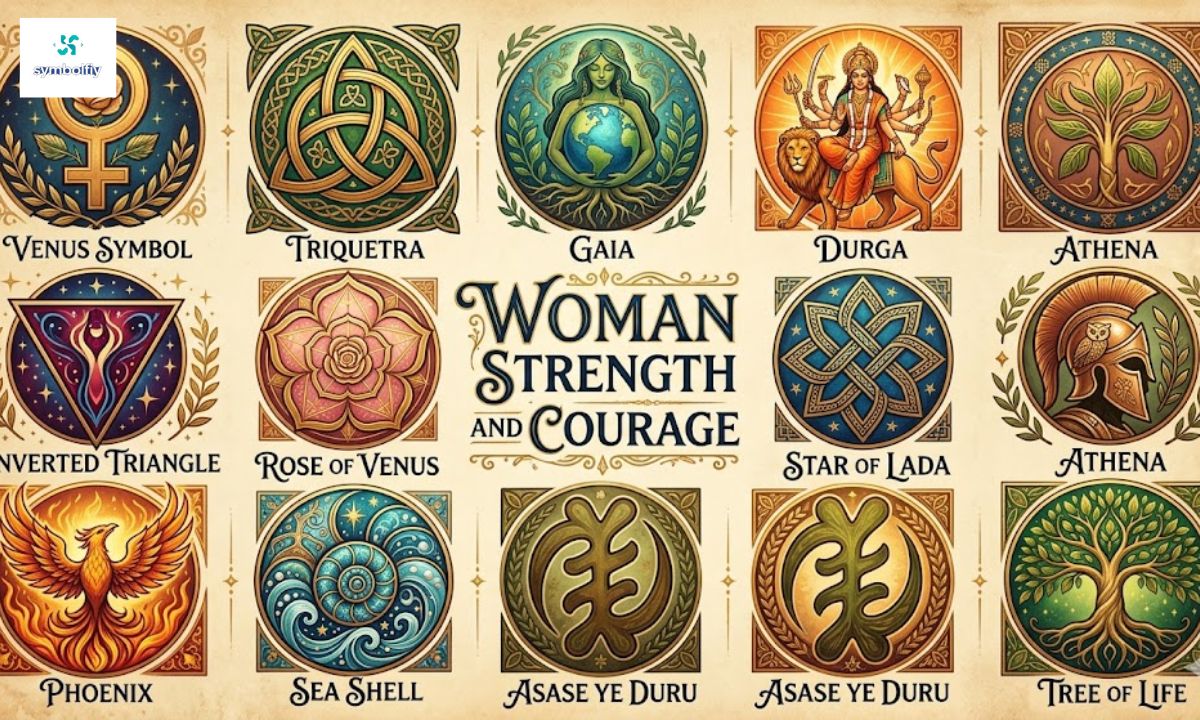
Symbols have always carried weight. Long before written language, people used images to express ideas that felt too big for words. When it comes to women and strength, those images go deep — across religions, cultures, and thousands of years of history.
Whether you’re drawn to ancient mythology, spiritual traditions, or modern empowerment, these symbols speak to something real. They don’t just represent strength. They remind you it’s already there.
What Do Woman Symbols of Strength and Courage Symbolize?
At their core, these symbols represent the full range of feminine power — not just the obvious kind, but the quiet, persistent kind too. The kind that holds a family together, rebuilds after loss, or pushes forward when no one is watching. These are symbols of survival, transformation, and courage that doesn’t always look loud.
Each culture found its own way to express this. Some used animals. Others used nature, goddesses, knots, or fire. But they all pointed at the same truth: that women carry a kind of strength that can’t be easily broken. Spiritually, these symbols connect to the divine feminine — a force that shows up in nearly every major religious and cultural tradition on earth.
25+ Woman Symbols of Strength and Courage and Their Meanings
Spiritual significance: The phoenix burns completely and rises renewed — a powerful image of surviving the worst
Modern use: One of the most popular tattoo symbols for women who’ve overcome hardship
The phoenix doesn’t just survive. It comes back stronger. That’s why so many women connect with it after going through grief, illness, or major life changes.
2. The Lotus Flower
Origin: Hindu and Buddhist traditions
Meaning: Purity, spiritual growth, resilience
Cultural connection: In Hinduism, the lotus is linked to goddesses Lakshmi and Saraswati — symbols of wisdom and prosperity
Emotional symbolism: It grows in murky water but blooms clean. A perfect metaphor for rising through hardship without losing your grace.
3. The Lioness
Origin: African cultures, ancient Egypt, Mesopotamia
Historical note: The Egyptian goddess Sekhmet wore a lion’s head to represent destructive, protective power
She hunts. She leads and protects. The lioness does all this quietly, without needing to prove it. That’s exactly what makes her a symbol of real feminine strength.
4. The Triple Moon (Triple Goddess)
Origin: Wiccan and Pagan traditions
Meaning: The three phases of womanhood — maiden, mother, crone
Spiritual meaning: Represents the full cycle of a woman’s life, tied to the waxing, full, and waning moon
Each phase holds its own kind of wisdom. Youth brings possibility. Motherhood brings nurturing power. Age brings deep knowing. Together, they make the complete picture.
5. The Butterfly
Origin: Universal — appears in Native American, African, and Western traditions
Meaning: Transformation, freedom, personal growth
Cultural note: In some sub-Saharan African traditions, the butterfly’s metamorphosis marks female rites of passage
There’s courage in becoming something new. The butterfly carries that story with every wing beat.
6. The Venus Symbol (♀)
Origin: Ancient Greece and Rome
Meaning: Femininity, equality, female empowerment
Historical background: Originally an alchemical symbol for copper, it later became the universal marker for women
Today, it stands for the fight for women’s rights and equality. Simple in design, enormous in meaning.
7. Athena’s Owl
Origin: Ancient Greece
Meaning: Wisdom, strategy, courage guided by intelligence
Historical note: Athena was the goddess of both war and wisdom — unusual because she fought with her mind first
The owl perched on her shoulder was said to reveal hidden truths. It’s a reminder that strength doesn’t always mean force — sometimes it means seeing clearly.
8. The Spiral Goddess
Origin: Western Pagan traditions, ancient female figurines
Meaning: The divine feminine, cycles of life, creative energy
Spiritual significance: Spirals appear in some of the oldest human carvings — they’ve always pointed toward growth, expansion, and the mystery of existence
This symbol connects modern women to something ancient and unbroken.
9. Durga
Origin: Hinduism
Meaning: Warrior feminine energy, protection, the power to overcome evil
Cultural connection: Durga is the warrior form of Shakti, the cosmic female energy that sustains the universe
She’s shown with multiple arms, each holding a weapon — not out of aggression, but because protecting what matters sometimes demands everything you have.
10. The Berkano Rune
Origin: Norse/Scandinavian tradition
Meaning: New beginnings, feminine power, healing, family
Historical note: This rune is associated with birch trees, which symbolize renewal and fertility in Norse culture
It looks like a breast turned sideways, and yes — it’s intentional. It honors the life-giving, nurturing aspect of feminine strength.
11. The Hamsa (Hand of Fatima)
Origin: Jewish, Islamic, and Christian traditions across the Middle East and North Africa
Meaning: Protection, good fortune, warding off harm
Spiritual meaning: The open hand with an eye at its center is believed to shield its wearer from negative energy
Women across multiple faiths have worn this symbol for centuries. It crosses religious lines because protection is something everyone understands.
Cultural connections: In African traditions, the lunar cycle aligns with female fertility and ritual calendars. In Christianity, Mary is often depicted standing on the moon.
The moon pulls the tides and mirrors the rhythms of women’s bodies. That’s not a coincidence — it’s a connection cultures have honored forever.
13. The Celtic Motherhood Knot
Origin: Celtic tradition
Meaning: The unbreakable bond between mother and child
Design: Two interlocked hearts with no beginning or end — symbolizing a love that can’t be untied
Strength doesn’t get more real than the kind that holds through everything. This knot captures that perfectly.
14. The Triskelion (Triple Spiral)
Origin: Celtic Ireland and Scotland
Meaning: Birth, death, rebirth — the cycle of life, forward motion
Spiritual note: Three connected spirals representing constant movement and the balance of life’s three stages
Life keeps moving. The triskelion says lean into that instead of fighting it.
15. Isis (Tyet Knot)
Origin: Ancient Egypt
Meaning: Protection, resurrection, motherhood, magical power
Historical background: The tyet — or knot of Isis — was placed with the dead to protect them in the afterlife. It was typically made of red stone.
Isis resurrected her husband Osiris and raised Horus alone. She is one of history’s most enduring symbols of a woman who holds everything together through sheer force of will.
16. The Valkyrie
Origin: Norse mythology
Meaning: Warrior courage, choosing destiny, honorable power
Cultural significance: Valkyries chose which warriors lived and died in battle — that’s not passive power, that’s fate-making authority
Few symbols communicate decisive feminine strength more clearly than a warrior woman who literally shapes the afterlife.
17. Medusa
Origin: Ancient Greece
Meaning: Reclaimed power, protection, resistance to being silenced
Modern interpretation: Once a monster story, now a feminist icon — Medusa represents the danger of underestimating a woman
Her story has been rewritten. She wasn’t the villain. She was the one who was wronged, and her gaze became her armor.
18. The Scarab Beetle
Origin: Ancient Egypt
Meaning: Rebirth, transformation, protection
Spiritual significance: Associated with the sun god Ra — representing the cyclical journey from darkness to light
Women in ancient Egypt wore scarab amulets for strength and protection. The symbolism hasn’t faded.
19. The Spider (Spider Grandmother)
Origin: Native American traditions (Ojibwe, Hopi, Navajo)
Cultural note: In Hopi legend, Spider Grandmother created humans from clay. In Navajo stories, she taught people weaving — the foundation of their culture.
She creates and protects. She teaches. The Spider Grandmother is one of the most complete symbols of feminine power in any tradition.
20. The Tree of Life
Origin: Across Celtic, Norse, Jewish (Kabbalah), Hindu traditions
Meaning: Strength, growth, deep roots, connection between worlds
Emotional symbolism: The tree stays grounded while reaching higher. That balance captures what many women live every day.
21. The Swan
Origin: Ancient Greece, Norse tradition, European folklore
Meaning: Grace, loyalty, strength through elegance
Historical note: Aphrodite was often depicted with swans as a symbol of health and divine beauty
The swan looks effortless on the surface. Underneath, it’s working constantly. Sound familiar?
22. The Dara Knot
Origin: Celtic tradition
Meaning: Inner strength, resilience, the deep root system of an oak tree
Spiritual significance: “Dara” comes from the Irish word for oak. The knot represents the massive invisible root system that lets the tree survive everything above ground.
Your strength has deep roots too, even when no one sees them.
23. The Pomegranate
Origin: Ancient Greece, Persian and Middle Eastern traditions
Meaning: Fertility, the balance of life and death, resilience
Historical story: Persephone’s connection to the pomegranate represents a woman who navigates two worlds and survives both
It’s a symbol of surviving the underworld and coming back. Every season, without fail.
24. The Tiger
Origin: Ancient China and Japan
Meaning: Protective power, quiet strength, balance of feminine and masculine energy
Cultural note: In Japanese tradition, mirrors decorated with tigers were gifted to brides as symbols of feminine protection
The tiger doesn’t roar to prove itself. It acts when it matters. That’s the kind of strength this symbol points to.
25. Pele (Hawaiian Goddess)
Origin: Hawaiian tradition
Meaning: Creative and destructive power, respect, the force of nature
Cultural significance: Pele is both creator and destroyer — she makes new land through lava but burns what’s in her path
Real power creates. Real power also clears the way for something new. Pele holds both truths at once.
Historical note: Because ferns reproduce without flowers or seeds, early peoples thought they were magical — connected to eternal life
The fern doesn’t shout. It just keeps growing, quietly, in places other plants can’t survive.
Ancient Cultures That Used These Symbols
Ancient Egypt — Women were deeply woven into Egyptian spiritual life. Goddesses like Isis, Hathor, and Sekhmet represented protection, motherhood, and fierce power. Amulets like the tyet and the scarab were worn daily.
Ancient Greece — Athena embodied wisdom and strategic courage. Other goddesses like Persephone and Medusa, even in darker stories, became symbols of survival and reclaimed power over time.
Norse/Viking culture — Valkyries and runes like Berkano gave women a spiritual and warrior identity. Norse women were seen as destiny-shapers, not just supporters.
Celtic traditions — Intricate knots, spirals, and sacred trees represented feminine endurance and the unbreakable cycles of life. The Celts encoded strength into design itself.
Hinduism and Buddhism — Shakti, Durga, and the lotus flower placed feminine energy at the center of spiritual creation and destruction. These aren’t background figures — they hold up the cosmos.
Native American traditions — The Spider Grandmother and the moon played central roles in creation stories. Feminine wisdom was tied to weaving, agriculture, and the fabric of community life.
Why These Symbols Still Matter Today
We live in a world flooded with information but sometimes starved for meaning. Symbols cut through that noise. When someone gets a phoenix tattoo or wears a hamsa necklace, they’re not just following a trend — they’re claiming a story. They’re saying, “This is what I’ve been through, and this is who I am now.”
These symbols still show up everywhere: in meditation practices, in jewelry design, in art, in social movements, and in the quiet rituals people build into their daily lives. They connect modern women to thousands of years of women who faced hard things and came through. That thread doesn’t break. It just keeps getting longer.
Frequently Asked Questions
What is the most recognized woman symbol of strength?
The Venus symbol (♀) is one of the most widely recognized globally, used across history and modern feminism.
What does the lotus flower mean for women?
It represents growing through difficulty with grace — blooming in muddy water without being stained by it.
Which Celtic symbol represents female strength?
The Dara Knot and the Celtic Motherhood Knot are both strong Celtic symbols tied to feminine resilience and endurance.
Why is the phoenix a symbol for women’s strength?
Because it represents surviving complete destruction and rising renewed — a story many women deeply identify with.
Can these symbols be used in tattoos?
Yes, and they often are — women frequently choose them to mark personal milestones, healing, and hard-won growth.
Conclusion
These symbols didn’t survive thousands of years by accident. They stuck around because they’re true. They reflect something real about what it means to face hard things, hold on, and keep going.
Whether you find yourself drawn to the quiet endurance of the fern, the fierce protection of the lioness, or the total transformation of the phoenix — somewhere in this list is a symbol that already belongs to you.