Web 3.0 is the next stage of the internet. It aims to give users control of their own data. It moves power away from a few large platforms and also helps machines understand information, not just display it. Some parts of it already work today, and others are still being built. This guide explains what it is, how it works, and where it falls short.
Thank you for reading this post, don't forget to subscribe!
Web 3.0 is a vision of the internet where users own their data, apps run on shared networks instead of company servers, and software can understand the meaning of information. It is often called the decentralized web.
The idea has two roots. One is the semantic web, a concept Tim Berners-Lee described early in the history of the web. The other is blockchain technology, which lets strangers agree on records without a middleman.
In simple terms, Web 3.0 moves the internet from a place where you rent space on someone else’s platform to a place where you can hold your own accounts, files, and assets.
The Internet Timeline
The web has changed in clear stages. Looking at each one makes it easier to see what Web 3.0 is trying to fix.
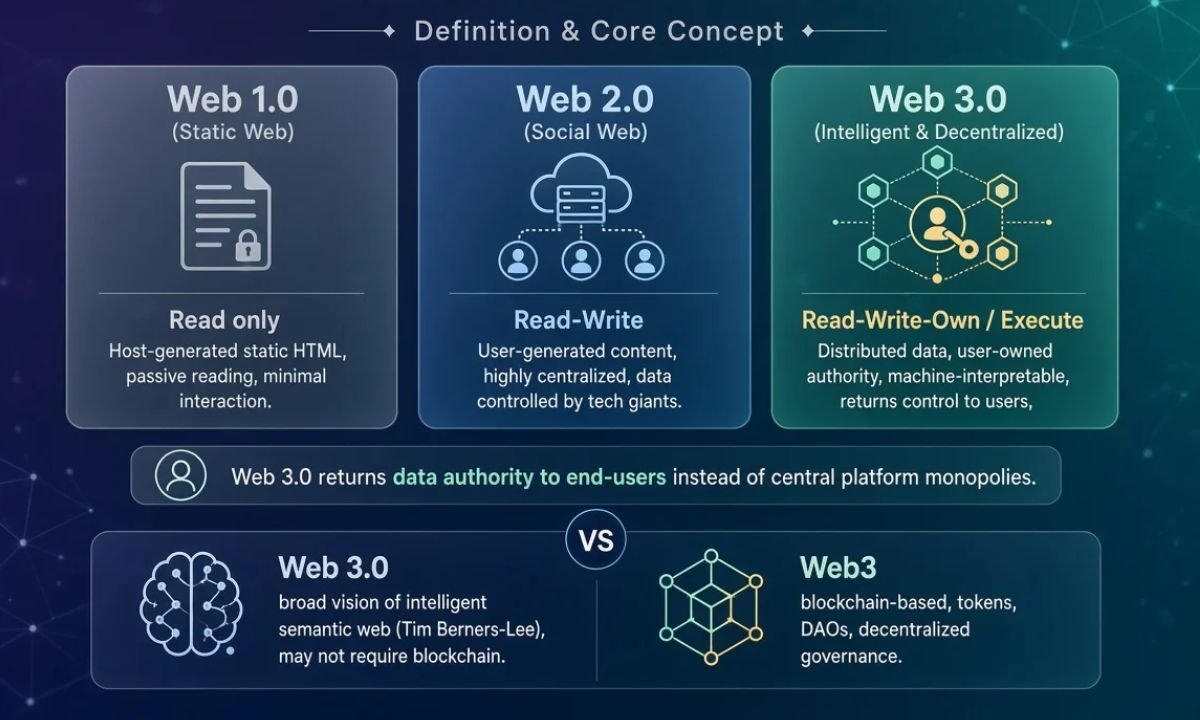
Web 1.0: Read Only
The first web was mostly static pages. A small number of publishers created content, and everyone else read it. Pages were linked together, but there was little interaction.
You could visit a site, read it, and leave. Commenting, sharing, and posting were limited or did not exist. The web worked like a digital library.
Web 2.0: Read-Write
Web 2.0 let anyone publish. Social networks, video platforms, blogs, and online stores turned users into creators. This is the web most people use today.
The trade-off is control. Your posts, photos, and contacts live on servers owned by companies. They set the rules, they can change them, and they earn money from your data.
Web 3.0: Read-Write-Own
Web 3.0 adds ownership. Instead of storing your identity and assets on a company’s servers, you hold them yourself, often with a digital wallet. Some describe this as Read-Write-Execute, because code can run on shared networks and carry out agreements automatically.
Here is a quick comparison.
Feature
Web 1.0
Web 2.0
Web 3.0
Main activity
Read
Read and write
Read, write, and own
Who controls data
Site owners
Platforms
Users
Where apps run
Single servers
Company clouds
Distributed networks
How data is understood
Not at all
Mostly by people
By people and machines
Web 3.0 vs. Web3
People use these two terms as if they mean the same thing. They do not, and the difference matters if you want to read about this topic without getting confused.
Web 3.0 is the broader idea. It focuses on a smarter web where data carries meaning and machines can connect it. It does not strictly require blockchain.
Web3 is a narrower term that appeared around 2014. It describes an internet built on blockchain networks, tokens, and community-run organizations called DAOs.
So is Web 3.0 the same as Web3? Not exactly. Web3 is one way of building toward Web 3.0, and today it gets most of the attention. Many articles blend the two, which is why search results can feel inconsistent.
Feature
Web 3.0
Web3
Core focus
Data meaning and intelligence
Ownership and decentralization
Blockchain required
No
Yes
Key idea
Semantic connections
Tokens and smart contracts
Origin
Early semantic web vision
Blockchain community
How Web 3.0 Works
A normal website runs on a server that a company controls. You send a request, the server answers, and the company decides what you can see and do.
A Web 3.0 app works differently. Its code and data are spread across many computers, called nodes. No single machine is in charge, and the network follows shared rules that everyone can inspect.
Here is the basic flow for a blockchain-based app:
You connect a digital wallet instead of creating an account with a password.
You approve an action, such as a payment or a vote, by signing it with your wallet.
The network checks the action against the rules written in a smart contract.
If it passes, the result is recorded on a distributed ledger that many nodes copy and verify.
A smart contract is a small program that runs when set conditions are met. It can release a payment, transfer a digital item, or record a vote without a person approving each step.
The semantic side works in a different way. Data is labeled so software can tell what it means and how it relates to other data. A search for “jaguar” can then tell the animal from the car because the surrounding facts differ.
Core Pillars of Web 3.0
Several technologies work together here. None of them alone is Web 3.0, but each covers a gap the older web left open.
The Semantic Web
The semantic web adds structure to information. It uses standards such as RDF and OWL to describe things and the links between them. These descriptions form knowledge graphs, which are maps of facts.
This is how modern search tools answer direct questions instead of only listing pages. It also lets different systems share data without a person translating between them.
Artificial Intelligence
AI helps process the huge amount of data that a connected web produces. It can sort information, spot patterns, personalize results, and generate content on request.
In a Web 3.0 setting, the hope is that AI works for the user, not only for the platform. For example, a personal assistant could manage your data permissions on your behalf. That goal is still more promise than reality.
Edge Computing
Edge computing processes data close to where it is created, such as on your phone or a local device, instead of sending everything to a distant data center.
This cuts delay and keeps more information on your own hardware. Techniques like federated learning let models improve from many devices without gathering raw personal data in one place.
Decentralized Storage
Traditional cloud storage keeps your files in a company’s data centers. Decentralized storage splits files into pieces and spreads them across many computers.
IPFS is a well-known example. Files are found by what they contain, not by where they sit, so a file stays reachable as long as someone on the network keeps a copy. The catch is that nobody is forced to keep it, so important files need people or services paid to store them.
The appeal of Web 3.0 comes down to control. Here is what that looks like in practice.
True Data Ownership
Your digital identity can live in a wallet that you hold. You choose which apps can see which details, and you can move to a different app without losing your history.
Digital items can also be yours in a stronger sense. An NFT is a record on a blockchain that proves who holds a specific item. It can cover art, tickets, game items, or membership passes, and you can sell or transfer it without asking a platform for permission.
Enhanced Privacy
Web 3.0 can reduce how much personal data you hand over. Instead of sharing your name, email, and birth date to sign in, you can prove one fact, such as “I am over 18,” without revealing the rest.
This works through cryptographic methods that confirm a claim without exposing the underlying data. Keep in mind that most public blockchains are open ledgers. Transactions are visible, and a wallet address can sometimes be linked back to a person. Privacy depends on how an app is built, not on the label “Web 3.0.”
Other benefits include fewer single points of failure, since a network with many nodes keeps running if some go offline. Rules are also visible in code, which makes some services more transparent than a closed platform.
Real-World Web 3.0 Examples
If you are wondering what Web 3.0 websites look like, most are apps and services, not traditional sites. A few categories already exist:
Decentralized finance (DeFi): Lending, borrowing, and trading run by smart contracts instead of banks.
Digital collectibles and tickets: NFTs that prove ownership of art, event passes, or in-game items.
Community-run organizations: DAOs where members vote on decisions using tokens.
Decentralized storage and file sharing: Networks that store files across many computers.
Virtual worlds: Online spaces with their own economies, where items can move between different apps.
Learning and credentials: Student records and certificates stored in a way that schools and employers can verify, without calling the original institution.
The semantic side shows up in everyday tools too. Knowledge panels in search results, smart assistants, and product listings that carry structured details all rely on machine-readable data.
Can Web 3.0 Run Without Cryptocurrency?
Yes, in part. The semantic web, edge computing, and AI do not need crypto at all. Only the blockchain-based branch relies on tokens, usually to pay network fees and reward the people who run the network.
If your goal is to understand the broader direction of the internet, do not assume crypto is the whole story. It is one piece.
How to Try Web 3.0 Today
You do not need to be technical to explore this space. A careful first try looks like this:
Start with learning, not money. Read how wallets and smart contracts work before you buy anything.
Set up a wallet. Choose a well-reviewed wallet app, and write down the recovery phrase on paper. Never store it in a screenshot or share it with anyone.
Use a small test amount. If you buy anything, start with an amount you can afford to lose.
Check each app before connecting. Look for audits, an active community, and a clear history. Read what a transaction asks you to approve.
Be wary of urgent offers. Free giveaways and pressure to act fast are common scam signals.
There is no customer support line for a lost recovery phrase. That is the cost of real ownership, and it is worth understanding before you begin.
The Environmental Question
Sustainability is a part of this topic that many guides skip. The impact depends heavily on how a network agrees on its records.
Older blockchain designs, known as proof of work, use large amounts of electricity because many computers compete to solve puzzles. Newer designs, known as proof of stake, use far less energy. One major network switched to proof of stake in 2022 and cut its energy use by a very large margin.
Decentralized storage raises its own question. Keeping many copies of the same data across many machines uses more hardware than one efficient data center. Whether that trade is worth it depends on how much you value resilience and independence.
Biggest Obstacles Ahead
Web 3.0 faces real problems. Ignoring them would give a false picture.
Regulatory Hurdles
Laws were written for companies with an address and a legal team. A network run by thousands of strangers across many countries does not fit that model well.
Questions remain about who is responsible when something goes wrong, how tokens should be classified, and how taxes apply. Rules differ from country to country and keep changing. Financial crime and fraud have also followed the money into this space, which adds pressure on lawmakers.
Tech Limitations
Many Web 3.0 apps still depend on the older web. A decentralized app may store data on a blockchain but use a traditional cloud service to load its website. That weakens the claim of independence.
Other issues include:
Speed and cost: Some networks are slower than regular apps, and fees can spike when demand is high.
Ease of use: Wallets, recovery phrases, and fees confuse new users.
Security: Bugs in smart contracts can lead to permanent losses, and transactions usually cannot be reversed.
Content moderation: With no central authority, harmful material and false information are harder to remove.
Market swings: Token prices can rise and fall sharply, which makes the space risky for newcomers.
The Future of the Web
Nobody can say for sure how this will play out. The most likely outcome is a mix, not a clean break from the current web.
Expect more apps that quietly use pieces of Web 3.0 while looking like normal software. Sign-in with a wallet, verifiable credentials, and machine-readable data may become routine without most users noticing. Fully decentralized platforms may stay a smaller part of the picture, aimed at people who value control above convenience.
The real test is simple: does it make life easier or safer for ordinary people? Ideas that pass that test will last. The rest will fade, as they have in every earlier stage of the web.
Frequently Asked Questions
What is Web 3.0 in simple words?
Web 3.0 is a version of the internet where users own their data and software can understand what information means.
Is Web 3.0 the same as Web3?
No, Web 3.0 is the broad idea of a smarter, user-controlled web, while Web3 is the blockchain-based version of it.
What are examples of Web 3.0 websites?
Common examples include decentralized finance apps, NFT marketplaces, DAOs, and decentralized storage networks, though most work as apps more than traditional websites.
How does Web 3.0 protect data privacy?
It lets you keep your identity in your own wallet and share only the details an app needs, though public blockchains can still expose transaction history.
Can Web 3.0 run without cryptocurrency?
Partly, because the semantic web, AI, and edge computing work without crypto, but blockchain-based apps usually need tokens.
Conclusion
Web 3.0 is an attempt to fix the biggest trade-off of the modern internet, where convenience comes at the cost of control over your own data. It combines meaning-aware data, smarter software, and shared networks so that users can hold their identity and assets without asking a platform for permission.
The ideas are promising, but the technology still has rough edges in cost, security, law, and ease of use. The smart approach is to stay curious, learn the basics, test carefully with small steps, and judge each product by what it actually does for you.