People have always reached for symbols to explain things that feel too big for words. A flag, a star, an animal, or even a simple branch can carry centuries of history in one small shape.
Italy is full of these symbols. They show up in its flag, its emblem, its food, and its old stories. Each one holds a piece of Italian identity, faith, struggle, and pride. In this guide, we look at over 25+ Italian symbols and what they really mean.
Italian symbols are not random pictures. They grew out of real history. Wars, kingdoms, religion, and art all shaped them over time. Many symbols tell a story about freedom, unity, or hope, while others speak about faith and family.
These symbols also carry emotional weight. They remind people of home, heritage, and belonging. Whether it is the Italian flag or the image of a wolf, each symbol connects people to something bigger than themselves, like their roots, their ancestors, and their shared culture.
Official National Symbols of Italy
Italy has a small set of symbols that represent the country at a government level. These appear on documents, buildings, and ceremonies. They were chosen carefully after Italy became a republic.
🇮🇹 The Italian Flag (Il Tricolore)
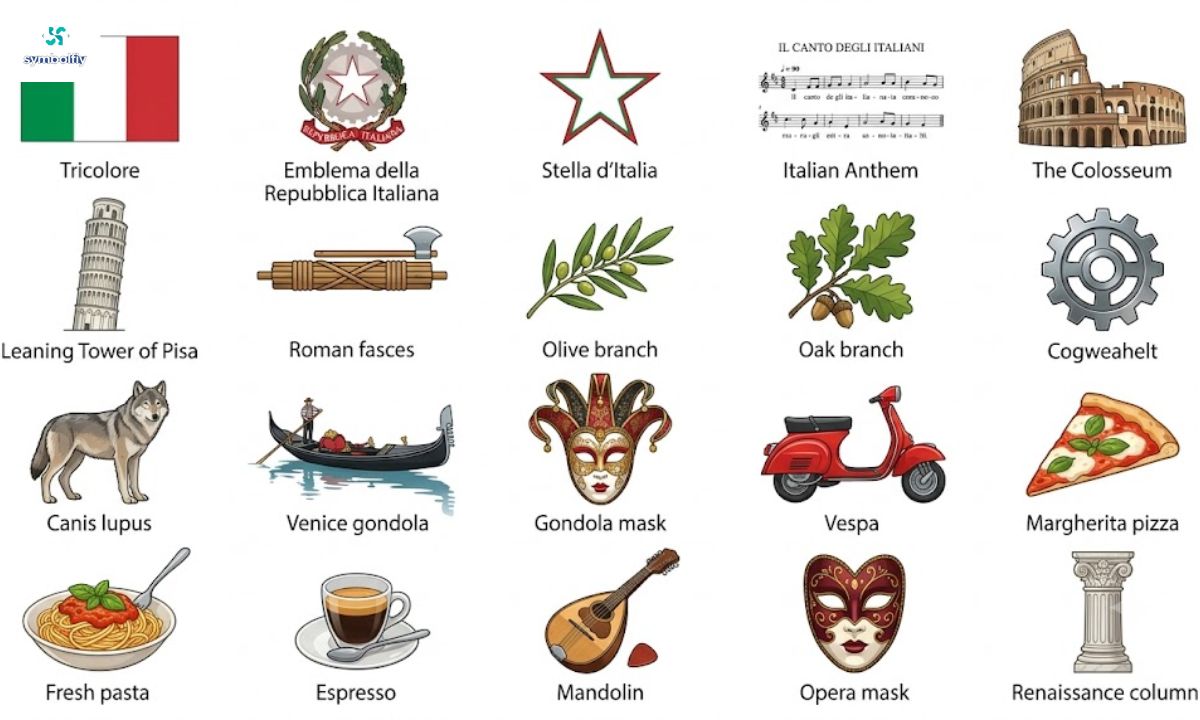
The Italian flag has three vertical stripes: green, white, and red. Green stands for the land and hope, white for faith and snow-capped mountains, and red for blood spilled for freedom. It was inspired by the French flag during Napoleon’s era and later became a symbol of Italian unity during the 1800s independence movement.
🦅 The Emblem of the Italian Republic
This emblem shows a five-pointed white star on a red shield, set inside a gear wheel, framed by an olive branch and an oak branch. It was adopted in 1948 after Italy became a republic. It represents work, peace, strength, and the Italian people’s hope for a fairer future.
⭐ Stella d’Italia (Star of Italy)
The Stella d’Italia is a white five-pointed star, often seen glowing in red. It is one of Italy’s oldest national symbols, dating back to ancient times when it represented Italia, the personification of the land itself. Today it stands for guidance, unity, and national pride.
⚙️ The Cogwheel
The cogwheel inside Italy’s emblem represents the labor of Italian workers. It was added after World War II to honor the working class and the idea that the new republic was built by ordinary people, not kings or nobles.
🌿 The Olive Branch
The olive branch wraps around the right side of Italy’s emblem. It is an old symbol of peace, used since ancient Greek and Roman times. For Italy, it represents the country’s wish for a peaceful future after years of war.
🌳 The Oak Branch
On the left side of the emblem sits an oak branch. Oak trees are linked with strength and endurance. This branch symbolizes the strong will of the Italian people and their ability to survive hard times.
🎶 Il Canto degli Italiani (The Italian Anthem)
Italy’s national anthem was written by Goffredo Mameli and composed by Michele Novaro. It is also called “Inno di Mameli.” The song speaks of unity, sacrifice, and Italian pride, and it became official in 1946, right when Italy was rebuilding itself.
🐺 The Gray Wolf
The gray wolf is Italy’s national animal. It connects to the legend of Romulus and Remus, the twin brothers said to have founded Rome after being raised by a she-wolf. The wolf stands for survival, loyalty, and deep Roman roots.
Ancient and Historical Symbols of Italy
Italy’s history goes back thousands of years, long before it became one country. Many old symbols from the Roman Empire still carry meaning today, even outside Italy.
🪓 The Roman Fasces
The fasces is a bundle of wooden rods tied around an axe. In ancient Rome, it represented the power and authority of magistrates. It later became controversial in the 20th century due to its use by Italian fascism, but its older meaning was simply about unity and strength in numbers.
🏛️ The Roman Eagle (Aquila)
The eagle was the proud symbol of the Roman legions. Soldiers carried eagle standards into battle, and losing one was seen as a deep shame. The eagle stood for power, victory, and the far reach of the Roman Empire.
🏟️ The Colosseum
This ancient amphitheater in Rome is one of the most recognized symbols of Italian history. It speaks of Roman engineering skill, public entertainment, and the rise and fall of a great empire. Today it stands for resilience and lasting legacy.
🐍 SPQR (Senatus Populusque Romanus)
These four letters mean “The Senate and People of Rome.” You can still see them on manholes, buildings, and flags in Rome today. They represent the old Roman idea that power belonged to both leaders and citizens together.
🏺 The Roman Laurel Wreath
Worn by emperors and victors, the laurel wreath symbolized honor, victory, and achievement. It traces back to the Greek god Apollo and was later adopted fully into Roman culture as a mark of success.
Religious and Spiritual Symbols in Italy
Italy is home to Vatican City and centuries of Catholic history. Many Italian symbols carry deep spiritual roots tied to faith, protection, and devotion.
✝️ The Christian Cross
The cross is one of the most common symbols across Italy, seen in churches, homes, and jewelry. It represents faith, sacrifice, and the core belief of Christianity. Italy’s strong Catholic history makes the cross deeply woven into daily life.
🔑 The Keys of Saint Peter
These two crossed keys appear on the Vatican flag and many church symbols. They represent the keys to heaven, given by Jesus to Saint Peter. In Italian culture, they also symbolize spiritual authority and guidance.
👼 The Guardian Angel
Many Italian families keep small angel figurines or charms at home. This symbol represents protection, comfort, and the belief that loved ones are watched over by a spiritual guardian, even after death.
🐦 The Dove
The dove is a peaceful symbol often used in Italian religious art. It represents the Holy Spirit, purity, and hope. It is common during Easter and other Catholic celebrations across Italy.
🌟 The Halo
Seen in countless Italian religious paintings, the halo represents holiness and divine presence. It shows up around saints and angels in Renaissance art, a style Italy is globally famous for.
Cultural and Folk Symbols of Italy
Beyond religion and government, Italy has many symbols rooted in everyday culture, superstition, and tradition. These often pass down through families for generations.
🐍 The Cornicello (Italian Horn)
This twisted horn-shaped charm is worn to ward off bad luck and the “evil eye.” It is one of the most popular Italian folk symbols, often made of red coral or gold, and is still gifted today for protection.
👁️ The Evil Eye (Malocchio)
Many Italians believe in the malocchio, a curse caused by jealous or envious looks. Charms and gestures are used to protect against it. This belief shows how deeply superstition is tied to Italian daily life.
🤞 The Horned Hand Gesture (Mano Cornuta)
This hand gesture, made by raising the pinky and index finger, is used to ward off bad luck, similar to the cornicello. It is common in southern Italy and connects to old beliefs about protection from curses.
🍀 The Four-Leaf Clover (Quadrifoglio)
Though common worldwide, Italians also see the four-leaf clover as a sign of luck and good fortune. It is often paired with other protective charms in jewelry.
🌹 The Red Rose
In Italian culture, the red rose symbolizes deep love and passion. It is a classic gift between couples and is tied to Italy’s reputation as a country of romance and emotion.
Symbols From Italian Art and Architecture
Italy gave the world some of its greatest art and buildings. Many of these creations became symbols themselves, representing beauty, creativity, and human achievement.
🗼 The Leaning Tower of Pisa
This tilted tower is a famous symbol of Italy’s architectural history. Its leaning structure happened by accident due to soft ground, but it became a beloved icon representing imperfection turned into beauty.
🎭 The Venetian Mask
Worn during Carnival in Venice, these masks symbolize mystery, transformation, and freedom. In the past, people of all classes wore masks to hide their identity and mix freely, which made the symbol stand for equality too.
🛶 The Gondola
This narrow boat is tied closely to Venice and represents romance, slow living, and old-world charm. It also reflects Italy’s deep connection to water and canals in its coastal cities.
🎨 The Mona Lisa’s Smile
Though painted by Leonardo da Vinci, an Italian artist, this smile became a symbol of mystery and emotional depth. It represents Italy’s massive influence on world art during the Renaissance.
🏰 The Italian Villa
Grand villas with arches and gardens symbolize Italian elegance, wealth, and a love for beauty in daily living. They also represent Italy’s lasting influence on architecture across the world.
Italian Symbols of Food and Lifestyle
Food in Italy is more than just a meal. It carries identity, family values, and a sense of comfort that has spread globally.
🍕 Pizza
Pizza began in Naples and now represents Italian creativity and simplicity. It symbolizes community, since it is often shared, and reflects Italy’s gift for turning simple ingredients into something joyful.
🍝 Pasta
Pasta represents comfort, family meals, and tradition. It is tied to memories of grandparents cooking, Sunday dinners, and the Italian belief that food brings people together.
☕ Espresso
A small cup of espresso symbolizes Italian pace of life, quick but meaningful pauses, and social connection. Italians often drink it standing at a bar while chatting with friends.
🍷 Wine
Wine represents celebration, hospitality, and Italy’s deep farming roots. Many regions are known for specific wines passed down through generations of family vineyards.
🍋 The Lemon (Limone)
Especially tied to southern Italy, like Sicily and the Amalfi Coast, lemons symbolize freshness, sunshine, and warm Mediterranean living.
Symbols Tied to Italian Regions
Italy is made of many regions, each with its own pride and local symbols passed down for generations.
🦁 The Lion of Venice
This winged lion represents the historic Republic of Venice. It stood for strength, protection, and the city’s old power as a trading empire.
🐬 The Dolphin of Naples
Dolphins appear often in Neapolitan art and folklore, symbolizing the region’s strong bond with the sea and its lively, joyful spirit.
🏔️ The Alpine Edelweiss
Found in northern Italy, this flower symbolizes purity and toughness, since it grows in harsh mountain conditions. It is often linked to mountain pride and survival.
🌋 Mount Vesuvius
This volcano near Naples represents both danger and life. It destroyed Pompeii but also created fertile soil, symbolizing how destruction and renewal often live side by side.
🐂 The Bull of Turin
Seen on city crests in Turin, the bull symbolizes strength, stubborn pride, and the city’s industrial history.
Ancient Cultures That Used These Symbols
Many Italian symbols did not appear alone. They borrowed meaning from older cultures that shaped the Mediterranean world.
Roman culture – Gave Italy the eagle, fasces, laurel wreath, and SPQR, all tied to power and order.
Greek mythology – Influenced the laurel wreath and ideas about gods, beauty, and victory found across Italian art.
Etruscan traditions – Early Italian tribes brought animal symbols and burial art that shaped later Roman beliefs.
Christianity – Brought the cross, dove, and keys of Saint Peter, shaping centuries of Italian spiritual life.
Byzantine influence – Added halo imagery and religious gold art seen in southern Italian churches.
Norman and medieval kingdoms – Left behind crests, lions, and shields still found on regional flags today.
Why Symbols Still Matter Today
Even now, people wear Italian symbols as tattoos, necklaces, and charms. A cornicello pendant or a small cross can hold deep personal meaning, connecting someone to family, faith, or heritage. These symbols are not just decoration. They carry emotional comfort and a sense of belonging.
Symbols also help people process bigger feelings, like grief, hope, or identity. Many use them in meditation, prayer, or art to feel grounded. As long as people search for meaning in their roots, Italian symbols will continue to matter, both in Italy and across the world.
Frequently Asked Questions
What are the official symbols of Italy?
The flag, the national emblem, the anthem “Il Canto degli Italiani,” and the gray wolf are Italy’s main official symbols.
What does the emblem of Italy mean?
It represents work, peace, and unity through the cogwheel, olive branch, oak branch, and white star.
What do the colors of the Italian flag represent?
Green means hope and land, white means faith, and red means the blood spilled for freedom.
What is the Stella d’Italia?
It is the Star of Italy, an ancient symbol of guidance and national pride still used today.
What is the national animal of Italy?
The gray wolf, tied to the legend of Rome’s founders, Romulus and Remus.
Conclusion
Italian symbols carry far more than visual beauty. They hold stories of war, peace, faith, and family that span thousands of years. From the official emblem to a simple lemon on the Amalfi Coast, each symbol gives a small window into what Italy truly values. Learning about them helps us understand not just Italy, but how humans everywhere use symbols to hold on to meaning.