Symbols are one of the oldest ways humans share feelings. Long before words, people used objects, colors, fire, and shapes to say “I love you,” “I celebrate you,” or “you matter.”
Birthday symbols are no different. They carry deep meaning — from ancient rituals to modern emojis. Understanding them makes every celebration feel a little more intentional and a lot more meaningful.
Birthday symbols go far beyond party decorations. Each one carries a story — rooted in history, spirituality, and human emotion.
They connect us to the people we love, to our culture, and even to something greater than ourselves. In many traditions, birthday symbols are tied to the divine, to protection, and to the passage of time.
These symbols also serve an emotional purpose. They say “you are worth celebrating.” Whether it’s a flickering candle or a colorful balloon, every symbol is a quiet reminder that life is precious — and that the people in it deserve to be honored.
25+ Happy Birthday Symbols and Their Meanings
Party and Celebration Symbols 🎉
Short, joyful, and instantly recognizable — these are the symbols most people picture when they think of a birthday party.
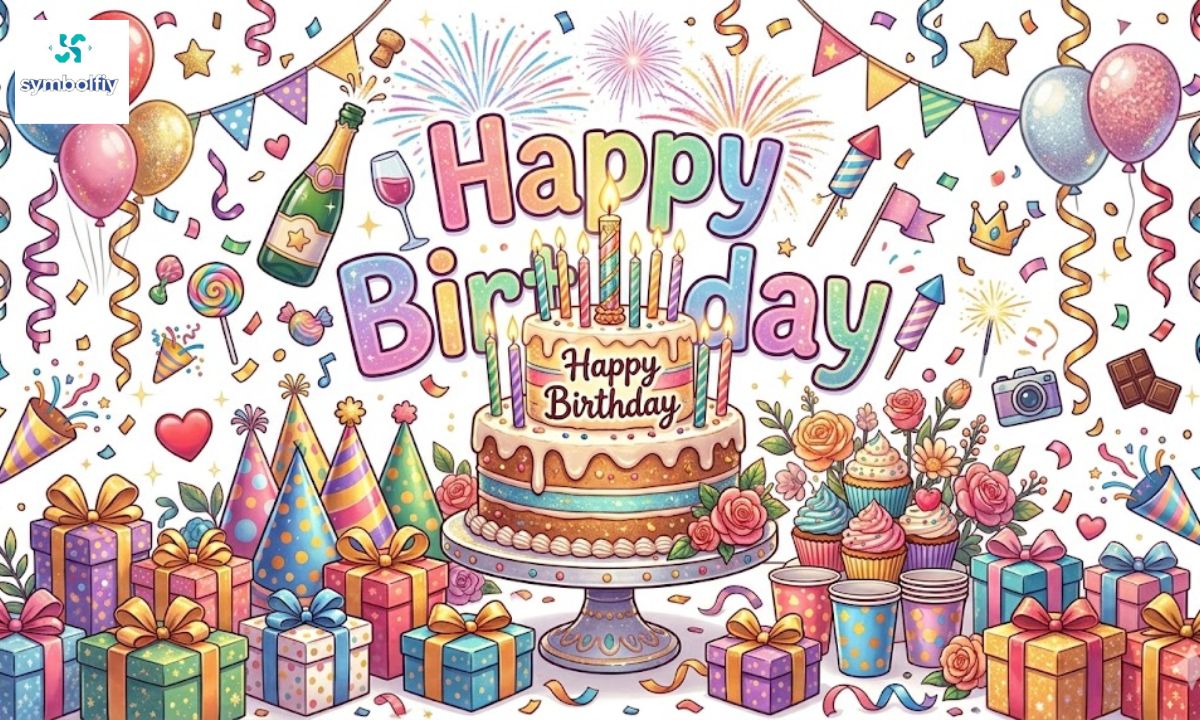
🎂 Birthday Cake
The birthday cake is the most iconic of all happy birthday symbols. Its roots go back to ancient Greece, where round cakes were baked as offerings to Artemis, the goddess of the moon. The round shape represented the full moon and the cycle of life. Today, cutting and sharing a cake is a symbol of unity and joy.
🕯️ Birthday Candles
Candles on a cake have a spiritual origin. Ancient Greeks believed fire connected the human world to the divine. In medieval Germany, a single candle was placed on a child’s cake to represent the “light of life.” Blowing out candles while making a wish carries on that spiritual tradition — the smoke was believed to carry prayers to the heavens.
🎈 Balloons
Balloons bring an instant feeling of lightness and joy. They symbolize happiness, celebration, and the spirit of rising above everyday worries. Their bright colors carry emotional meaning too — red for love, yellow for joy, blue for peace. Balloons are one of the most widely recognized birthday celebration symbols across cultures.
🎁 Gift Box
Gift-giving is one of humanity’s oldest rituals. Across cultures and through centuries, offering a gift on someone’s birthday symbolizes love, thoughtfulness, and generosity. The wrapped gift box represents the spirit of giving — the idea that someone took time to think of you and honor your day.
🎉 Party Popper
The party popper is a symbol of sudden joy and surprise. The burst of confetti it releases represents abundance and excitement. It’s a modern symbol but carries the same emotional energy as ancient celebratory rituals — marking a moment as special and worthy of noise and color.
🎊 Confetti
Confetti has roots in ancient harvest festivals where grains and flower petals were thrown to celebrate abundance. Today, the colorful paper pieces symbolize festivity, joy, and the scattering of blessings. Seeing confetti instantly signals that something worth celebrating is happening.
🥳 Partying Face Emoji
In the digital age, the partying face emoji has become one of the most used happy birthday symbols online. It represents pure, uninhibited joy — the kind of happiness that makes you put on a hat and blow a noise maker. It carries the emotional energy of celebration in a single character.
🎀 Birthday Ribbon / Bow
A bow or ribbon on a gift is more than decoration. It represents the care put into wrapping something for someone. Symbolically, it ties together the gift and the feeling behind it — love, appreciation, and connection. In some cultures, bows are also associated with luck and prosperity.
Decorative Birthday Symbols 🎏
These symbols transform a space into a celebration and carry their own symbolic weight.
🎏 Streamers
Streamers are long, flowing strips of color that fill a space with movement and life. They symbolize joy in motion — the idea that happiness is not static but alive and flowing. Historically, ribbon-like decorations were used in festivals across cultures to mark sacred or joyful occasions.
🎑 Birthday Banner
A birthday banner carries a simple but powerful message: “You are celebrated here.” It publicly declares that this day — and this person — matters. Banners and signs have been used since ancient times to announce important events and honor those being recognized.
🎠 Party Hat (Cone Hat)
The cone-shaped party hat has been linked to ancient traditions where pointed hats were associated with wisdom, celebration, and even the stars. Today it is purely playful — a wearable symbol of fun that says “I’m here to celebrate and I don’t take myself too seriously.”
✨ Sparklers
Sparklers are mini fireworks that symbolize light, wonder, and the magic of a special moment. Their brief, bright burn is a metaphor for life itself — brilliant and precious. They carry a sense of awe, reminding us that some moments deserve to shine.
🪄 Number Balloons
Number balloons are a modern birthday symbol that marks a specific milestone. They make the number of years visible and celebratory, turning age into something to be proud of rather than hidden. The number itself becomes a symbol of life lived.
🌟 Gold Star
In many cultures, the star symbolizes guidance, excellence, and divine connection. A gold star on a birthday card or decoration says “you shine.” It carries the deeper meaning of being someone who lights the way for others.
Food and Treat Symbols 🍰
Food has always been central to celebration across cultures. These birthday food symbols carry meaning beyond just sweetness.
🍰 Cake Slice
A single slice of cake represents the personal, individual moment of a birthday. While the whole cake symbolizes the group celebration, your slice is yours alone — a moment of joy given directly to you. Sharing cake has always been a symbol of generosity and togetherness.
🧁 Cupcake
The cupcake is a smaller, personal version of the birthday cake. It symbolizes individuality — each person gets their own. In modern celebrations, cupcakes represent personalization and the idea that every person deserves their own moment of sweetness on their birthday.
🍭 Candy / Sweets
Candy at birthday parties carries the symbolism of sweetness and delight. In many spiritual traditions, sweetness is associated with joy, blessing, and prosperity. Offering sweets to guests is a way of sharing your happiness and spreading good energy.
🥂 Champagne / Toast
Raising a glass is one of humanity’s oldest celebratory rituals. The toast on a birthday is a symbol of unity — everyone lifting their glass together to honor one person. It represents community, gratitude, and shared joy. The bubbles in champagne are even associated with rising spirits and new beginnings.
Nature and Personal Birthday Symbols 🌸
These symbols connect a birthday to something deeper — nature, identity, and destiny.
🌸 Birth Flowers
Every birth month has a flower, and each carries its own symbolic meaning. January has the carnation (love and admiration), April has the daisy (innocence and purity), and June has the rose (beauty and passion). Gifting someone their birth flower is a way of honoring who they are at a deeper level.
💎 Birthstones
Birthstones have been used for centuries as symbols of protection, identity, and luck. Ancient cultures believed each gemstone carried spiritual power connected to the month of a person’s birth. Garnets (January) represent passion, emeralds (May) symbolize growth, and sapphires (September) are linked to wisdom and truth.
♈ Zodiac Signs
Zodiac symbols connect a birthday to the position of the stars at the moment of birth. Each sign carries personality traits, spiritual meanings, and cosmic connections. They are one of the oldest birthday symbols — used by Greeks, Romans, Babylonians, and many other ancient civilizations to understand the self.
🌙 Birth Moon Phase
The phase of the moon on the night someone was born carries spiritual meaning in many traditions. A full moon birth is associated with abundance and high energy. A new moon birth symbolizes new beginnings and potential. Moon phase birthday symbols have seen a huge rise in popularity as personal spiritual symbols.
🌺 Lotus Flower
In Eastern spiritual traditions, the lotus is a powerful birthday symbol. It represents the soul rising above difficulty to bloom beautifully. Gifting a lotus symbol on a birthday carries the message: “You have grown through everything and you are beautiful for it.” It is deeply meaningful in Buddhist, Hindu, and Egyptian traditions.
🕊️ Dove
The dove as a birthday symbol represents peace, purity, and divine blessing on a new year of life. In Christian tradition, the dove symbolizes the Holy Spirit and God’s favor. In many cultures, seeing a dove on your birthday is considered a spiritual sign of protection and good fortune ahead.
🌈 Rainbow
A rainbow appearing on a birthday is widely seen as a symbol of hope, promise, and good things to come. In many spiritual traditions, rainbows represent the bridge between the earthly and divine realms. As a birthday symbol, a rainbow says “this year, beauty and blessings await you.”
🕯️ Wish Candle
Beyond birthday cake candles, a single wish candle carries deep intention. Lighting it while holding a desire in your heart connects to ancient fire rituals across cultures. The flame is a symbol of the inner light — the spirit, the soul, the life force that continues to burn and grow year after year.
🎵 “Happy Birthday” Song
The “Happy Birthday to You” song, written by Mildred and Patty Hill in 1893, has become the most recognized birthday symbol in song form. Singing it together is a ritual act of communal celebration — a moment when everyone stops and focuses entirely on honoring one person. The song itself is a symbol of being seen and loved.
Ancient Cultures That Used These Symbols
Birthday symbols have roots that stretch back thousands of years across many civilizations.
Ancient Egypt — Egyptians believed a pharaoh’s birthday marked their transformation into a god. Celebrations involved ritual offerings, fire, and sacred symbols of eternal life.
Ancient Greece — Greeks baked round moon cakes for Artemis and used candles to honor the divine. They also believed birthdays connected a person to protective spirits called “daemons.”
Roman Culture — Romans were among the first to celebrate common people’s birthdays, using flowers, wine, and offerings to the gods as birthday symbols.
Medieval Germany — The tradition of “Kinderfest” brought birthday cakes and candles into family celebrations for children, adding protective and spiritual meaning to the ritual.
Chinese Culture — Long noodles are a traditional birthday symbol in China, representing long life. Peaches are also deeply symbolic, tied to immortality and good fortune.
Mexican Culture — The piñata is a powerful birthday symbol rooted in both indigenous traditions and Catholic symbolism. Breaking it represents overcoming evil and releasing the good things inside.
Celtic Traditions — Celts used fire, flowers, and natural symbols to mark important life events including birthdays. They believed nature itself spoke through such occasions.
Why Symbols Still Matter Today
In a world full of instant digital messages, symbols still carry a weight that words alone cannot. A birthday cake with candles, a bunch of balloons at the door, or a birthstone gift says something that a text message rarely can. Symbols speak to the part of us that knows some moments deserve more than words.
People today use birthday symbols in tattoos, jewelry, birth flower art, and zodiac prints as expressions of identity and personal meaning. A birthstone pendant or a zodiac symbol tattoo is a permanent reminder of who you are and when you came into the world.
In meditation and spiritual practice, birth symbols are used to connect with purpose and direction. The symbols have changed form over thousands of years, but their core function stays the same: to say that life is sacred and worth marking.
Frequently Asked Questions
What are the most common happy birthday symbols?
The birthday cake, candles, balloons, gift boxes, confetti, and party poppers are the most universally recognized birthday symbols.
Why do we blow out candles on a birthday cake?
It comes from an ancient Greek ritual where candle smoke was believed to carry wishes and prayers up to the gods.
What do balloons symbolize at a birthday party?
Balloons represent joy, lightness, and celebration — their colors also carry emotional meaning, with red for love and yellow for happiness.
What is the spiritual meaning of a birthday?
Many traditions see a birthday as a sacred moment of spiritual renewal — a personal new year where the soul reflects, resets, and steps forward with new intention.
What are birth symbols connected to a person’s birthday?
Birthstones, birth flowers, zodiac signs, and moon phases are the main birth symbols tied to a person’s specific birthday.
Conclusion
Happy birthday symbols are more than party decorations. They are living pieces of human history — carrying meaning from ancient temples and harvest festivals all the way to modern emoji and birthday Instagram posts.
Each symbol, whether it’s a flickering candle or a carefully chosen birthstone, tells someone they are worth celebrating. That message is timeless, and no amount of time or technology will ever make it feel any less true.