Not all gods carry swords. Some carry flames. Hestia, the Greek goddess of the hearth, held no weapon and fought no war — but she sat at the center of every home, every temple, and every city in ancient Greece.
Her symbols are quiet and warm, but they carry some of the deepest meaning in all of Greek mythology. They speak to shelter, belonging, nourishment, and the sacred act of simply being home.
For anyone who wants to understand what truly holds a life together, these symbols are a good place to start.
Hestia symbols represent the things that make life feel safe and whole. The hearth, the flame, the cooking pot — these are not grand or dramatic. They are the small, steady things that keep a family fed, warm, and together.
In ancient Greece, Hestia was honored before every meal and every prayer. Her symbols reminded people that peace at home is not small — it is the foundation of everything.
On a deeper level, Hestia’s symbols connect to purity, continuity, and divine presence in everyday life. She was the first-born child of the Titans Cronus and Rhea, yet she never chased glory.
She chose stillness and service instead. Her symbols reflect that same wisdom — that the most sacred things are often the most simple.
25+ Hestia Symbols and Their Meanings
Core Sacred Symbols of Hestia
These are the symbols most directly tied to Hestia’s identity as the goddess of the hearth and home. They appear in ancient art, hymns, and temple worship across all of Greece.
🔥 The Sacred Flame
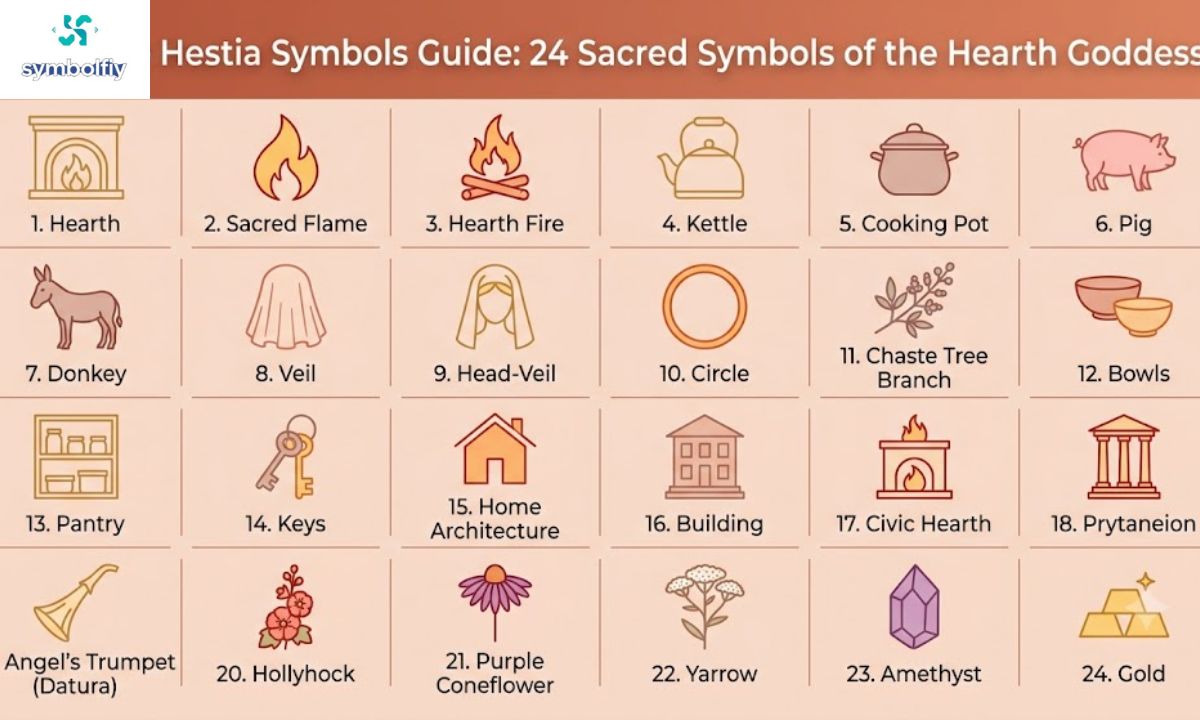
The sacred flame is Hestia’s most powerful symbol. It represents eternal life, purity, and divine protection. Every Greek home and city kept a fire burning in her honor — letting it die out was seen as a serious spiritual failure. The flame means that life is ongoing and the goddess is present.
🏠 The Hearth
The hearth is where the family gathered to cook, pray, eat, and find warmth. It was the literal and spiritual center of the Greek home. Hestia did not just watch over the fire — she was the hearth itself. Her name in Greek, Hestía, literally means “fireside” or “hearth.”
♾️ The Circle
The circle was linked to Hestia because her hearth was round. It stands for completeness, eternity, and an unbroken cycle of life. A circle has no start and no end — just like Hestia’s eternal, steady presence in the home.
🫕 The Kettle / Cooking Pot
The kettle was one of Hestia’s main attributes shown in ancient art. It represents nourishment, cooking, daily care, and the domestic rituals of family life. Hestia presided over every meal that was prepared over the sacred fire.
🏛️ The Prytaneion (Civic Hearth)
Every Greek city kept a public flame in a building called the prytaneion — the town hall or civic council chamber. This fire was Hestia’s flame for the whole city. When settlers left to start a new colony, they carried embers from this flame to light the fire of their new home, carrying Hestia with them across the sea.
🍞 Bread and Grain
Bread was one of the most common offerings given to Hestia. Grain, flour, and baked goods all fell under her domain because they were prepared at the hearth. Giving bread to the fire was a simple, daily act of devotion that connected the ordinary to the sacred.
🕯️ The Candle / Torch
Candles and torches carry the same energy as Hestia’s sacred flame. In modern practice, lighting a candle for Hestia is one of the most common ways to honor her. The candle stands for her continued presence in the home, even when no traditional hearth exists.
Animal Symbols of Hestia
Unlike warrior gods with fierce animals, Hestia’s sacred creatures are gentle and domestic. They reflect her quiet, caring nature.
🐷 The Pig
The pig was the most common animal sacrificed to Hestia in ancient Greece. Pigs represented fertility, motherhood, and the blessings of domestic life. Offering a pig to Hestia was a way to ask for her protection over children, family, and the household.
🐴 The Donkey
The donkey has a special place in Hestia’s story. According to the myth, a donkey’s loud braying woke Hestia just as the god Priapus crept up on her while she slept at a festival. The donkey saved her honor. Because of this, the donkey became her symbol of faithfulness, protection, and humble service.
🐄 The Cow (Young Calf)
Young cows — especially one-year-old heifers — were also sacrificed to Hestia in some regions of Greece. The calf represents innocence, nourishment, and the gentle strength of a domestic life well lived.
Plant and Nature Symbols of Hestia
Plants were tied to Hestia through their connection to purity, the home, and the sacred act of tending to living things.
🌿 The Chaste Tree (Vitex agnus-castus)
The chaste tree is Hestia’s most sacred plant. Its medicinal properties were said to reduce desire, which made it a natural symbol for Hestia’s vow of chastity. Its flowers were laid upon the hearth as offerings. The chaste tree also had healing properties connected to women’s health.
🌾 Yarrow
Yarrow is a wildflower with strong healing properties. It was one of several plants associated with Hestia because of its connection to domestic healing and protection of the home. Ancient Greeks used it as a medicinal herb, linking it to the nourishing, healing energy of the goddess.
🌸 Hollyhock
The hollyhock is a tall, flowering plant long associated with home, warmth, and protection. Its upright growth near doorways and homes made it a natural symbol for Hestia’s role as guardian of the threshold.
🌻 Goldenrod
Goldenrod blooms in warm gold tones that mirror Hestia’s sacred colors. It represents abundance, health, and the warmth of a well-tended home. Its bright color evokes the light of a fire.
🌼 Chamomile
Chamomile is calming, gentle, and used to soothe and heal. It mirrors Hestia’s own energy — peaceful, quiet, and deeply restorative. It is often used in modern Hestia rituals for its calming scent and golden color.
💜 Lavender
Lavender stands for peace, purity, and domestic calm. It connects directly to Hestia’s role as a bringer of harmony in the home. In modern practice, lavender is burned or placed on altars to invite Hestia’s presence.
Gem and Crystal Symbols
Stones and crystals associated with Hestia reflect her warmth, grounding energy, and spiritual purity.
🟣 Amethyst
Amethyst is a stone of calm, clarity, and spiritual protection. Its purple tone and cooling energy balance the warmth of Hestia’s flame, representing the peaceful, pure side of her nature.
🔴 Garnet
Garnet is deep red like burning embers. It carries the warmth and protection of the hearth fire and is associated with home, family, and grounded love. It is one of the most fitting stones for Hestia.
🟠 Carnelian
Carnelian is orange and fire-colored. It represents creativity, warmth, and vitality — the same energy that a hearth brings to a cold room. Placing carnelian near a Hestia altar adds fire energy without a flame.
🟡 Citrine
Citrine is golden and bright like sunlight or a glowing fire. It represents abundance, joy, and warmth. It connects to Hestia’s role as a giver of domestic happiness and comfort.
🤍 Clear Quartz
Clear quartz is associated with purity, clarity, and amplifying intention. It connects to Hestia’s title Hestia Hagné, meaning “Hestia the Pure.” It is often placed on altars to represent her light.
🟤 Tiger’s Eye
Tiger’s Eye is a grounding, protective stone. It reflects the watchful, steady nature of Hestia — always present, always keeping the home safe. Its warm golden tones match her colors.
🌟 Sunstone
Sunstone carries the warmth and joy of sunlight. It connects to the life-giving power of fire and to Hestia’s quiet ability to brighten a space simply by being present within it.
Color and Elemental Symbols
🟡 Gold
Gold is Hestia’s primary sacred color. It represents the glow of the flame, divine blessing, and the richness of a life lived with warmth and purpose. Gold is used in altar work and offerings to honor her.
🔴 Orange and Red
Orange and red are the natural colors of fire. They represent passion, protection, warmth, and the primal comfort of a hearth. These colors are strongly connected to Hestia’s elemental fire nature.
🤍 White
White represents purity, chastity, and sacred space. It connects to Hestia’s status as a virgin goddess and to the clean, clear light of a flame burning in a dark room.
🔥 Fire (Element)
Fire is Hestia’s primary element — specifically the hearth fire, not wild fire. Hestia is not a goddess of destruction. She is the goddess of the controlled, life-giving flame that warms the home, cooks the food, and anchors the family.
🌍 Earth (Element)
Earth is Hestia’s secondary element. She is a grounding force. Her energy is stable, rooted, and constant. Some ancient philosophers even linked Hestia to the earth itself — the center point around which everything revolves.
Architectural and Devotional Symbols
🏡 The Home / House Structure
The house itself is a symbol of Hestia. According to the ancient writer Diodorus Siculus, Hestia was said to have invented the art of building houses. Every home was therefore a temple to her, and every roof was built under her blessing.
🗝️ The Key
Keys appear in some Hestia traditions as symbols of her role as guardian of the home — keeper of what enters and what stays out. A key represents safety, security, and the sacred boundary between home and the outside world.
🧣 The Veil
In ancient Greek art, Hestia is always shown as a modestly dressed, veiled woman. The veil represents her purity, her virginity, and her quiet power. She does not need to be seen or celebrated to be powerful. Her strength is internal, not displayed.
🌿 The Flowered Branch
In several ancient vase paintings, Hestia is shown holding a flowering branch — possibly from the chaste tree. It represents growth, life, and the gentle beauty of a well-tended domestic world.
🏺 Oil, Wine, and Water
Oil, wine, and water were poured as offerings at Hestia’s altar. These liquid offerings were among the simplest and most sincere ways to honor her. They represent sustenance, celebration, and the clean, nourishing gifts of daily life.
Ancient Cultures That Used Similar Symbols
Hestia’s symbols did not exist in a vacuum. Many ancient cultures honored similar ideas through their own sacred fire traditions:
Ancient Rome — Hestia became Vesta, and the Vestal Virgins kept her sacred flame burning in the Temple of Vesta in the Roman Forum for over 1,000 years. Letting the flame die was considered a disaster for the entire city.
Hindu tradition — The sacred fire god Agni is honored in Hindu rituals as a messenger between humans and the divine, mirroring Hestia’s role as the recipient of the first offerings at every sacrifice.
Celtic traditions — The goddess Brigid shares deep parallels with Hestia. Brigid governs the hearth, healing, and the sacred flame. Her fire at Kildare in Ireland was kept burning by her priestesses, just as Hestia’s flame was tended in Greece.
Zoroastrian tradition — Fire temples in ancient Persia kept eternal flames as the center of worship. The flame was not just light — it was the physical presence of the divine.
Slavic traditions — Many Slavic cultures worshipped a hearth spirit who guarded the home and family. Offerings were left by the fire. The parallel to Hestia is clear.
Norse traditions — The long-house fire in Viking culture was the sacred center of the home, around which all life revolved. Like Hestia’s hearth, it was never carelessly extinguished.
Why Hestia’s Symbols Still Matter Today
Hestia’s symbols have survived for more than 2,500 years because the feelings they represent never go away. People still need safety. They still need warmth. They still need a place that feels like theirs.
Today you see Hestia’s energy in the way people decorate their homes with intention, light candles before a difficult conversation, or gather the family around a shared meal. These are all Hestia’s rituals — even if no one uses her name.
In spiritual communities, Hestia is seeing a quiet revival. Modern pagans, Hellenists, and witches honor her with simple altar setups in their kitchens — a candle, a piece of bread, a stone of garnet or citrine.
People get her sacred flame tattooed as a reminder to stay grounded and return to themselves. In a world that constantly pushes outward, Hestia’s symbols are a reminder to come back inside, tend your own fire, and honor the life you are already living.
Frequently Asked Questions
What is Hestia’s most important symbol?
The sacred hearth flame — it represents her eternal presence in every home and temple.
Is Hestia the goddess of fire?
Not exactly — she is the goddess of the hearth fire specifically, not fire in general.
What is the difference between Hestia and Vesta?
Vesta is Hestia’s Roman equivalent; both govern the sacred home flame, but Vesta had a larger formal priesthood.
Why did Hestia choose to remain a virgin goddess?
She refused proposals from both Apollo and Poseidon and swore a vow of chastity before Zeus, choosing her sacred duties over marriage.
How do people honor Hestia today?
By lighting a candle at home, offering the first sip of a drink, or setting up a simple kitchen altar with her symbols.
Conclusion
Hestia may be the quietest goddess in the Greek pantheon, but she is also one of the most essential. Her symbols — the flame, the hearth, the kettle, the veil, the gentle donkey — all point toward the same truth: that a good life is built not on conquest, but on care.
Whether you are drawn to her for spiritual practice, for mythology, or simply because you want to feel more at home in your own life, Hestia’s symbols offer something real and lasting. Tend your flame. Honor your home. That is her entire teaching — and it is more than enough.