The Reiki emotional healing symbol is commonly identified as Sei He Ki, one of the core symbols in Usui Reiki. Practitioners associate this symbol with the mind, emotions, balance, and inner calm. They often use it during Reiki practice when they want to focus on difficult feelings, emotional patterns, or mental tension.
Sei He Ki has a distinctive flowing shape. Some people compare it to a wave, a bird’s wing, or a moving current. Its appearance supports the traditional idea of movement and balance. However, Reiki teachers and lineages can explain the symbol in different ways.
Some traditions connect Sei He Ki with the phrase “God and man become one.” This phrase represents a spiritual interpretation of the symbol rather than a scientifically established definition. Reiki itself also uses ideas such as ki, or life-force energy, which belong to its spiritual framework.
Understanding this difference helps you explore Sei He Ki with respect. You can learn what Reiki practitioners believe the symbol represents without presenting those beliefs as proven medical facts.
Sei He Ki is commonly described as the mental and emotional symbol in Usui Reiki. Practitioners use it to focus their intention on emotional balance and mental calm.
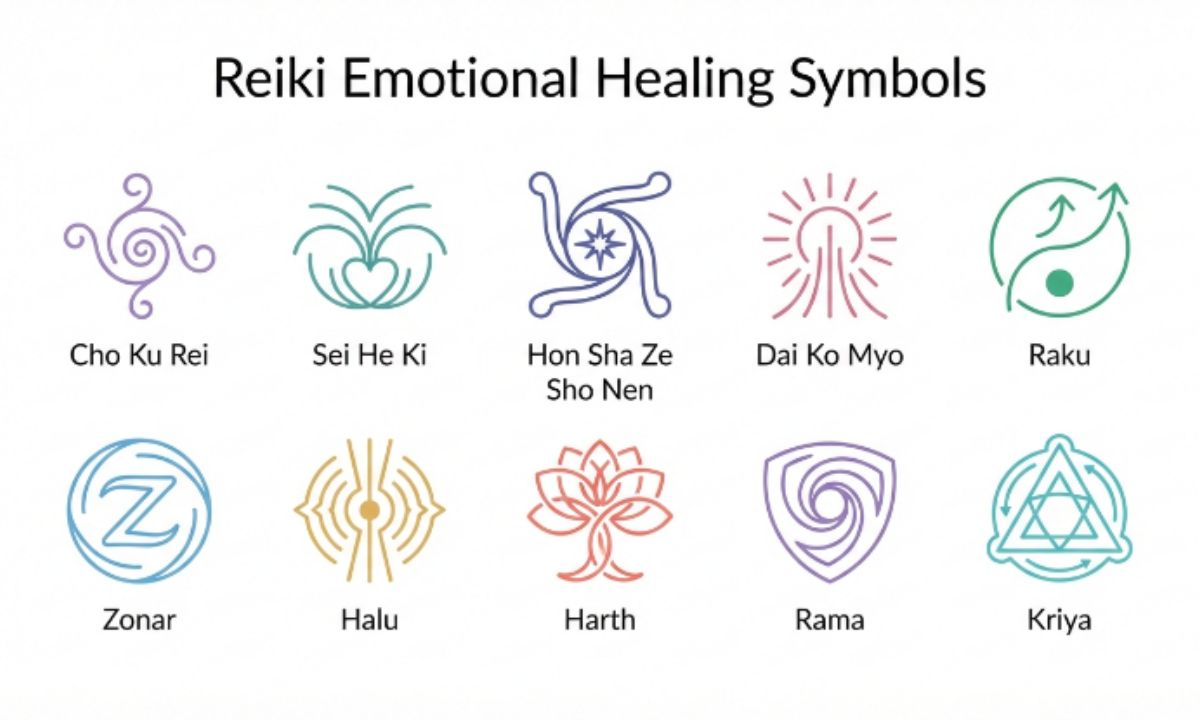
Traditional Reiki practice treats symbols as tools for directing attention. Each symbol has a particular role within the system. Cho Ku Rei focuses on power, Hon Sha Ze Sho Nen relates to distance work, and Sei He Ki centers on mental and emotional themes.
The symbol does not have one universal interpretation across every Reiki school. Different teachers may explain its name, shape, and purpose in different ways. This makes it important to identify the Reiki lineage when discussing its meaning.
What Does Sei He Ki Mean?
Sei He Ki is often translated in Reiki teachings as “God and man become one.” Other explanations focus more on harmony between different parts of the mind.
Rather than treating one translation as the only correct answer, it is more accurate to describe these meanings as traditional interpretations. The symbol’s role can also change depending on the teacher and Reiki system.
Why Is Sei He Ki Linked With Emotional Healing?
Reiki practitioners connect Sei He Ki with emotional work because they use it when focusing on feelings, thoughts, habits, and inner patterns.
A practitioner may draw or visualize the symbol during meditation or a Reiki session. The symbol can serve as a mental reminder to focus on calm, balance, forgiveness, or emotional release.
These uses describe Reiki practice and belief. They do not prove that Sei He Ki treats a mental-health condition.
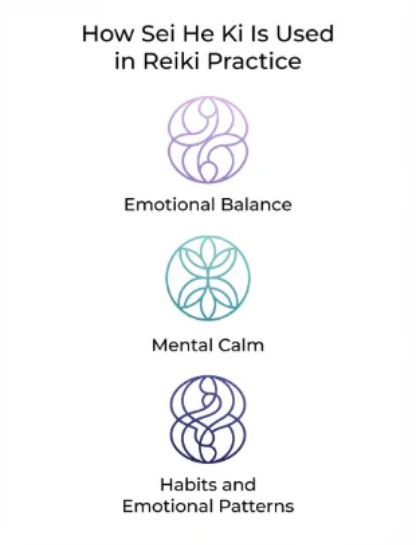
How Sei He Ki Is Used in Reiki Practice
Practitioners may use Sei He Ki in several ways. The exact method depends on their training and Reiki lineage.
Some practitioners draw the symbol before a session. Others visualize it while focusing on an emotional concern. Some incorporate it into meditation or personal Reiki practice.
The goal is usually to create a clear intention.
Emotional Balance
Practitioners often associate Sei He Ki with emotional balance. They may use it when a person feels overwhelmed, unsettled, or emotionally stuck.
The practice can provide a structured moment for reflection. A person may focus on a feeling and use the symbol as part of their spiritual routine.
Mental Calm
Sei He Ki also has a strong connection with mental focus in Reiki teachings. Practitioners may use it during meditation when they want to settle racing thoughts or create a calmer mental space.
This does not mean the symbol has been proven to treat anxiety or other mental-health conditions. It describes how Reiki practitioners traditionally understand and use the symbol.
Habits and Emotional Patterns
Some Reiki practitioners use Sei He Ki when working with habits they want to change. They may focus on the emotional patterns connected to a habit and use the symbol as part of their intention.
For example, someone might use it during meditation while reflecting on anger, fear, grief, or recurring negative thoughts.
The practice can support personal reflection, but it should not replace professional treatment for serious or persistent problems.
Sei He Ki and the Idea of Balance
Balance is one of the strongest themes associated with the Reiki emotional healing symbol.
The symbol contains flowing sections that many practitioners interpret as representing harmony between different aspects of experience. Some connect this idea with the conscious and subconscious mind.
This interpretation gives Sei He Ki a broader meaning than simple relaxation. It frames emotional healing as a process of becoming more aware of thoughts, feelings, and inner reactions.
Conscious and Subconscious Experience
Some Reiki teachings use Sei He Ki to represent the relationship between conscious and subconscious experience.
In this view, emotional patterns may exist outside a person’s immediate awareness. Practitioners use the symbol as a focus while exploring those patterns.
This remains a spiritual interpretation. Modern psychology uses different concepts and evidence to explain emotions, habits, memory, and unconscious processes.
Emotional Release
Reiki practitioners may also describe Sei He Ki as a symbol for emotional release. They may use it while focusing on emotions that feel difficult to process or let go.
For some people, a quiet spiritual practice can create space for reflection. However, emotional distress can have many causes, and Reiki should not serve as a substitute for qualified mental-health care.
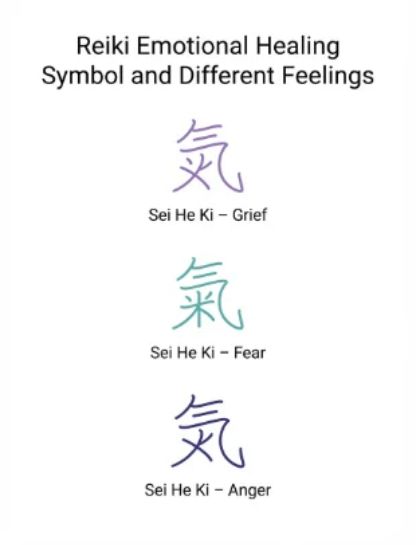
Reiki Emotional Healing Symbol and Different Feelings
People often associate Sei He Ki with a wide range of emotional experiences. These associations come from Reiki practice rather than established clinical evidence.
Grief
Some practitioners use Sei He Ki during spiritual practices focused on grief. They may visualize the symbol while acknowledging memories, emotions, and feelings of loss.
Grief does not follow one fixed path. Reiki can be part of a personal spiritual routine, but people experiencing severe or prolonged distress may benefit from professional support.
Fear
Practitioners may also use Sei He Ki when focusing on fear or emotional tension. The symbol gives them a specific point of attention during meditation or Reiki work.
The aim is usually to encourage calm and awareness rather than to claim that the symbol removes fear through a proven medical effect.
Anger
Anger can become another focus of personal Reiki practice. A practitioner may use Sei He Ki while reflecting on the source of an emotional reaction.
This approach can encourage self-observation. It does not replace evidence-based strategies for managing severe anger or mental-health concerns.
Spiritual Meaning of Sei He Ki
Sei He Ki has a strong spiritual role in Reiki traditions. Its commonly cited translation, “God and man become one,” expresses a sense of unity.
The phrase should remain within its traditional context. It does not represent a scientific explanation of how the brain or body works.
Reiki symbols also have historical links to Japanese spiritual practices and, in some expanded Reiki systems, Buddhist and Sanskrit traditions. Different Reiki schools combine these influences in different ways.
Symbol as a Focus Tool
Reiki practitioners do not need to treat a symbol as a magical object. Within the practice, a symbol can function as a focus tool.
A practitioner may draw, visualize, or mentally repeat the symbol to strengthen an intention. This creates a clear structure for meditation and spiritual practice.
Personal Meaning
The meaning of Sei He Ki can also become personal. Someone may associate it with peace, emotional balance, forgiveness, acceptance, or self-awareness.
Personal meaning can make a spiritual practice more significant. It should not, however, be confused with clinical evidence.
Is Sei He Ki a Medical Treatment?
No. Sei He Ki belongs to Reiki, a complementary spiritual practice. It should not replace medical or mental-health treatment.
People sometimes describe Reiki symbols with terms such as healing, trauma release, anxiety relief, or emotional treatment. Those descriptions reflect practitioner beliefs and experiences. They do not establish that the symbol can diagnose or treat a health condition.
What Does Science Say About Reiki?
Scientific research has not clearly established Reiki as an effective treatment for specific health conditions. Studies have produced mixed results and often have methodological limitations.
That distinction matters when discussing the Reiki emotional healing symbol. You can describe how practitioners use Sei He Ki without presenting those uses as medically proven.
When to Seek Professional Help
Reiki should not replace qualified care for serious emotional or mental-health concerns.
Consider seeking professional support if you experience:
Persistent anxiety or depression
Severe emotional distress
Trauma-related symptoms
Thoughts of self-harm
Problems that interfere with daily life
Emotional symptoms that continue or become worse
A Reiki practice may exist alongside professional care if a healthcare provider considers it appropriate.
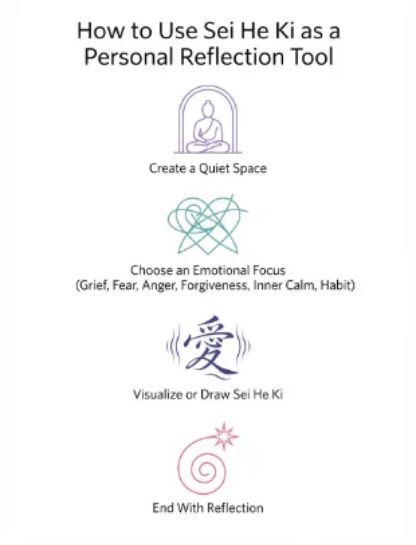
How to Use Sei He Ki as a Personal Reflection Tool
People who practice Reiki may incorporate Sei He Ki into meditation or personal reflection. The exact process varies between teachers. A simple spiritual practice can focus on intention rather than making medical claims.
Create a Quiet Space
Choose a comfortable place where you can sit without unnecessary distractions. Take a few slow breaths and allow your attention to settle.
Choose an Emotional Focus
Think about one feeling or pattern you want to explore. Keep the focus simple.
You might choose:
Emotional tension
Grief
Fear
Anger
Forgiveness
Inner calm
A recurring habit
Do not force yourself to revisit painful memories. If reflection becomes overwhelming, stop and seek appropriate support.
Visualize or Draw the Symbol
If your Reiki training includes Sei He Ki, you may draw or visualize the symbol according to your teacher’s instructions.
Focus on the intention connected to your practice. You might use words such as calm, balance, acceptance, or awareness.
End With Reflection
After the practice, notice how you feel. You can write down thoughts or emotions that came up.
Keep the exercise focused on reflection rather than expecting the symbol to cure a specific condition.
Sei He Ki Compared With Other Reiki Symbols
Sei He Ki is one of several symbols found in Reiki systems. Each symbol has a different traditional role.
Cho Ku Rei
Cho Ku Rei is commonly known as the power symbol. Practitioners use it to strengthen focus on Reiki energy and intention.
Hon Sha Ze Sho Nen
Hon Sha Ze Sho Nen is known as the distance symbol. Reiki practitioners associate it with distance healing and connections across space and time.
Dai Ko Myo
Dai Ko Myo is traditionally associated with Reiki Master practice. Practitioners connect it with spiritual development and advanced Reiki training.
Raku
Raku appears in some Reiki traditions as a completion or grounding symbol. Its use varies by lineage.
Compared with these symbols, Sei He Ki has a stronger traditional association with mental and emotional themes.
Why People Connect With the Reiki Emotional Healing Symbol
Sei He Ki remains meaningful to many Reiki practitioners because it gives emotional reflection a clear spiritual focus.
The symbol can become a visual reminder to pause, observe feelings, and reconnect with an intention. For someone who already follows Reiki, that structure may add meaning to meditation or personal practice.
Its value within Reiki therefore depends on the practitioner’s beliefs and experience. Its spiritual significance should remain separate from claims about proven medical treatment.
Frequently Asked Questions
What is the Reiki emotional healing symbol?
Sei He Ki is commonly described in Usui Reiki as the mental and emotional symbol.
What does Sei He Ki mean?
Reiki teachings often translate Sei He Ki as “God and man become one,” although interpretations vary between Reiki lineages.
What is Sei He Ki used for?
Practitioners use Sei He Ki to focus on emotional balance, mental calm, habits, and difficult feelings.
Can Sei He Ki treat anxiety or depression?
There is no clear scientific evidence that Sei He Ki treats anxiety, depression, or other mental-health conditions.
Do I need Reiki training to use Sei He Ki?
Traditional Reiki practice usually teaches symbols through specific levels of training and attunement, so methods can vary by lineage and teacher.
Conclusion
The Reiki emotional healing symbol, Sei He Ki, holds an important place in Usui Reiki. Practitioners associate it with emotional balance, mental calm, personal reflection, and difficult emotional patterns.
Its meaning comes from Reiki traditions and spiritual interpretations, not from established medical science. The symbol can serve as a focus for meditation or personal practice, while professional healthcare remains important for mental-health conditions.
Learning about Sei He Ki also means understanding its cultural and spiritual context. When you separate traditional beliefs from scientific claims, you can explore the symbol with greater clarity and respect.