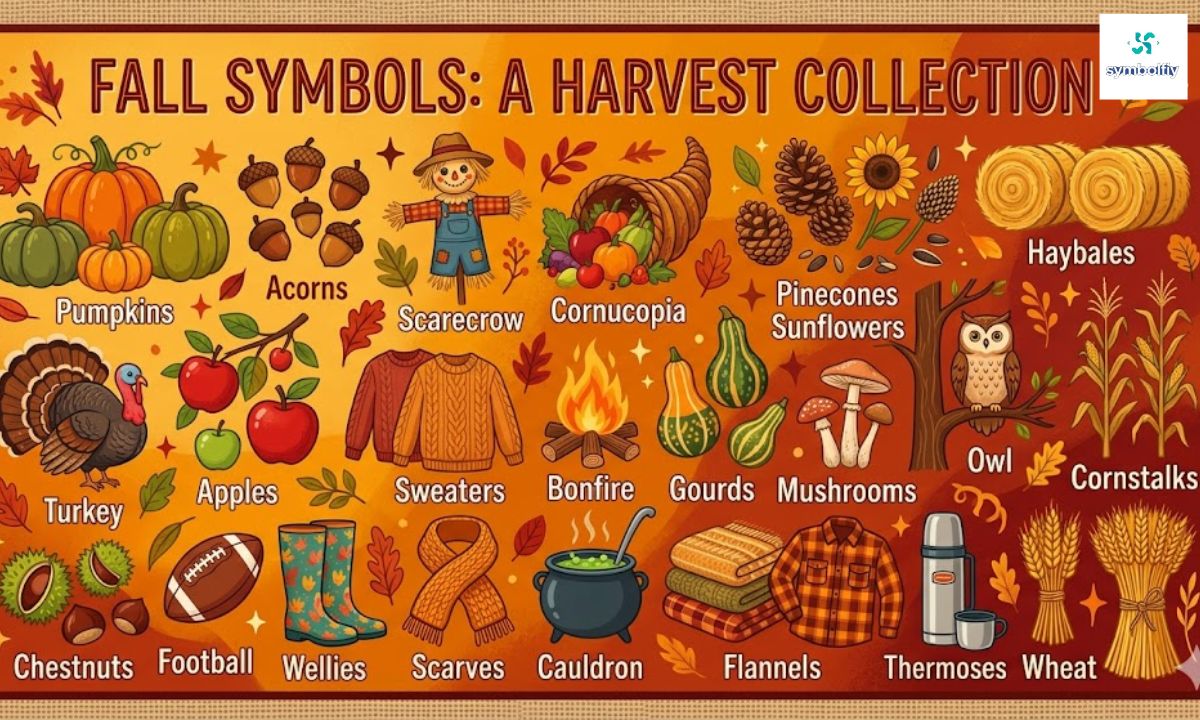
Autumn has always spoken to something deep inside us. Long before modern holidays or seasonal décor, people used fall symbols to make sense of change, loss, gratitude, and renewal.
These symbols were not decorative choices. They were emotional and spiritual tools that helped humans navigate the turning of the year.
Whether you are drawn to the colors of changing leaves, the weight of a harvest moon, or the quiet of a foggy morning, every fall symbol carries a meaning older than any tradition you might know. This guide explores them all.
Fall symbols, at their core, represent transition. They mark the point where growth ends and rest begins, where the outer world starts to slow down and the inner world wakes up.
Across cultures and centuries, autumn has been understood as the season of harvest, wisdom, and honest acceptance of what cannot last forever.
Spiritually, these symbols point to cycles rather than endings. They teach that letting go is an act of trust, not loss. Emotionally, they reflect the part of human experience that knows some things must end so other things can begin.
That universal truth is why fall symbols still resonate so strongly today, in tattoos, art, poetry, rituals, and everyday moments of quiet reflection.
25+ Fall Symbols and Their Meanings
🍂 Nature and Plant Symbols
🍁 Maple Leaf
One of the most instantly recognized fall symbols in the world. In Canada, it carries national identity and pride. Spiritually, the maple leaf represents balance and generosity, as the maple tree gives both sweetness and shade. In many Indigenous North American traditions, the maple is considered a sacred tree linked to abundance and the sweetness of life.
Origin: North America and East Asia
Spiritual meaning: Balance, generosity, and the beauty of transformation
Cultural connection: National symbol of Canada; honored in Indigenous traditions
Emotional symbolism: Nostalgia, warmth, and the ache of beautiful things ending
🍂 Falling Leaves
Perhaps the most universal of all autumn symbols. As trees release their leaves, humans across cultures have read it as a lesson: letting go is not weakness, it is wisdom. In Japanese tradition, the practice of watching autumn leaves, known as momijigari, is a spiritual and meditative ritual.
Origin: Global, observed in every culture with deciduous trees
Spiritual meaning: Surrender, impermanence, and acceptance of natural cycles
Historical use: Inspired harvest poetry in ancient China, Japan, and medieval Europe
Emotional symbolism: Bittersweet release, the peace that comes after a long season
🌰 Acorn
Small but deeply significant. The acorn holds the full genetic blueprint of a massive oak tree inside a tiny shell. Celtic peoples considered it one of the most sacred symbols in nature, a sign that great things grow from small and patient beginnings.
Origin: Celtic Europe and Native American woodland cultures
Spiritual meaning: Potential, patience, and future strength
Historical use: Druids carried acorns as symbols of wisdom and longevity
Modern use: Tattoos representing slow growth and inner potential
🌾 Wheat Sheaf
Bundled wheat is one of the oldest harvest symbols on earth. It appears in Egyptian tomb paintings, Greek fertility rites, and medieval European churches. The tied bundle represents the reward of hard work and the collective effort of community.
Origin: Ancient Mesopotamia, Egypt, and Greece
Spiritual meaning: Abundance, provision, and gratitude
Religious connection: Used in Christian harvest festivals and Pagan Mabon celebrations
Emotional symbolism: Pride in effort, safety, and the fullness of a completed season
🌽 Corn (Maize)
Corn holds sacred status in many Indigenous American traditions where it was literally the foundation of life. Across Mesoamerican cultures, corn deities represented creation, fertility, and the continuation of the human race. In fall, dried corn and corn husks symbolize the harvest’s end and gratitude for survival.
Origin: Mesoamerica; cultivated for thousands of years
Spiritual meaning: Life force, fertility, and divine provision
Cultural connection: Sacred to Aztec, Maya, and many North American Indigenous peoples
Modern interpretation: Decoration, abundance, Thanksgiving tradition
🍄 Mushroom
Mushrooms appear in autumn as forests decompose and the earth begins to recycle. They represent the hidden work happening beneath the surface, the invisible processes that make new life possible. In folklore across Europe and Asia, mushrooms were associated with doorways to other worlds.
Origin: Global; appears in European, Asian, and Indigenous folklore
Spiritual meaning: Hidden knowledge, transformation from decay, and liminal spaces
Cultural connection: Fairy rings in Celtic lore; sacred mushrooms in Siberian shamanism
Emotional symbolism: Mystery, the unseen, and trust in what is invisible
🌿 Dried Herbs and Sage
In many traditions, autumn is the time for drying and storing herbs before winter. Sage in particular carries strong cleansing and protective symbolism. It was used in Native American smudging ceremonies and in European folk medicine as a sacred plant that cleared away negative energy.
Origin: Mediterranean and North American indigenous cultures
Spiritual meaning: Purification, wisdom, and preparation
Historical use: Burned in rituals to cleanse spaces during seasonal transitions
Modern use: Smudging, meditation, and autumn altar practices
🍎 Apple
Apples have been fall symbols since ancient times. They appear in Greek mythology as golden prizes, in Norse legend as the fruit that kept the gods immortal, and in Celtic harvest lore as symbols of the otherworld. In autumn, the apple represents the ripeness of things fully lived.
Origin: Central Asia; widely mythologized across ancient Europe
Spiritual meaning: Knowledge, immortality, and harvest completion
Cultural connection: Norse goddess Iðunn, Greek myth, Celtic Samhain traditions
Emotional symbolism: Completion, sweetness earned through time, and wisdom
🎃 Pumpkin
The pumpkin is one of autumn’s most powerful symbols of abundance and protection. Indigenous North American peoples cultivated pumpkins as a vital food source for thousands of years. Its hollow form became associated with light in darkness, which is why carved pumpkins became lanterns for guiding spirits or warding them away.
Origin: North America; cultivated by Indigenous peoples
Spiritual meaning: Protection, abundance, and light within darkness
Historical use: Harvest food and ritual object in Indigenous and early American traditions
Modern interpretation: Halloween, Thanksgiving, autumn celebration
🌻 Dying Sunflower
A sunflower that has turned, dried, and faces downward is a quiet but powerful fall symbol. It represents the completion of a full life cycle, the journey from bright flowering to humble seed. Many cultures see the dried sunflower as a symbol of lasting beauty and the wisdom that comes after peak moments pass.
Origin: Native to the Americas; widely cultivated globally
Spiritual meaning: Completion, humility, and the grace of endings
Emotional symbolism: Bittersweet acceptance and the dignity of what has been fully lived
🍇 Grape Vine
Grapes harvested in autumn are central to some of humanity’s oldest religious and cultural traditions. In ancient Greece, they were sacred to Dionysus, the god of wine, celebration, and transformation. In Christianity, wine made from grapes became one of the most sacred symbols in faith.
Origin: Ancient Mesopotamia and Mediterranean cultures
Spiritual meaning: Abundance, transformation, and sacred celebration
Religious connection: Central to Christian Eucharist; sacred in Greek and Roman religion
Emotional symbolism: Joy, community, and the fullness of the harvest season
🌙 Sky and Weather Symbols
🌕 Harvest Moon
The full moon nearest to the autumnal equinox is called the Harvest Moon. For thousands of years before electric light, its brightness allowed farmers to work late into the night, gathering crops before the season turned. It became a symbol of completion, timing, and cosmic generosity.
Origin: Agricultural societies worldwide
Spiritual meaning: Completion, cosmic timing, and gratitude
Cultural connection: Celebrated in Asian moon festivals; honored in Celtic harvest traditions
Emotional symbolism: Fullness, beauty in the brief, and the clarity of endings
☁️ Fog
Autumn fog is one of the most emotionally evocative of all fall symbols. It softens edges, blurs boundaries, and makes familiar landscapes strange. In Celtic traditions, fog was seen as a sign that the veil between the living world and the spirit world was thinning.
Origin: Celtic and Northern European traditions
Spiritual meaning: Mystery, transition between worlds, and the unknown
Historical use: Associated with Samhain and the thinning of the spirit veil
Emotional symbolism: Uncertainty, the quiet between chapters, and gentle disorientation
💨 Wind
Autumn wind strips trees bare and carries seeds across long distances. It has always been associated with invisible forces at work, change that cannot be seen but is deeply felt. In many traditions, wind is a messenger between the physical and spiritual worlds.
Origin: Universal; present in virtually every mythology
Spiritual meaning: Invisible change, divine messages, and the breath of the world
Cultural connection: Wind gods in Norse, Greek, Japanese, and Native American traditions
Emotional symbolism: Restlessness, the feeling of something ending, and anticipation
🌤️ Shorter Days
As daylight shrinks in autumn, humans naturally turn inward. Ancient peoples marked this shift with rituals and festivals. The shortening of days symbolizes the movement from outer, active life toward inner, reflective life, a shift honored across many spiritual traditions.
Origin: Observed by all ancient agrarian and astronomical cultures
Spiritual meaning: Introspection, the inner journey, and preparation for renewal
Cultural connection: Honoring darkness in Celtic, Norse, and Indigenous traditions
Emotional symbolism: The call to slow down, rest, and reflect
☄️ Autumnal Equinox
The moment when day and night are exactly equal in length. Ancient cultures around the world treated this as a sacred threshold. It represents perfect balance, the briefest moment of equilibrium before the world tips toward darkness.
Origin: Observed by ancient Celts, Greeks, Egyptians, and Mesoamericans
Spiritual meaning: Balance, harmony, and the pivot between seasons
Astrological connection: The sun enters Libra, the sign of the scales
Emotional symbolism: The wisdom of equal weight given to light and shadow
🦌 Animal Symbols
🦌 Deer
In autumn, deer are at their most visible, moving through falling leaves in search of food before winter. In many cultures they represent gentleness, awareness, and the grace needed to navigate difficult transitions. Celtic traditions saw the deer as a guide between worlds.
Origin: Celtic, Native American, and East Asian traditions
Spiritual meaning: Gentleness, intuition, and spiritual guidance
Cultural connection: Sacred in Celtic mythology; honored in many Indigenous traditions
Emotional symbolism: Grace under pressure and quiet awareness during change
🦉 Owl
Owls are strongly associated with autumn and the lengthening nights. They are ancient symbols of wisdom, hidden knowledge, and the ability to see clearly in darkness. Many cultures connect owls to the spirit world and to the wisdom that comes only after long experience.
Origin: Ancient Greece, Rome, Celtic traditions, and Native American cultures
Spiritual meaning: Wisdom, the unseen, and navigation through darkness
Cultural connection: Sacred to Athena, the Greek goddess of wisdom
Emotional symbolism: The comfort of trusting your own inner knowing
🐿️ Squirrel
The squirrel is one of autumn’s most practical symbols. Busily storing nuts for winter, the squirrel has become a universal image of preparation, foresight, and resourcefulness. Spiritually, it represents trusting your instincts and planning for what you cannot yet see.
Origin: Observed in European, Asian, and North American folklore
Spiritual meaning: Preparation, foresight, and trust in future provision
Emotional symbolism: The wisdom of gathering what you need before the season changes
🐻 Bear
As autumn deepens, bears prepare for hibernation. This biological process became one of the most powerful spiritual metaphors in human culture: the willingness to rest completely, to go inward, to trust that waking up is possible. Bears in fall symbolize inner strength, healing rest, and the courage to let go of productivity.
Origin: Native American, Norse, Celtic, and Siberian shamanic traditions
Spiritual meaning: Rest as strength, inner journeying, and renewal through stillness
Cultural connection: The bear is a protector spirit in many Indigenous traditions
Emotional symbolism: Permission to rest and trust the silence
🐦 Migrating Birds
Every autumn, enormous flocks of birds follow invisible paths across continents. Migration is one of nature’s most powerful demonstrations of trusting instinct over certainty. Birds that migrate in fall symbolize the courage to move on, to follow your inner compass even when the destination is unknown.
Origin: Observed and mythologized across all cultures with bird migration
Spiritual meaning: Trust, movement, and following inner guidance
Cultural connection: Seen as omens and messengers in Celtic, Native American, and Asian traditions
Emotional symbolism: Letting go of familiar places and trusting the journey ahead
🦊 Fox
The fox is strongly associated with autumn in many cultures, partly because its reddish coat mirrors the colors of fall leaves. Foxes represent cunning, adaptability, and the ability to thrive at the edges of things, between wild and domestic, between seen and unseen.
Origin: Japanese, Celtic, and European folklore
Spiritual meaning: Adaptability, cleverness, and the wisdom of in-between places
Cultural connection: The kitsune in Japanese mythology is a shapeshifting fox spirit
Emotional symbolism: The ability to find your way even through changing conditions
🐌 Snail
The snail retreating into its shell in autumn is a quiet but profound symbol. It represents withdrawal as wisdom, the choice to go inward when the outer world becomes too much. Many spiritual traditions see the spiral shape of the snail shell as a symbol of the soul’s journey.
Origin: Celtic and Mediterranean symbolic traditions
Spiritual meaning: Retreat, inner sanctuary, and the spiral of spiritual growth
Emotional symbolism: The value of slowing down and protecting your inner world
🕯️ Human and Cultural Symbols
🎃 Jack-o’-Lantern
The carved pumpkin lantern has its roots in Celtic Samhain traditions, where turnips and gourds were hollowed out and lit to ward off spirits. The lantern symbolizes a light that protects, guides, and defines the boundary between the living world and whatever lies beyond it.
Origin: Celtic Ireland; later adapted in North American Halloween tradition
Spiritual meaning: Protection, light in darkness, and the boundary between worlds
Historical use: Used in Samhain rituals to guide ancestors and ward off harmful spirits
Modern interpretation: Halloween decoration and playful symbol of autumn
🌾 Cornucopia
The horn of plenty, overflowing with fruits, vegetables, and grain, is one of the most ancient symbols of autumn abundance. It originated in Greek mythology as the horn of Amalthea, the goat who nursed the infant Zeus. From that origin, it became the universal symbol of earth’s generosity.
Origin: Ancient Greek mythology
Spiritual meaning: Infinite abundance, earth’s generosity, and divine provision
Cultural connection: Present in Greek, Roman, and later European harvest traditions
Modern interpretation: Thanksgiving centerpiece and symbol of gratitude
🕯️ Candle
In autumn, as natural light decreases, candles become symbolic. They represent human defiance of darkness, the choice to create warmth and light by intention. In spiritual practice, candles lit in autumn are associated with honoring the dead, seeking clarity, and protecting the home.
Origin: Used in virtually every ancient spiritual and religious tradition
Spiritual meaning: Light, protection, memory, and the warmth of intention
Cultural connection: Central to Samhain, Diwali, and All Saints Day observances
Emotional symbolism: Comfort, presence, and the refusal to be overwhelmed by darkness
📜 Harvest Festival
The harvest festival is less a single symbol and more a universal human ritual that carries layered symbolic meaning. Across every culture that farmed, the end of harvest was marked with communal celebration, gratitude, and offerings to whatever forces were understood to have provided the abundance.
Origin: Present in virtually all ancient agricultural cultures worldwide
Spiritual meaning: Collective gratitude, community, and honoring divine provision
Cultural connection: Sukkot in Jewish tradition, Mabon in Pagan practice, Thanksgiving in North America, Zhongqiu in China
Emotional symbolism: Belonging, relief, and the joy of enough
🏚️ Scarecrow
The scarecrow stands alone in an emptying field, a human figure made of straw and old clothes. It is one of the most haunting and layered autumn symbols. Originally practical, it became deeply mythologized, representing guardianship, the threshold between the living and the hollow, and the dignity of standing firm through cold and change.
Origin: Agricultural cultures worldwide; deeply embedded in European and American folk tradition
Spiritual meaning: Protection, guardianship, and the threshold
Cultural connection: Featured in folklore, fairy tales, and autumn festivals
Emotional symbolism: Solitude, endurance, and standing your ground in an empty field
☕ Warm Drinks
The ritual of wrapping hands around a hot cup as temperatures drop is one of autumn’s most universal human experiences. Hot cider, tea, and later coffee became fall symbols of comfort, slowdown, and intentional warmth. This small act carries enormous emotional weight: it says that some things are still warm, still safe, still good.
Origin: Universal human response to cold; ritualized across all cultures
Spiritual meaning: Comfort, presence, and the small acts that sustain the soul
Emotional symbolism: Safety, belonging, and the warmth we create for ourselves and others
🧺 Harvest Basket
The basket carried back from the field represents everything gathered through a season of effort. In spiritual terms, a full harvest basket is a symbol of reaping what you have sown. It appears in folklore, religious iconography, and dream symbolism as an image of reward and completion.
Origin: Universal agricultural symbol
Spiritual meaning: Reaping rewards, completion of effort, and gratitude
Cultural connection: Present in European, African, and Native American harvest traditions
Emotional symbolism: The satisfaction of work well done
🕰️ Hourglass
The hourglass is strongly associated with autumn because both represent time running its natural course, neither too fast nor too slow. Ancient Greeks used it to mark time. In autumn, it became a memento mori, a reminder that life is finite and deserving of full attention while it lasts.
Origin: Ancient Greece and medieval Europe
Spiritual meaning: The passing of time, impermanence, and the preciousness of now
Cultural connection: Common in European fall art and vanitas paintings
Emotional symbolism: The urgency to be present in the life you are living
📚 Books and Firelight
The image of reading by firelight as autumn deepens is culturally powerful. Books gathered in autumn suggest turning inward, pursuing knowledge during the long quiet months, and the life of the mind as a refuge. In many traditions, autumn is when stories are told and wisdom is passed down.
Origin: Northern European and East Asian traditions of indoor gathering during cold months
Spiritual meaning: Inner life, knowledge, and the wisdom traditions carry
Emotional symbolism: Comfort, curiosity, and the companionship of good ideas
🌑 Spiritual and Symbolic Concepts
🪬 Samhain
Samhain is the ancient Celtic festival marking the end of the harvest and the beginning of winter. It falls on October 31 and was understood as the night when the boundary between the living world and the spirit world was at its thinnest. It is one of the most spiritually charged of all fall symbols.
Origin: Ancient Celtic Ireland and Scotland
Spiritual meaning: The thinning of the veil, ancestor honoring, and cycle endings
Historical use: Bonfires, offerings, and spirit communication rituals
Modern connection: The root of Halloween; still practiced in Pagan and Wiccan traditions
🌀 The Spiral
The spiral appears throughout autumn, in shell patterns, in snail trails, in the way smoke rises from a fire. Ancient peoples carved spirals into stone temples aligned with the autumn equinox. The spiral represents the journey inward and the promise that the path leads back outward again.
Origin: Neolithic Europe; found in Celtic, Mesoamerican, and Indigenous traditions
Spiritual meaning: The inward journey, cycles, and spiritual evolution
Historical use: Carved into Newgrange and other ancient sites marking seasonal shifts
Emotional symbolism: The trust that going inward leads to something worth finding
🌑 Darkness
Increasing darkness is not merely a weather fact in autumn. It is a symbol. Ancient cultures treated the growing dark as a doorway, not a threat. Darkness in fall symbolizes the necessary rest that precedes renewal, the unknown that holds the seeds of the next season.
Origin: Universal; honored in Celtic, Norse, and many Indigenous traditions
Spiritual meaning: Rest, the unknown, and gestation of new beginnings
Cultural connection: Winter solstice and autumn darkness rituals worldwide
Emotional symbolism: The courage to sit in uncertainty and trust what is coming
🍂 Letting Go
Letting go is not just a theme in autumn. It is a symbol in its own right, represented by every falling leaf, every bare branch, every field returned to stillness. Across spiritual traditions, the ability to release what is finished is considered one of the highest forms of wisdom.
Origin: Universal spiritual concept; expressed in Buddhism, Celtic spirituality, and indigenous traditions
Spiritual meaning: Non-attachment, trust, and making space for new growth
Emotional symbolism: The peace that follows a long, honest release
⚖️ Balance
The autumnal equinox, when day and night are equal, made balance one of autumn’s most ancient symbols. Many cultures used this brief equilibrium as a reminder to seek harmony in their own lives, to give equal weight to work and rest, to outer life and inner life.
Origin: Ancient astronomical and agricultural observation worldwide
Spiritual meaning: Harmony, the meeting of opposites, and inner equilibrium
Astrological connection: The sun’s entry into Libra during autumn
Emotional symbolism: The brief, beautiful moment when everything is in its right place
🌒 The Veil Between Worlds
In Celtic tradition, autumn is the season when the boundary between the living and the dead becomes its thinnest. This concept, sometimes called “the thinning of the veil,” appears in some form across many global cultures. It is a spiritual understanding that autumn is a time when ancestors are close and communication between the seen and unseen is possible.
Origin: Celtic, Mexican Día de los Muertos, and many Indigenous traditions
Spiritual meaning: Ancestor connection, the afterlife, and cycles of the soul
Cultural connection: Samhain, Halloween, Day of the Dead, and other honoring traditions
Emotional symbolism: Grief, love that outlasts death, and the comfort of feeling connected to those who have gone
Ancient Cultures That Used Fall Symbols
Celtic traditions: Honored autumn most intensely through Samhain, marking the end of harvest, the honoring of ancestors, and the sacred darkness of winter’s approach. Bonfires were lit and offerings left for spirits.
Ancient Greek culture: Autumn was deeply tied to the myth of Persephone descending to the underworld each year, explaining the dying of crops and the grief of the earth goddess Demeter. Fall represented divine sorrow and the natural cycle of loss.
Native American traditions: Autumn was a time of deep communal gratitude. Corn, squash, and other crops were honored as sacred gifts. Many nations held harvest ceremonies tied to specific stars, animals, and land relationships.
Ancient Chinese culture: The Moon Festival, or Zhongqiu, celebrated the autumn harvest with offerings to the moon and symbolic foods. Autumn represented balance, family reunion, and appreciation for earth’s abundance.
Japanese tradition:Momijigari, the practice of viewing autumn leaves, is a centuries-old ritual. Autumn represents mono no aware, the bittersweet awareness of impermanence that deepens appreciation for beauty.
Norse culture: Autumn was the season of preparation before the long dark winter. It was tied to themes of survival, honoring the dead, and seeking the protection of gods like Odin during the darker months.
Ancient Egypt: The harvest season was sacred to Osiris, god of death and renewal. Autumn marked the time when the Nile receded, leaving fertile land behind, a cycle of loss and regeneration that mirrored the natural world.
Why Fall Symbols Still Matter Today
People still reach for fall symbols in the modern world because the emotional truths they carry are permanent. Change, loss, harvest, rest, and renewal are not ancient experiences. They are the lived experience of every human life, every single year.
A leaf tattoo, an autumn altar, a carved pumpkin on a doorstep, these are not just aesthetic choices. They are small acts of meaning-making in a world that can sometimes feel disconnected from natural rhythms.
In design, fashion, spiritual practice, and personal identity, fall symbols show up because they offer something rare: honest beauty. They do not pretend that things last forever.
They say instead that the ending of something can be one of the most beautiful moments in its whole existence. That message, ancient as it is, feels urgently needed today.
Frequently Asked Questions
What are the most common fall symbols?
Falling leaves, pumpkins, acorns, the harvest moon, and migrating birds are the most universally recognized fall symbols across cultures.
What does autumn symbolize spiritually?
Autumn symbolizes letting go, surrender, gratitude, and the trust that endings lead to renewal.
Why is the maple leaf a fall symbol?
The maple leaf is linked to fall because maple trees produce some of the most vivid autumn foliage, and it carries cultural meaning of balance and abundance.
What does the harvest moon represent?
The harvest moon represents completion, cosmic timing, and gratitude for the abundance of the season.
Are fall symbols used in spiritual practices today?
Yes, many Pagan, Wiccan, and Indigenous spiritual practices still use autumn symbols in seasonal rituals, altars, and ceremonies honoring the harvest and the dead.
Conclusion
Fall symbols are not about decoration. They are a language that humans have spoken for thousands of years to describe the most honest experiences of being alive. Every leaf that falls, every candle lit against the dark, every basket carried home full from the field, carries a meaning worth knowing.
Autumn asks us to pay attention, to gather what matters, to release what does not, and to trust that the quiet ahead is not empty but full of something not yet visible.