Thursday is not just the fourth day of the workweek. It carries a weight that most people walk right past without noticing. Across Norse mythology, Roman religion, Hindu tradition, and Christian observance, Thursday has been marked as something set apart — a day of thunder, divine wisdom, abundance, and sacred power.
The symbols connected to Thursday reach back thousands of years and still show up in astrology, spiritual practice, and everyday language. Understanding them gives you a richer picture of a day that has always meant more than a spot on the calendar.
Thursday stands at the intersection of two great mythological forces: Thor and Jupiter. Both were the most powerful gods in their respective traditions. Both ruled the sky. While Both were connected to justice, protection, and abundance.
That shared identity gave Thursday a reputation as the most fortunate and expansive day of the week — a day to act boldly, plan wisely, and reach for something larger than yourself.
On a deeper level, Thursday symbolizes growth that comes from strength, not luck. It is associated with wisdom earned through experience, leadership grounded in service, and the kind of confidence that does not need to announce itself.
Spiritually, it is a day many cultures have treated as sacred — set aside for prayer, fasting, devotion, and important decisions. The symbols connected to Thursday all point toward the same core idea: there is power here, and it is meant to be used responsibly.
12 Thursday Symbols and Their Meanings
1. Thor’s Hammer (Mjolnir)
Origin: Norse mythology, ancient Scandinavia
Spiritual meaning: Divine protection, sacred order, and the power to defend what matters
Historical background: Thor was the Norse god of thunder and the protector of humanity. His hammer Mjolnir was the weapon he used to defend both gods and humans from chaos. Thursday takes its English name directly from Thor — “Thor’s Day”
Cultural connection: Vikings wore Mjolnir amulets for protection and blessing. The hammer was also used to consecrate marriages, births, and funerals — a symbol present at life’s most important thresholds
Modern interpretation: Still worn as jewelry and used in Norse pagan practice; also popular in tattoo and pop culture through Marvel’s Thor franchise
Emotional symbolism: Represents the courage to protect others even at personal cost, and the strength that comes from standing firm in your values
2. The Lightning Bolt
Origin: Universal; appears in Norse, Greek, Roman, and Hindu traditions
Spiritual meaning: Divine energy, sudden clarity, and the power of transformation
Historical background: Thursday’s governing god in every major tradition commanded the sky and storm. Lightning was seen as the voice of the divine, not a natural phenomenon but a message from the heavens. Zeus, Jupiter, Thor, and Indra all wielded it
Cultural connection: In astrology, the lightning bolt represents Jupiter’s sudden interventions of fortune; in Hinduism it is connected to Indra, god of storms and rain; in Norse tradition it was Thor’s direct act
Modern interpretation: Used as a symbol of inspiration, breakthrough, and electric energy in modern design, brand logos, and tattoo art
Emotional symbolism: Captures the feeling of a sudden realization or turning point — the moment something clicks and changes everything
3. Jupiter (Planet Symbol ♃)
Origin: Roman astronomy and astrology, later inherited by Western astrological tradition
Spiritual meaning: Expansion, abundance, higher wisdom, and good fortune
Historical background: The Romans named the fifth day “dies Iovis” — Jupiter’s day. Jupiter was the king of the Roman gods, ruler of the sky and bringer of justice. His planetary symbol ♃ represents a crescent moon rising above a cross, traditionally interpreted as the spirit ascending above matter
Cultural connection: In Western astrology, Jupiter rules Thursday and governs luck, travel, philosophy, higher education, and spiritual growth; in many Romance languages (French: jeudi, Spanish: jueves, Italian: giovedì), Thursday is literally called “Jupiter’s day”
Modern interpretation: Astrologers still recommend Thursday for major decisions, financial moves, new ventures, and spiritual intention-setting
Emotional symbolism: Carries a feeling of optimism and forward movement — the sense that things can genuinely get better from here
4. The Oak Tree
Origin: Norse and Celtic sacred tradition
Spiritual meaning: Strength, endurance, wisdom, and deep rootedness
Historical background: The oak was Thor’s sacred tree. In Norse belief, oak trees attracted lightning and were therefore touched by Thor himself. Celts considered the oak the most powerful of all trees — the center of the sacred grove, the gateway between worlds
Cultural connection: Ancient Germanic and Scandinavian peoples held ceremonies under oak trees on Thor’s day; the Druids worshipped the oak as the embodiment of the divine masculine; in Roman tradition the oak wreath was Jupiter’s sacred crown
Modern interpretation: Used in herbal and pagan practice on Thursdays for spells and rituals connected to strength, protection, and leadership
Emotional symbolism: The oak speaks to the kind of strength that grows slowly over time — deep roots, wide canopy, unbothered by storms
5. The Eagle
Origin: Roman mythology and Norse tradition
Spiritual meaning: Divine authority, vision, and the bridge between earth and heaven
Historical background: The eagle was Jupiter’s sacred animal and his messenger across the sky. In Norse mythology, an eagle perched at the top of the World Tree Yggdrasil, seeing everything across all nine realms. Thursday carries this bird as one of its oldest visual symbols
Cultural connection: Roman emperors kept eagles as symbols of divine rule; the eagle appears on the standards of Roman legions; in Native American tradition the eagle connects to the Creator and to wisdom that sees from above
Modern interpretation: Widely used in leadership imagery, national symbols, and personal tattoos representing vision and freedom
Emotional symbolism: Represents the ability to see the bigger picture when you are standing in the middle of difficulty
6. The Color Royal Blue
Origin: Roman and Norse astrological tradition
Spiritual meaning: Truth, trust, divine order, and the depth of wisdom
Historical background: Royal blue and purple are the colors assigned to Thursday across most astrological and magical traditions. Blue mirrors the sky that both Thor and Jupiter ruled. Purple carries the weight of royalty and divine authority, the color of kings who ruled by the grace of the gods
Cultural connection: In ceremonial magic and Wiccan practice, blue and purple candles are lit on Thursdays for abundance, protection, and spiritual work; in Hindu tradition Thursday is associated with yellow, the color of Brihaspati (the divine teacher)
Modern interpretation: Many people who align their week with spiritual correspondences dress in blue or light blue candles on Thursdays for intention-setting
Emotional symbolism: Blue carries calm authority — the confidence of someone who knows what they believe and is not easily shaken
7. Lord Vishnu (Hindu Symbolism)
Origin: Vedic tradition, ancient India
Spiritual meaning: Divine preservation, protection, grace, and the sustaining force of the universe
Historical background: In Hindu tradition, Thursday is called “Guruvara” — the day of the Guru. It is dedicated to both Lord Vishnu, the preserver of the universe, and Brihaspati, the teacher (guru) of the gods and the divine personification of Jupiter. Many Hindus fast on Thursdays and wear yellow clothing in honor of these deities
Cultural connection: Thursday fasting (Guruvar Vrat) is among the most widely observed weekly fasts in India; devotees offer yellow flowers, gram lentils, and clarified butter; the day is considered especially auspicious for beginning new studies or honoring a teacher
Modern interpretation: Thursday remains a day of religious observance for millions of Hindus worldwide; spiritual teachers and gurus are honored with special respect on this day
Emotional symbolism: Connects Thursday to the idea that true wisdom flows through relationship — student to teacher, human to divine
8. The Scales of Justice
Origin: Roman mythology, Jupiter’s sphere of influence
Spiritual meaning: Moral law, fairness, truth, and the right use of power
Historical background: Jupiter was not only the king of the gods but also the guardian of oaths and the enforcer of moral law. He was invoked when deals were made, treaties were signed, and justice was sought. This connection gave Thursday an association with legal matters, ethical decisions, and accountability
Cultural connection: In Western astrology, Jupiter rules law, philosophy, and higher principles; courts and legal proceedings were traditionally associated with Jupiter’s day in ancient Rome; the scales of justice as a symbol flows directly from this tradition
Modern interpretation: Thursday is still considered favorable for legal matters, contract signings, and important negotiations in astrological practice
Emotional symbolism: Reminds you that power without ethics is not strength — it is just force
9. The Thundercloud
Origin: Norse, Greek, Roman, and Hindu traditions
Spiritual meaning: Transformation, clearing what is stagnant, and the arrival of something new
Historical background: Every Thursday deity commanded the storm. Thor’s chariot wheels created thunder across the sky. Jupiter’s thunderbolts split open the heavens. Indra’s storms brought rain that ended drought. The thundercloud was not a symbol of destruction but of necessary disruption — the clearing that makes space for growth
Cultural connection: In many agricultural societies, Thursday storms were seen as blessings rather than threats, signs that the god of abundance was present and active; in Norse lore, thunder was Thor’s protection passing overhead
Modern interpretation: Used in spiritual symbolism to represent the clearing of obstacles and the arrival of a turning point
Emotional symbolism: Sometimes things need to break open before they can grow. The thundercloud on Thursday carries that honest truth
10. The Tin Metal
Origin: Alchemical and astrological tradition
Spiritual meaning: Flexibility, expansion, and the ability to hold abundance without being hardened by it
Historical background: Each planet in classical astrology was assigned a metal. Jupiter’s metal is tin — a material that is malleable, conductive, and useful. Unlike gold (the Sun) or iron (Mars), tin is not about hardness or brilliance. It is about usefulness, adaptability, and quiet value
Cultural connection: In alchemical practice, tin was worked with on Thursdays for rituals connected to growth and financial wellbeing; in folk magic traditions, tin objects were kept as Thursday talismans
Modern interpretation: Less commonly known today but still referenced in ceremonial and esoteric practice as Thursday’s material correspondence
Emotional symbolism: Tin’s softness is not weakness — it is the ability to be shaped by experience while still holding its form
11. The Amethyst
Origin: Classical gemology and astrological tradition
Spiritual meaning: Spiritual insight, higher wisdom, and protection from excess
Historical background: Amethyst is one of the primary stones associated with Thursday and Jupiter. Ancient Greeks and Romans wore amethyst to maintain clarity of mind and to prevent overindulgence. Jupiter’s energy is expansive, which means it can tip into excess — the amethyst was seen as a way to channel that energy wisely
Cultural connection: In spiritual practice, amethyst is placed on altars or carried on Thursdays for clarity in decision-making, spiritual work, and deepening intuition; lapis lazuli and sapphire also carry Thursday’s energy in many traditions
Modern interpretation: Among the most widely used crystals in modern spiritual practice; recommended for meditation, study, and Thursday intention-setting
Emotional symbolism: Represents the calm wisdom that sits underneath all that Thursday energy — the knowing that guides the power
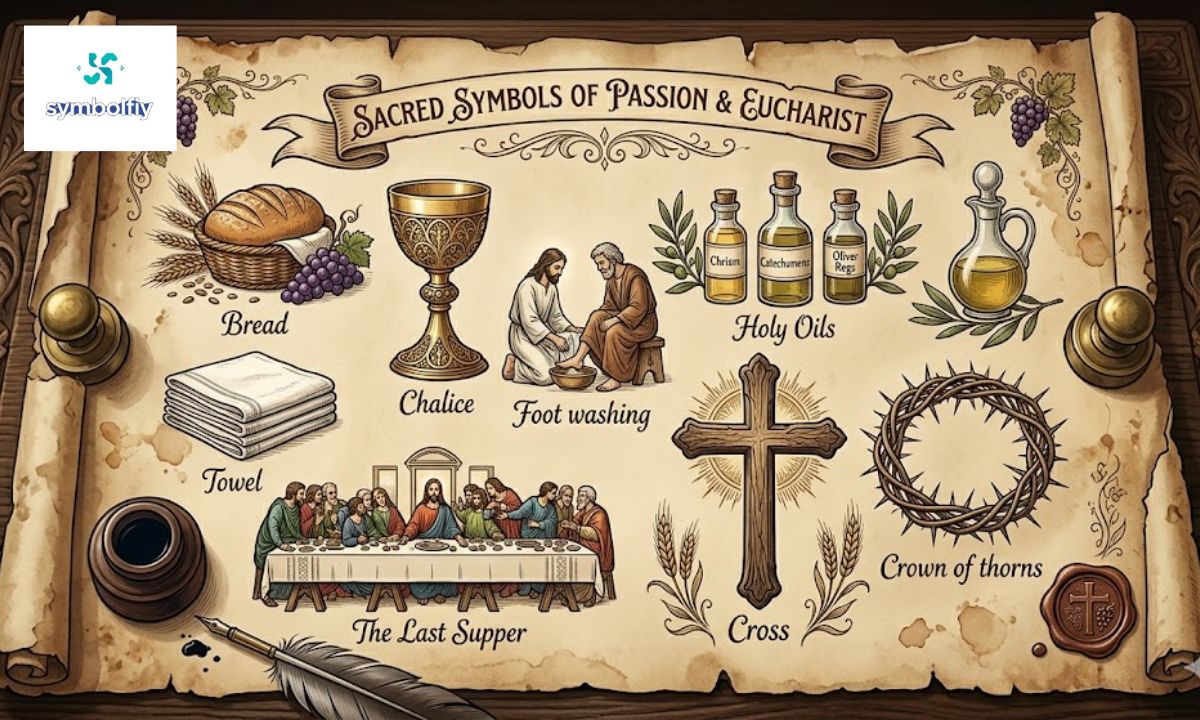
12. The Maundy Thursday Cross and Basin
Origin: Christian tradition, the Last Supper and Holy Week
Spiritual meaning: Servant leadership, sacrifice, and love expressed through action
Historical background: Thursday holds sacred significance in Christianity as the night of the Last Supper. Jesus washed his disciples’ feet, broke bread, and gave the new commandment to love one another. The word “Maundy” comes from the Latin mandatum, meaning commandment. The basin, the towel, the chalice, and the broken bread all became enduring Thursday symbols in Christian tradition
Cultural connection: Catholic and many Protestant churches observe Maundy Thursday with foot-washing ceremonies, the stripping of the altar, and night vigils; in the UK the Monarch distributes Maundy Money on this day in a tradition centuries old
Modern interpretation: One of the most widely observed Christian holy days worldwide; the symbols from this night appear in art, jewelry, tattoos, and church architecture across every denomination
Emotional symbolism: This Thursday symbol adds a layer that the others do not carry — not just power and abundance, but the choice to kneel and serve, the courage to love when betrayal is coming
Spiritual Meaning of Thursday Symbols
Thursday symbols consistently point toward one spiritual truth: greatness serves. Whether it is Thor protecting humanity with his hammer, Jupiter upholding moral law as king of the gods, Vishnu sustaining the universe through grace, or Jesus washing feet at the Last Supper — the most powerful figures connected to Thursday all exercise their power in service of others. That is not coincidence. It is the day’s deepest lesson.
For people who work with spiritual practice, Thursday is considered a day of heightened access to wisdom, abundance, and divine guidance. Many traditions recommend using Thursday for prayer, study, mentorship, and significant decisions.
The energy of the day is not passive — it is expansive and directional. It moves outward. Thursday symbols remind you that you are allowed to take up space, to grow, and to lead — as long as you are doing it for something beyond yourself.
Ancient Cultures That Used These Symbols
Norse tradition: Named the day “Thunresdaeg” in honor of Thor. The hammer, the oak tree, and the thundercloud were all sacred Thursday symbols used in protection rituals, blessings, and ceremony.
Roman culture: Called the day “dies Iovis” (Jupiter’s day). The eagle, the oak wreath, the scales of justice, and the planet’s symbol all carried Thursday’s energy in Roman religious and civic life.
Greek mythology: Zeus, Jupiter’s Greek equivalent, ruled Thursday’s sky domain. The lightning bolt, the eagle, and the thundercloud connect directly to Greek sacred tradition.
Hindu tradition: Thursday is “Guruvara” — the day of the divine teacher. Lord Vishnu and Brihaspati are honored with fasting, yellow offerings, and devotion to one’s spiritual teacher.
Babylonian tradition: The Babylonians named the day after Marduk, their chief god and the equivalent of Jupiter. This is actually the oldest layer of Thursday’s planetary association, predating both Greek and Roman naming by centuries.
Christian tradition: Maundy Thursday is one of the most sacred days in the Christian calendar. The symbols of that night — bread, wine, basin, chalice, and the stripped altar — carry the weight of the entire Holy Week narrative.
Why Thursday Symbols Still Matter Today
People are still drawn to Thursday symbols because they address something permanent in human nature: the desire for both power and meaning. Jupiter’s energy promises expansion. Thor’s energy promises protection. Vishnu’s energy promises sustaining grace.
Those are not ancient needs. They are today’s needs, especially for anyone navigating a world that moves too fast and asks too much. In practical terms, Thursday symbols show up everywhere.
Amethyst and lapis lazuli are among the best-selling crystals in modern spiritual shops. Thor’s hammer remains one of the most popular tattoo symbols globally. The eagle appears on flags, currencies, and corporate logos.
The Last Supper is reproduced in art, film, and social media more than almost any other image in Western culture. These symbols are not relics. They are alive, doing exactly what symbols have always done: compressing something too large for words into a shape you can hold.
Frequently Asked Questions
What is Thursday named after?
Thursday is named after Thor, the Norse god of thunder — from the Old English “Thunresdaeg,” meaning Thor’s day.
What planet rules Thursday in astrology?
Jupiter rules Thursday in astrology, connecting the day to expansion, abundance, wisdom, and good fortune.
What is the spiritual color of Thursday?
Royal blue, purple, and gold are the most widely used Thursday colors, representing wisdom, divine authority, and abundance.
What crystals are associated with Thursday?
Amethyst, lapis lazuli, and sapphire are the primary crystals connected to Thursday’s Jupiter energy.
What is the significance of Thursday in Hinduism?
Thursday is “Guruvara” in Hinduism, dedicated to Lord Vishnu and Brihaspati, making it the most auspicious day for honoring teachers and seeking divine guidance.
Conclusion
Thursday carries more history, more mythology, and more spiritual meaning than most people realize. From Thor’s hammer to Jupiter’s eagle, from the oak tree to the amethyst, from the Hindu fast to the Maundy Thursday basin — these symbols all point toward the same truth. This is a day that has always been set apart. Whatever you bring to Thursday, bring it with intention. The energy of the day has been building for thousands of years.