Humans have used symbols to express who they are for thousands of years. Long before written language, people carved animals on cave walls and painted shapes on their skin. A symbol can say things that words sometimes can’t.
It can show your strength, your beliefs, your culture, or your personal story. Whether you’re choosing a tattoo, designing a logo, or just trying to understand yourself better, this guide will help you find a symbol that truly feels like you.
A personal symbol is an image, shape, or object that reflects your identity. It can show your values, your personality, your culture, or your emotional journey. Think of it like a visual shortcut for everything that makes you who you are.
These symbols have roots in ancient history. Warriors painted them on shields. Monks carved them into temple walls. Families passed them down through generations. Today, people use them in tattoos, jewelry, art, logos, and even journaling. A good personal symbol doesn’t just look cool. It carries a piece of your story.
25+ Symbols To Represent Yourself and Their Meanings
Animal Symbols for Identity
Animals have been used as personal symbols since the earliest civilizations. They connect us to qualities we recognize in ourselves, or qualities we want to grow into.
🦁 Lion
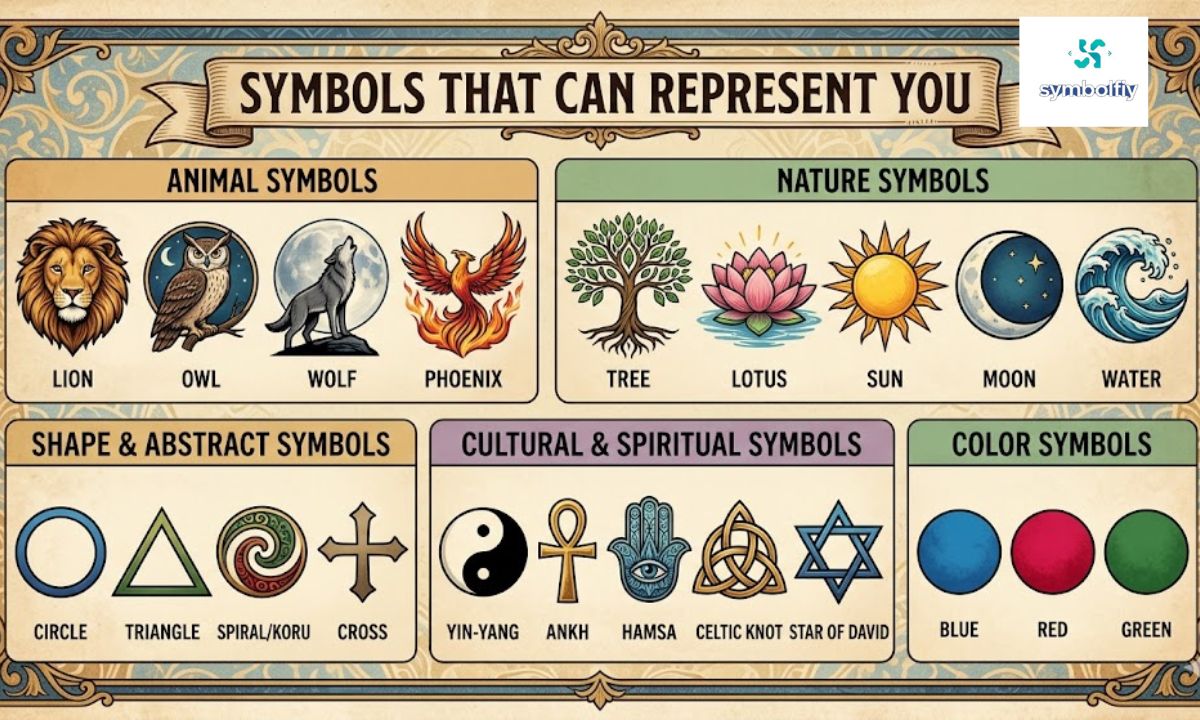
The lion has stood for courage and leadership across almost every culture. Ancient Egyptians saw it as a protector of the divine. In Christianity, it represents Christ as the King of Kings. If you identify with boldness, confidence, or natural authority, the lion speaks for you.
🦅 Eagle
Eagles carry deep meaning in Native American traditions, where they represent vision, freedom, and a direct connection to the spiritual world. The bald eagle is also the national symbol of the United States, standing for strength and independence. It suits someone who thinks big and refuses to be held down.
🦋 Butterfly
The butterfly is one of the most universal symbols of transformation. In Greek, the word for butterfly and soul is the same: psyche. It represents personal growth, change, and the beauty that comes after a hard season. A strong choice for anyone who has been through real change and come out different on the other side.
🐺 Wolf
In Native American and Norse traditions, the wolf represents loyalty, instinct, and fierce independence. Wolves live in tight packs but can also survive alone. This symbol fits people who value deep relationships but also trust their own instincts over the crowd.
🦉 Owl
Since ancient Greece, the owl has been tied to Athena, the goddess of wisdom. Across many cultures, it represents intelligence, patience, and the ability to see what others miss. It is a fitting symbol for deep thinkers, teachers, and quiet observers.
🐉 Dragon
Dragons appear in both Eastern and Western traditions, though with different meanings. In Chinese culture, the dragon is a powerful symbol of luck, imperial strength, and divine energy. In Western traditions, it represents raw power and mystery. It suits someone who carries great strength, whether seen or hidden.
🦊 Fox
The fox is known for cleverness and adaptability. In Japanese culture, the kitsune (fox spirit) is associated with wisdom and shape-shifting. Across Celtic traditions, the fox was seen as a guide through the spirit world. A great symbol for creative thinkers and problem solvers.
🐢 Turtle
The turtle appears in Chinese, Native American, and Celtic traditions as a symbol of patience, endurance, and earth-based wisdom. Its shell is seen as a map of the cosmos in some cultures. If you value steadiness and taking life at your own pace, the turtle is a strong match.
🐦 Phoenix
The phoenix is a mythical bird that burns to ash and is reborn from the flame. It appears in Greek, Egyptian, and Chinese mythology. It is one of the most popular personal symbols because it represents survival, renewal, and starting over after loss. Many people who have overcome major pain feel deeply connected to it.
🐝 Bee
The bee represents community, hard work, and purpose. In ancient Egypt, the bee was the symbol of Lower Egypt and a sign of royalty. In modern life, it suits someone who is devoted, organized, and shows up for others.
Nature Symbols for Self-Expression
Nature has given humans a rich library of symbols. These connect us to the earth and remind us that we are part of something much bigger.
🌸 Lotus Flower
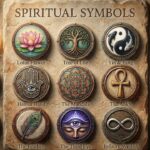
The lotus grows in muddy water but blooms clean and beautiful above the surface. In Buddhism and Hinduism, it represents purity, spiritual awakening, and rising above difficult circumstances. It is one of the most meaningful symbols for anyone who has found peace through hardship.
🌳 Tree
A tree is rooted deep in the ground but stretches toward the sky. It represents growth, stability, and the connection between where you came from and where you are going. The Celtic Tree of Life shows this idea well. Its roots and branches form a circle, symbolizing the endless cycle of life.
🌊 Ocean Wave
Water has always been tied to emotion, the unconscious mind, and the flow of life. In many spiritual traditions, water represents birth, cleansing, and renewal. If you feel deeply, move through life fluidly, or connect strongly to your inner world, the ocean is a powerful symbol for you.
🌙 Moon
The moon has been linked to feminine energy, intuition, and the rhythm of natural cycles across almost every culture in history. In Norse mythology, the moon god guided time itself. The moon suits people who are deeply intuitive, emotionally aware, or spiritually connected.
☀️ Sun
The sun is one of the oldest symbols in human history. It represents life, energy, clarity, and personal power. Egyptian pharaohs were considered sons of Ra, the sun god. In many Indigenous cultures, the sun is the ultimate source of spiritual and physical life. A bold symbol for someone who brings energy and warmth to the people around them.
🌿 Vine / Plant
Vines and plants represent growth, persistence, and resilience. In early Christian art, vines stood for spiritual connection and life’s abundance. If you’re someone who keeps growing no matter what the conditions are, this symbol carries that message quietly but clearly.
🏔️ Mountain
Mountains represent ambition, strength, and the willingness to face difficulty. In many spiritual traditions, mountains are sacred places where humans meet the divine. They suit people who set high goals and do the hard work to reach them.
Shape and Abstract Symbols
Shapes carry meaning on their own, independent of culture or language. They are often used in logos, sacred geometry, and personal design.
⭕ Circle
The circle has no beginning and no end. It has represented wholeness, eternity, and completion across nearly every civilization. Carl Jung described the circle, or mandala, as a symbol of the self in its truest, most complete form. A circle suits someone who values harmony, unity, and personal wholeness.
🔺 Triangle
The triangle represents power, direction, and balance. In Christianity, the triangle stands for the Holy Trinity. In ancient Egypt, pyramid shapes were linked to divine order and the afterlife. A triangle pointing upward symbolizes ambition and fire. Pointing downward, it represents water and intuition.
🌀 Spiral
The spiral is one of the oldest symbols found in human art, appearing in cave drawings and Celtic stonework alike. It represents growth, change, and the unfolding of life. The Maori koru, based on a fern frond unrolling, is a beautiful example. It stands for new beginnings, peace, and moving forward.
✝️ Cross
The cross appears across many cultures and carries different meanings depending on context. In Christianity, it represents faith, sacrifice, and redemption. In pre-Christian Celtic traditions, the equal-armed cross stood for the meeting of heaven and earth. As a personal symbol, it can represent spirituality, personal sacrifice, or deep faith.
♾️ Infinity Symbol
The infinity symbol (∞) represents endless possibility, eternal love, and continuity. It is widely used in modern personal branding and tattoo culture. It suits people who see life as an ongoing journey with no fixed end.
Cultural and Spiritual Symbols
These symbols come from specific traditions and carry deep cultural meaning. They can become personal when they are part of your heritage or when you connect genuinely with what they represent.
☯️ Yin-Yang
The yin-yang comes from Chinese Taoist philosophy and represents the balance of opposites. Light and dark. Strength and softness. Action and rest. It is a powerful symbol for anyone who has learned to hold two different sides of themselves without needing to choose one.
☥ Ankh
The ankh is an ancient Egyptian symbol shaped like a cross with a loop at the top. It represents eternal life and the connection between the physical and spiritual worlds. Pharaohs were often shown holding it. Today it is widely used to represent life, endurance, and spiritual awareness.
🔯 Star of David
The Star of David is a six-pointed star and one of the most recognized symbols of Jewish identity and heritage. It connects people to faith, community, and generations of shared history. As a personal symbol, it speaks to rootedness in tradition and spiritual identity.
🙏 Om (ॐ)
Om is a sacred sound and symbol in Hinduism, Buddhism, and Jainism. It is considered the sound of the universe, the first vibration from which all creation came. As a personal symbol, Om connects people to mindfulness, spiritual practice, and a sense of connection to something beyond the everyday.
🧿 Hamsa
The Hamsa is an open palm symbol found in Jewish, Islamic, and North African traditions. It represents protection, good fortune, and divine blessing. Many people use it as a personal symbol of safety and spiritual strength.
☘️ Celtic Knot
The Celtic knot has no start and no finish. Its endless pattern represents eternity, interconnection, and the ongoing cycles of life. It appears across Celtic jewelry, stone carvings, and illuminated manuscripts. It suits someone who values heritage, continuity, and spiritual depth.
Ancient Cultures That Used Personal Symbols
Many ancient cultures built entire systems of identity around symbols. Here is a quick look at some of the most influential:
Ancient Egypt — Used hieroglyphs, the ankh, and the eye of Ra as symbols of divine identity, protection, and power. Symbols were carved into tombs, temples, and royal jewelry.
Celtic Traditions — Created intricate knotwork, spirals, and tree symbols to represent eternity, nature, and spiritual growth. The Celts believed symbols held actual spiritual power.
Greek Mythology — Linked gods and heroes to animals and objects: the owl for Athena, the eagle for Zeus, the laurel wreath for Apollo. These became symbols of the qualities each figure represented.
Christianity — Built a rich symbolic language using the cross, the dove, the fish (ichthys), and the lamb. These symbols helped early Christians communicate faith in secret and in art.
Buddhism — Used the lotus, the dharma wheel, and the Bodhi tree as symbols of spiritual progress, enlightenment, and the path to inner freedom.
Native American Traditions — Animals like the eagle, bear, and wolf were used as totems representing spiritual identity, guidance, and the relationship between humans and the natural world.
Why Symbols Still Matter Today
In a world full of noise, a symbol cuts through cleanly. It carries meaning without needing explanation. People still use personal symbols in tattoos, jewelry, artwork, and digital spaces because they want to show who they are without having to write an essay about it.
There is also a psychological reason symbols stick. Research in depth psychology, particularly the work of Carl Jung, shows that symbols communicate with parts of the mind that words cannot always reach.
A symbol can connect to memory, emotion, and identity all at once. That is why choosing a symbol that genuinely reflects you can feel so meaningful. It is not just decoration. It is a statement.
Frequently Asked Questions
What is a personal symbol?
A personal symbol is an image, shape, or object that represents your identity, values, or personal story.
How do I find a symbol that represents me?
Think about your traits, values, culture, and life experiences, then look for symbols that match what you find.
Can I use a cultural symbol as my personal symbol?
Yes, if it connects to your heritage or you understand and genuinely respect its meaning.
What symbol represents strength?
The lion, eagle, mountain, and dragon are all widely recognized symbols of strength.
What symbols represent growth and change?
The phoenix, butterfly, lotus, and spiral all represent transformation and personal growth.
Conclusion
A personal symbol is more than just a design you like. It is a reflection of your values, your history, and your story. From ancient cave paintings to modern tattoos, humans have always found ways to say this is who I am through images. Take your time exploring the symbols in this guide. The one that feels right will not just look good. It will feel true.